

At thirty-eight, I was learning how to breathe again in a world that no longer had Daniel in it. Breathing sounds simple, but after losing someone you love, even that feels like work. For eleven years, Daniel and I had built a quiet life together.
It wasn’t fancy or dramatic. It was calm, steady, and full of small moments that mattered because we shared them. Morning coffee with too much sugar. Weekend walks through the park, side by side, talking about nothing important.
Lazy Sunday dinners where Daniel always washed the dishes because I always burned the garlic bread.
We had dreams, too. A bigger garden someday. Maybe another child. Trips we promised we’d take when Lucy was older. All of it was built on the simple belief that time was kind. That time would wait for us. That we had plenty of it.
But time didn’t wait.
At first, Daniel’s illness arrived quietly, like a soft warning we didn’t take seriously enough. Something small. Something we thought we could handle. Then it grew, slowly but surely, into something that took over everything.
Our dinner table was replaced by hospital rooms. Our plans were replaced by test results and tired smiles. Hope became something fragile, measured day by day.
And then one day, he was gone.
The silence he left behind was heavier than anything I had ever known. It wasn’t just quiet. It was absence. It filled every room, every breath, even the spaces between my thoughts. Suddenly, it was just me and our six-year-old daughter, Lucy, standing in a life that no longer fit us.
People told me, “Time will heal you.” But time didn’t stop to let us heal. Bills still came. Laundry still piled up. Lucy still needed breakfast, homework help, and bedtime stories. I went back to work not because I felt ready, but because I had no choice.
I moved through my days on autopilot, doing what needed to be done while feeling like something inside me had broken and would never fully heal.
Lucy noticed everything. Children always do. She didn’t ask many questions, but sometimes she would study my face for a long moment, like she was trying to understand something invisible. Then she’d quietly slip her small hand into mine.
She never said anything, but those moments held me together more than words ever could.
One cold winter morning, when everything felt too gray and too heavy, something changed. We were at the grocery store, rushing through our usual errands. Lucy skipped ahead of me, her pink hat slipping down over her eyes. Then she suddenly stopped.
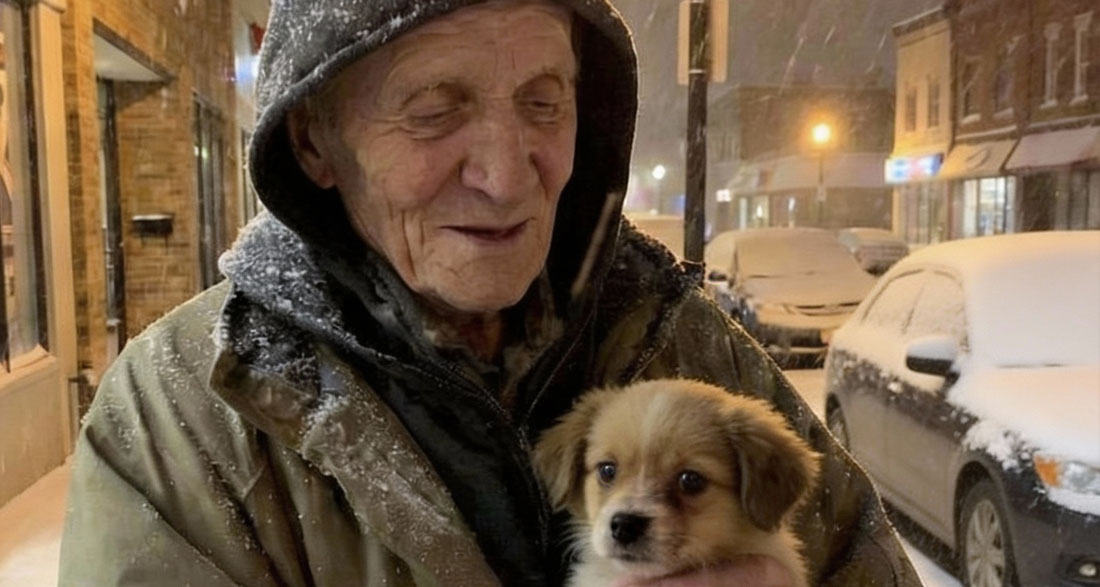
Near the edge of the parking lot sat a man wrapped in an old coat. His hands were cupped around a paper cup that might have once held coffee. Beside him was a small dog, curled tightly against his leg. Her fur was the warm color of toasted bread. When Lucy stepped closer, the dog lifted her head and looked at her with calm, gentle eyes.
I opened my mouth to call Lucy back, worried she might be bothering him. But Lucy was already kneeling down, reaching out with her mittened hands, fearless and kind in the way only children can be.
The man looked up at me. His face was tired and lined, but his voice was gentle when he spoke.
“She’s a good one,” he said softly. “Her name’s Grace.”
He rested his hand on the dog’s back and sighed. “I’ve had her since she was a pup. But I can’t keep her anymore. She deserves more than what I can give now.”
I hesitated. The world teaches you to be careful with strangers. But there was something in his voice that didn’t sound like a request. It sounded like letting go.
Lucy looked up at me, her eyes wide and hopeful.
“Mom,” she whispered, “she likes me.”
She was right. Grace had pressed herself gently against Lucy’s leg, her tail wagging slowly. The man smiled, a soft smile filled with both sadness and relief.
“She’ll bring you comfort,” he said quietly. “More than you know.”
He didn’t explain anything else, and I didn’t ask. Somehow, it felt like asking questions would ruin something fragile and important.
We brought Grace home that same afternoon. It didn’t feel like a decision. It felt like something that had already been decided for us. Grace settled into our home as if she had always belonged there. She didn’t bark much. She didn’t demand attention. She simply stayed close, filling spaces that had been too quiet for too long.
At night, when I couldn’t sleep, I’d hear the soft sound of her paws moving down the hallway. That small sound brought comfort. It reminded me that another heartbeat lived in our home.
Lucy fell in love with Grace instantly. Every morning, she woke up early just to feed her, talking nonstop.
“She listens better than you, Mom,” Lucy said one day, laughing.
She was right. Grace listened in the way animals do—without judgment, without interrupting. She seemed to understand when Lucy felt sad, when I was exhausted, when the air in the room felt too heavy. She would lay her head on a lap or press close, offering warmth instead of words.
Slowly, our days began to change. Lucy laughed more. The house felt alive again. One evening, I caught myself humming while washing dishes. I hadn’t done that in months. The grief was still there, but it no longer felt like an open wound. It felt like a scar—still present, but no longer unbearable.
Sometimes I’d find Lucy sitting on the floor, drawing pictures of Grace with crayon hearts.
“She’s part of our family now,” she’d say.
And she was.
Two months later, a letter arrived. It was another cold afternoon when I found it in the mailbox. There was no return address. Just my name, written carefully. Inside was one neatly folded page.
The man wrote that he had known Daniel years ago, before I ever met him. They had worked together for a short time and stayed in touch. He wrote that Daniel had spoken often about me and Lucy, about how proud he was of our life.
The man didn’t sign his name. He explained that after Daniel’s death, he had followed our story from a distance—not out of curiosity, but out of care.
He said he had fallen on hard times but wanted to give something back. Something kind. Something meaningful. He believed Grace was meant to find us. That she had a heart big enough to help heal ours.
My hands shook as I read the letter. I sat there for a long time, holding the paper, feeling the weight of a kindness I never expected. When I finally looked up, Lucy was on the floor playing with Grace, laughter filling the room.
For the first time in a long while, the light coming through the window felt warm instead of cold.
That night, I placed the letter in a drawer beside Daniel’s old watch—the one that had stopped ticking the day he died. Keeping them together felt right. Both were reminders of love that hadn’t ended, only changed shape.
As I watched Lucy fall asleep with Grace curled beside her, I realized something inside me had shifted. Grief was still part of me, but it no longer controlled me. It had become part of the story, not the whole story.
In the days that followed, I began noticing small things again. Morning light on the kitchen counter. The warmth of coffee in my hands. The smell of Lucy’s shampoo when she hugged me. My world, once so small, began to widen.
Sometimes, when I walked Grace through the park, I felt Daniel close—not in a painful way, but in a comforting one. Like a memory that knew how to breathe. Grace would stop, look up at me with those knowing eyes, and I’d smile. I started believing she carried a piece of him with her.
Lucy talked to Grace about her dad often.
“Daddy would have liked you,” she’d say with confidence.
The thought didn’t hurt anymore. It comforted me.
Spring arrived, soft and green. Lucy and I planted flowers in the yard—daisies and tulips, her choice. Grace sat nearby, tail brushing the grass.
“They’ll make Daddy happy,” Lucy said.
This time, I didn’t correct her.
Grace never replaced what we lost. But she reminded us that life continues. That love doesn’t disappear. It transforms. It waits. It shows up when you’re ready—sometimes quietly, wrapped in fur and gentle eyes.
Now, when I think of Daniel, I don’t see the hospital room. I see Lucy laughing. Grace running through the yard. A home that found its heartbeat again.
Love doesn’t end when someone dies. It changes shape. And sometimes, if you’re lucky, it teaches you how to keep living when the world you knew is gone.