

I was 55 years old, newly widowed after 36 years of marriage, when something I found at my husband’s funeral made me question whether I’d ever truly known the man I loved.
For the first time since I was 19, I didn’t have anyone to call “my husband.”
His name was Greg. Raymond Gregory on every form, but Greg to me.
We were married for 36 quiet years. No big drama, no fairytale. Just the kind of life built on grocery lists, oil changes, and him always taking the outside seat at restaurants “in case some idiot drives through the window.”
Then one rainy Tuesday, a truck didn’t stop in time.
One phone call. One trip to the hospital. One doctor saying, “I’m so sorry.” That was it. My life split into Before and After.
By the day of the viewing, I felt hollow. I had cried until my skin ached. My sister, Laura, had to zip my dress because my hands wouldn’t stop shaking.
He looked peaceful.
The chapel smelled of flowers and coffee. Soft piano music floated through the air. People touched my arm like I might crumble if they pressed too hard.
And there he was. Greg. In the navy suit I had bought for our last anniversary. Hair smoothed back the way he always did for weddings. Hands folded like he was just resting.
He looked peaceful.
That’s when I saw it.
I told myself, This is my last chance to do something for you.
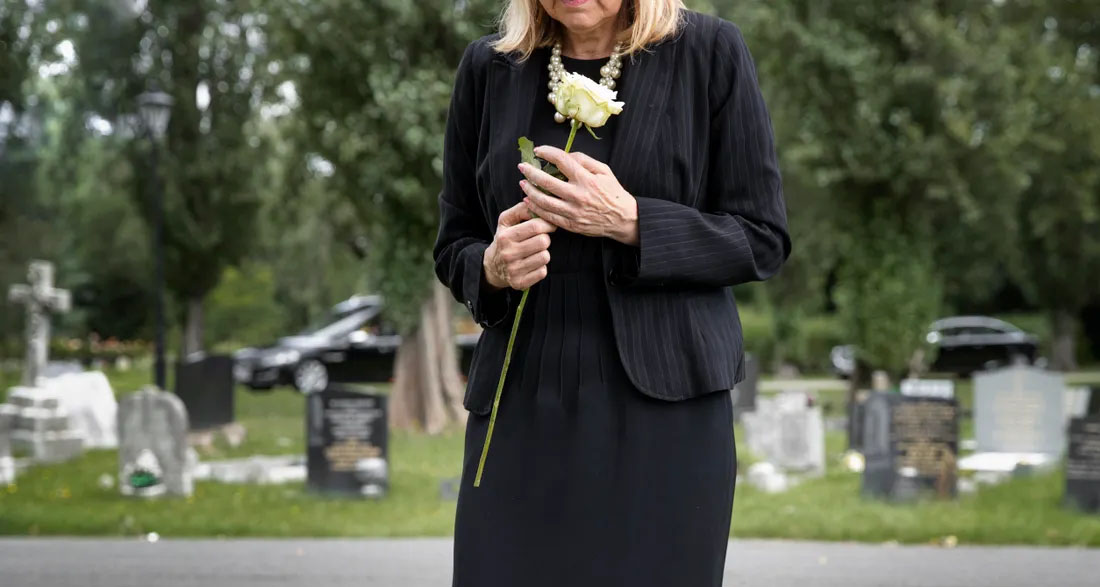
When the line thinned, I walked up with a single red rose. I leaned over and gently lifted his hands to tuck the stem between them.
That’s when I saw it.
A small white rectangle, tucked under his fingers. Not a prayer card. Wrong size.
No one around looked guilty.
Someone had put something in my husband’s casket and hadn’t told me.
I glanced around. People clustered in small groups. No one was watching me closely. No one looked guilty.
He’s my husband. If there’s a secret, it belongs to me more than anyone.
My fingers shook as I slid the paper free and tucked the rose in its place. I slipped the note into my purse and walked straight to the restroom.
For a moment, I didn’t understand the words. Then I did.
I locked the door, leaned against it, and unfolded the paper. The handwriting was neat, careful, in blue ink:
“Even though we could never be together the way we deserved… my kids and I will love you forever.”
For a second, my mind refused to process it. Then it hit me.
Greg and I didn’t have children.
Not because we didn’t want them. Because I couldn’t. Years of appointments. Tests. Quiet bad news. Years of me crying into his chest while he whispered, “It’s okay. It’s you and me. That’s enough. You are enough.”
Our kids? Who had children with my husband?
My vision blurred. I grabbed the sink and stared at my reflection. Mascara smeared. Eyes swollen. I looked like a cliché.
I didn’t cry. Not yet.
“Someone put this in his casket.”
I needed to see the cameras.
The security room was tiny, with four monitors. A man in a gray uniform looked up as I entered. His name tag said Luis.
“Ma’am, this area is—”
“My husband is in the viewing room,” I said. “Someone put this in his casket.”
He pulled up the chapel feed. I held up the note.
“I need to know who did it.”
He hesitated.
“I’m not sure if—”
“I paid for the room. He’s my husband. Please.”
He sighed and rewound the footage. Then fast-forwarded.
Dark hair, tight bun. People flickered across the screen. Hugs. Flowers. Hands on the casket.
“Slow down,” I said.
A woman in a black dress stepped up alone. Dark hair, tight bun. She glanced around, then slipped her hand under Greg’s, tucked something in, and patted his chest.
Susan.
I snapped a picture of the paused frame.
Susan Miller. His “work lifesaver.” She owned the supply company that delivered to his office. I’d met her a few times at events. Thin, efficient, always laughing just a little too hard. And now, the woman sneaking a note into my husband’s coffin.
I told Luis, “Thank you. You left something in my husband’s casket.”
Back in the chapel, Susan was near the back, talking to two women from Greg’s office. Tissue in her hand, eyes red, pretending to grieve.
When she saw me, her expression flickered—just for a second. Guilt.
I stopped in front of her.
“You left something in my husband’s casket.”
She blinked. “What?”
“I watched you do it on camera. Don’t lie to me. Who are the kids, Susan?”
“I… I just wanted to say goodbye,” she whispered.
“Then you could’ve done it like everyone else. You hid it under his hands. Why?”
People around us were listening. I could feel their eyes, their judgment.
Susan’s chin trembled.
“I didn’t mean for you to find it.”
I pulled the note from my purse. “Who are the kids, Susan?”
For a moment, she seemed like she might faint. Then, tiny nod.
“He didn’t want you to see them,” she said.
“They’re his?” I asked. “Greg’s kids?”
A buzz went through the onlookers. Gasps.
“Two. A boy and a girl,” she admitted.
“You’re lying.”
“I’m not. He didn’t want to hurt you. Told me not to bring them.”
My humiliation turned public. Every word hit like a knife. I couldn’t stay. Couldn’t scream in front of his casket.
So I walked out. I never read them.
After the burial, the house felt like a stranger’s. His shoes were still by the door. His mug on the counter. Glasses on the nightstand.
I sat on the edge of our bed and stared at the closet shelf. Eleven journals in a neat row. Greg’s handwriting on the spines. “Helps me think,” he’d say. I’d never read them. It felt like opening his head.
I pulled down the first journal. But Susan’s words echoed: “Two. A boy and a girl.”
I flipped page after page. Our honeymoon. Fertility appointments. My tears in the car. His quiet comfort. Our fights. Our jokes. My migraines. His fear of flying. Bills. Holidays. No mention of another woman. No secret kids. No double life.
Then, darker entries. By the sixth journal:
“Susan pushing again. Wants us locked in for three years. Quality slipping. Last shipment bad. People got sick.”
“Told her we’re done. She lost it. Said I was ruining her business.”
“Could sue. Lawyer says we’d win. But she has 2 kids. Don’t want to take food off their table.”
“I’ll let it go. But I won’t forget what she’s capable of.”
Two kids. Her kids. Not his.
I picked up my phone and called Peter, Greg’s closest friend from work.
“Ev?” he answered quickly.
“I need your help. And I need you to believe me.”
I told him everything. Note. Cameras. Susan. Journals. Silence.
“Peter?”
“I’ll help you find out what’s real,” he finally said. “I knew Ray. If he had kids with someone else, he couldn’t have hidden it. He was a terrible liar. I believe you.”
The next afternoon, he sent his son, Ben.
“I’ll lose my temper if I go,” Peter said. “Ben’s calmer.”
Ben, 17, tall, polite, awkward. He stopped by my house first.
“I can back out if you want. You don’t owe anyone proof.”
“I owe it to myself. And to Greg.”
Ben drove over to Susan’s. An hour later, back at my kitchen table, he told me everything.
Her daughter opened the door. Teenager. He explained about the funeral note. Susan’s husband froze. Susan came out, denied it. Yelled. Said she wanted to hurt me. Her words. “It was just words. I wanted her to hurt.”
No secret kids. No betrayal. Just a bitter woman deciding my grief wasn’t punishment enough.
I pressed my palms to my eyes and sobbed.
Ben whispered quietly, “My dad always said Ray was the most loyal guy he knew. For what it’s worth.”
“It’s worth a lot,” I said.
I grabbed an empty notebook. I would write the truth. About Greg. About the rose. About the note. About cameras, Luis, Peter, Ben, and a woman who tried to bury a good man twice.
My marriage wasn’t a lie.
Flawed, human, stubborn, sometimes annoying—but mine.
And even after everything, when I turn the pages of his journals, one thing is always there, over and over, in the margins, in the lines between thoughts:
“I love her.”
He never hid that.