

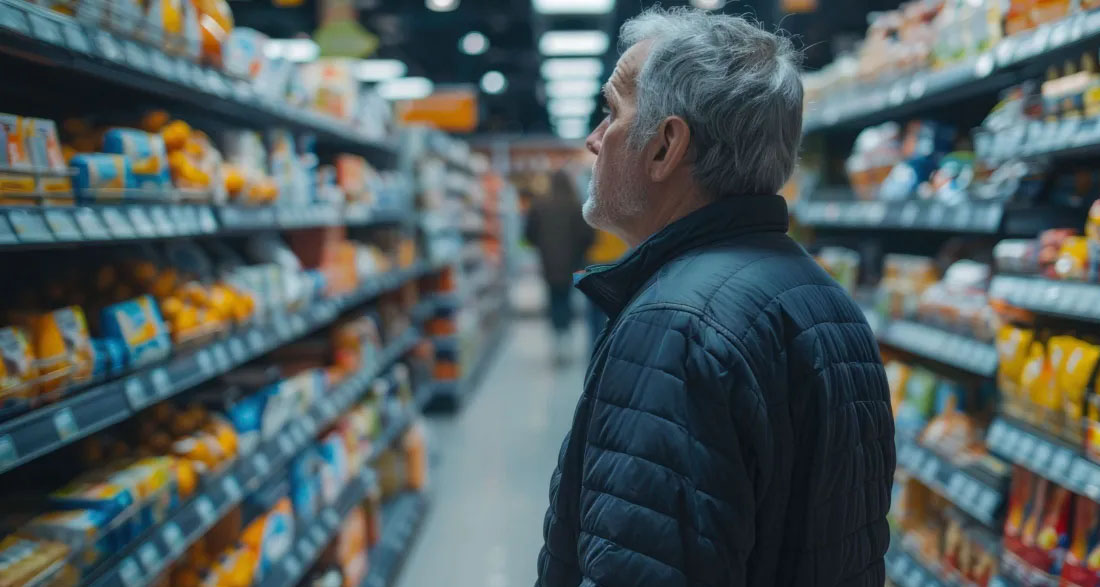
I knew something was wrong the moment I saw him in the grocery store.
He was an elderly man, standing frozen in the middle of the aisle, gripping a crumpled piece of paper in shaking hands. People brushed past him like he wasn’t even there. A man bumped his cart into him and muttered under his breath.
A woman reached over his shoulder for canned tomatoes without even glancing his way. Someone’s cart clipped his ankle, and he didn’t flinch.
But I saw the trouble. I’ve been a nurse for decades, and I can tell when someone is just thinking and when someone is completely lost. He was lost.
I stepped closer. “Sir, are you alright?”
He jumped, startled. “I’m… I’m sorry. I didn’t mean to block the aisle.”
Up close, he looked fine—pressed shirt, clean loafers, neatly combed hair. Only his hands gave him away, trembling so badly that the paper shook too.
I bent slightly to meet his gaze.
He held out the paper.
“Spaghetti. Tomato sauce. Parmesan. Coffee. Oatmeal.”
“My wife… Maeve… she used to write the lists. I just carried the bags,” he said softly. “We were married for 54 years. She… she passed away last month.”
“I’m very sorry,” I said.
He nodded once, looking down at the paper as if the words themselves might crumble. “Sunday dinners… always the same meal. I thought… maybe if I made it again, the house would feel less empty.”
I should have gone back to my own shopping. I had soup to make, a cat to feed—but I couldn’t leave him like that.
“Would you like some help?” I asked.
He blinked and gave me a small, hesitant smile. “If you don’t mind… I’m just a bit… turned around.”
“That happens,” I said gently.
We started with the pasta.
“Did Maeve have a favorite brand?” I asked.
He stared at the shelves, lost. “The one in the blue box… no, yellow. The yellow one.”
We moved slowly, aisle by aisle. Twice he stopped, frozen, staring blankly at the shelves.
“What were you reaching for?” I asked once.
“I had it just now,” he muttered, frowning.
“Let’s look at the list,” I suggested.
He nodded, shame flashing in his eyes, like someone had taught him struggling was his fault.
“Coffee?” I asked.
“Coffee,” he said, relief flooding his face as he grabbed the first can he saw.
As we shopped, he told me about Maeve.
“She labeled everything,” he said while comparing jars of tomato sauce. “Pantry, freezer, linen closet… even the Christmas decorations.”
I laughed. “She sounds organized.”
“She was terrifying!” he said with a proper smile for the first time. “If I put cumin back where paprika belonged, she’d appear from another room like some kind of spirit.”
“What is your name?” I asked.
“Tom. Good Lord, listen to me. Here you are helping me, and I haven’t even introduced myself.”
“Ruth,” I said, holding out my hand. He shook it.
At the register, things almost fell apart again. His wallet slipped, his card dropped, and he bent to retrieve it, nearly losing his balance.
“I’ve got it,” I said, catching the card before it slid under the candy display.
“Thank you,” he said to me, turning to the cashier. “I’m so sorry, miss.”
“No problem, sir,” the cashier smiled.
Outside, Tom leaned against the cart, grocery bags at his feet, and seemed to sag all at once.
“I almost didn’t come in. I didn’t think I could do it alone,” he admitted.
“But you did,” I said.
He gave a tired, small smile. Then the paper slipped from his hand. I bent to catch it before the wind took it, and the sunlight shone through the thin sheet. I noticed faint grooves pressed into the page—letters, hidden, like a secret meant for no eyes but his.
“Tom, there’s something else here,” I said softly.
He frowned. “What do you mean?”
“Look,” I held it to the sun.
He traced the grooves with his eyes, and his whole body went still. Tears ran down his face.
“Oh, God… Maeve, what have you done? How could you betray me like this?” he whispered.
I didn’t ask. I knew enough—whatever it said had shaken him to his core.
“You walked here?” I asked, looking toward the road.
“Yes… Maeve, what have you done?” He wiped his tears. “I walked.”
“Let me drive you home.”
He stiffened. “I can take care of myself. I can.”
“Your bags are heavy, and you’ve had a shock. I just want to help,” I said.
He opened his mouth to protest again, then looked down at the paper and seemed to lose the energy for pride. I loaded the groceries into my trunk and drove him to his home.
The front door burst open as soon as we arrived.
“Dad!” a woman in her 40s ran toward us. “Where have you been? I’ve called six times!”
“I went to the store,” he held up the list. “What is this, Jennifer? ‘Jen, start arrangements for Tom at assisted living’? What were you and Maeve up to behind my back?”
“You weren’t managing,” she said, eyes narrowing. “Mom asked me to look at options when she realized she wouldn’t get better.”
“You’re lying. Maeve wouldn’t go behind my back.”
“I’m not lying. You left the stove on last week. You forgot your pills—”
“Those were accidents! Anyone could make mistakes! I can live in my own home,” he snapped.
“You’re lying.”
“No,” Jen said, voice breaking. “You’re not fine. Assisted living is what’s best.”
I couldn’t leave. I had to speak.
“Can I say something?” I asked.
They looked at me.
“Tom, you have every right to be part of decisions about your life. But being scared doesn’t mean you can pretend everything is fine when it isn’t.”
He said nothing.
“And making plans without you… it always feels like betrayal, even if meant to protect you,” I said to Jen.
“I… I had no choice,” she whispered.
We went inside. Tom muttered under his breath and sat heavily in the living room. Jen made tea, and I followed her quietly.
“Who are you?” she asked.
“Ruth. I met Tom at the store. I’m a nurse,” I explained.
“Is this… dementia?” she asked.
“I’m not a doctor,” I said. “But there’s a way to get help without moving him from his home. In-home care, real help.”
She nodded carefully. “He listened to you more than he listens to me lately.”
We walked outside. Tom was gone. I found him at the park, sitting under a maple tree, hands folded, staring at the pond.
“Maeve and I used to come here every Sunday. She loved the trees,” he said. Then his shoulders slumped. “I know I’m not the same… I forget, I lose track. Without Maeve’s lists and schedules… I’m drowning. And now I might lose the house. I’ll start forgetting her.”
“Oh, Tom.”
“Without the house… I’m scared.”
“Tom, your daughter made plans because she wanted to make sure you were safe. But you can stay home—with real help.”
“A stranger?”
“Everyone’s a stranger at first,” I said gently.
He nodded. “I can live with that. But what about Jen?”
We went back. Jen stood in the hall, keys in hand. Relief flooded her face when she saw him.
“I’m sorry,” she said. “I shouldn’t have gone behind your back. I was scared.”
“And I’m sorry I assumed the worst,” he said. “But don’t make me leave, Jenny. Please.”
“Fair enough,” she whispered.
“Ruth… would you consider coming by, just for now? To help us figure things out? Dad trusts you,” she asked.
Tom looked at me. “I’d appreciate it.”
The next Sunday, the kitchen smelled of garlic and tomatoes. Tom stirred the sauce with a wooden spoon, I chopped basil, and Jen sat at the table pretending not to watch every move.
“Salt?” Tom asked.
I handed it to him.
“Thank you,” he said, pausing. “Couldn’t quite find it myself.”
Nothing was perfect. Nothing was fixed overnight. But everything was finally out in the open—and for people like Tom, that’s often the first step to healing.