

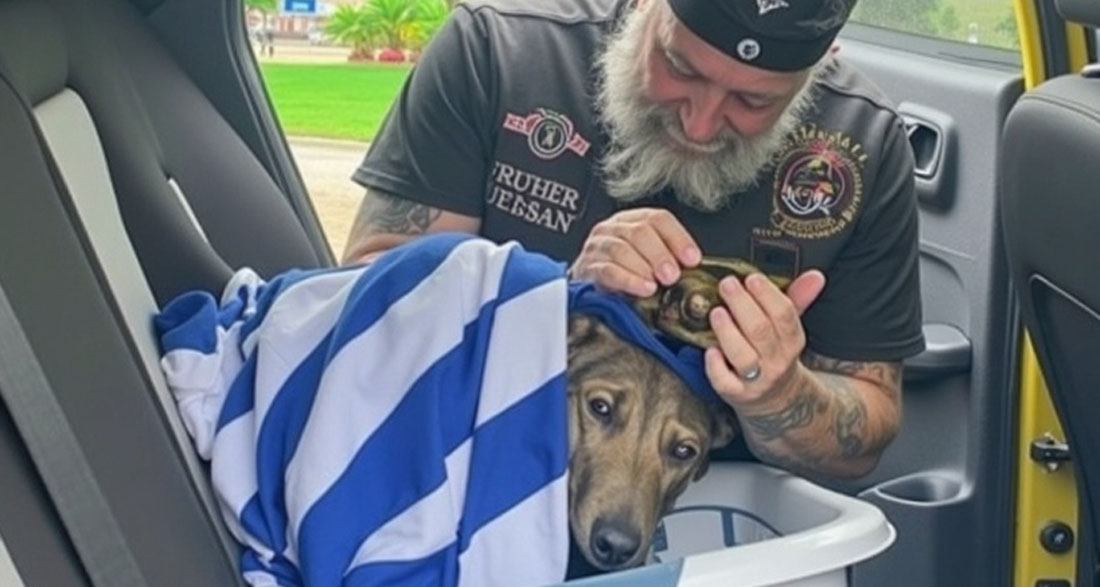
It was late afternoon, the kind of golden light that makes everything look calm and ordinary. I was driving home from work, half thinking about the road, half thinking about what to cook for dinner, when something on the shoulder of Highway 52 caught my eye. A motorcycle was pulled over, its engine quiet, and a man was crouched down next to the ditch.
At first, I thought it was just some biker with a breakdown. I’d always imagined bikers as rough, loud men—trouble waiting to happen. My mom used to warn me about guys like that when I was a kid. But something about the way he was standing made me slow down.
He wasn’t fiddling with his bike. He was holding something small, wrapped in a towel with blue and white stripes, like a beach towel. His hands were huge, tattooed, and rough, but he cradled whatever was in the towel like it was the most delicate thing on earth.
Curiosity and a quiet, guilty voice inside me made me pull over. I parked behind the bike and stepped out, my shoes crunching on the gravel.
As I walked closer, I heard him whispering, his voice low and shaky, like someone talking to a hurt friend. I leaned down and saw what he was holding—a tiny German Shepherd puppy, barely four months old.
Its fur was dirty and bloodied, one back leg bent at an impossible angle. The little thing’s breathing was fast and shallow, each inhale sounding like pain.
“Is he okay?” I asked, though I already knew the answer.
The man looked up. For a moment, I felt a flicker of fear. He was enormous—broad shoulders, a gray beard whipping in the wind, leather vest covered in patches. But his eyes—red, raw, full of tears—melted that fear.
“Someone hit her,” he said, voice cracking. “Hit her and didn’t even stop. She crawled into the ditch to die. I heard her crying when I rode by.”
My chest tightened. Here was this man, this figure I’d been ready to judge and drive past, holding a tiny life in his hands.
“I called the emergency vet,” he continued. “They’re in Riverside, twenty minutes away. But…” His voice faltered as he looked at the puppy. “I don’t think she’s got twenty minutes.”
Something inside me made a choice before I could think. “My car’s faster,” I said. “Let’s go.”
He blinked, surprised. “Thank you,” he whispered, almost breaking apart. “God, thank you.”
We ran to my car. He climbed in the backseat, cradling the puppy like she might shatter at a touch. I slammed the door and hit the gas.
In the rearview mirror, I saw him whispering, “Stay with me, baby girl. Stay with me. You’re gonna be okay. I got you. You’re safe now. Nobody’s ever gonna hurt you again.”
The puppy made a soft, broken sound. He let out a desperate sob that seemed too heavy for one man to carry.
I ran a red light without thinking. “What’s your name?” I asked, trying to fill the heavy silence.
“Nomad,” he said after a pause. “Real name’s Robert. Been riding for thirty-eight years. Never could ride past an animal in need. Just can’t do it.”
“I’m Chris,” I said. “And I’m sorry I almost didn’t stop.”
He looked up through the mirror. “You stopped,” he said softly. “That’s what matters. You’re a good man, Chris.”
I didn’t feel good. I felt foolish for judging someone before knowing them.
We hit the emergency vet in fourteen minutes. Nomad jumped out, running toward the door with the puppy pressed to his chest. A vet tech met him with a gurney.
“Hit by a car,” he said quickly. “Back leg’s broken. Might be bleeding inside. She’s been out there awhile.”
They took the puppy, and Nomad stood there, hands empty, staring at the space where she’d been. He wiped tears into his beard.
We waited. He barely spoke, hunched over, lips moving silently in prayer. Two hours later, the vet came out, looking tired but calm.
“She’s stable,” she said.
Nomad exhaled like the world had lifted off his shoulders. “Thank God.”
“She’s a fighter,” the vet said. “Broken femur, road rash, some shock, but no internal bleeding. Surgery and weeks of recovery ahead. Do you know who she belongs to?”
“No collar, no chip,” Nomad said. “Must’ve been dumped.”
“How much for everything—surgery, meds, recovery?” he asked.
“About three thousand dollars, maybe more,” the vet said hesitantly.
Nomad didn’t flinch. “I’ll pay it. All of it. When she’s healed, she’s coming home with me.”
I sat stunned. Thirty minutes ago, I might have driven past him. Now I was watching him save a life with no hesitation.
After the paperwork, he turned to me. “Chris, you saved her life as much as I did,” he said.
“You’re the hero,” I said.
Nomad smiled faintly. “She’s the hero. She didn’t give up. I’m just the lucky fool who gets to help her keep going.”
A nurse let him see her before surgery. He came back, eyes wet again. “She wagged her tail when she saw me,” he whispered. “Her leg’s shattered, and she still wagged her tail.”
I started crying. He pulled me into a hug, this massive man, smelling of oil and wind.
“The world’s hard enough,” he murmured. “We gotta be soft where we can be.”
We waited through surgery together. He told me about his life—Vietnam, losing his wife twelve years ago, his grown kids scattered across the country. He’d been riding that day just to clear his head.
“I almost didn’t hear her,” he said. “One second later and I’d have missed her completely. Guess someone upstairs wanted me to find her.”
When the vet came back, smiling, the surgery was a success. The puppy would stay five days, then go home. Nomad wrote every instruction down like it was sacred text.
I drove him back to his motorcycle at sunset. “Chris, you didn’t have to stop,” he said. “But you did. That means something.”
He handed me a worn business card. “Call me if you ever need help—anything.”
“What are you going to name her?” I asked.
“Hope,” he said. “Because that’s what she is. Hope that there’s still good in people. Hope that we can fix what’s broken. Hope it’s not too late.”
He rode off into the fading sun, the roar of his bike fading. I sat there, thinking about all the times I’d judged people, all the times I’d turned away. I’d almost driven past one of the best men I’d ever met.
Six weeks later, a text came from an unknown number—a picture of Hope, standing on all four legs, tail wagging, pink collar around her neck. The message: “Hope says thank you to Uncle Chris. She’s home.”
I stared at the photo, tears running down my face. That day on Highway 52 changed me. Heroes don’t always wear uniforms. Sometimes they wear leather, ride motorcycles, and hold something fragile like it’s made of glass.
I never drive past a biker anymore without thinking of Nomad and Hope. And I never assume I know someone by looking at them. Because sometimes, saving a life doesn’t require courage or power—it requires softness, where the world is hard enough already.