

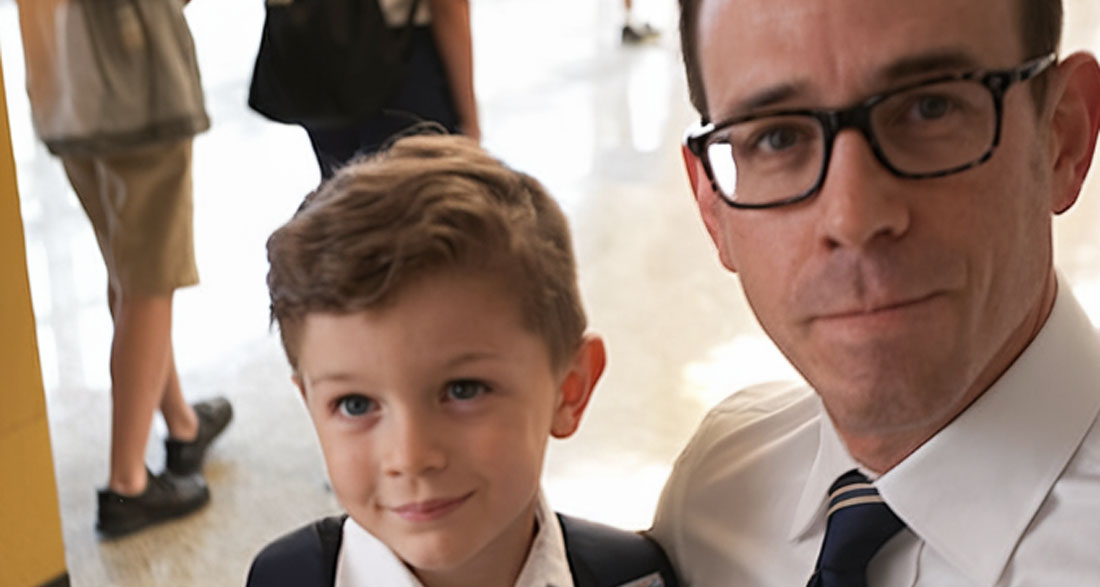
When Joe decided to grow his hair out, he didn’t expect the backlash that came with it. His classmates relentlessly teased him, and even Mr. Cooper, one of his teachers known for his traditional views, joined in.
The mockery didn’t just come from the students—it was endorsed by an adult. But everything changed when Joe’s father, Patrick, discovered what was happening and took an unexpected stand.
On the first day of school, Joe walked into the classroom with his long ponytail. Mr. Cooper saw him and sneered, “What’s with the ponytail? Are you trying to be a little girl?” The entire class burst into laughter.
Joe’s face turned red, and he hung his head, but he refused to let the taunts break his resolve. He had a reason for growing his hair, and no amount of teasing was going to change that.
Joe had started growing his hair the year before. During summer, no one really noticed, but now, with school back in session, his long ponytail was impossible to miss. The taunts grew harsher each day, and Joe came home in tears, hiding his pain from his parents by crying in the bathroom, hoping the bullying would end on its own.
One day, after class, Joe’s art teacher, Mrs. Burns, who was new at the school, noticed him crying. She approached him with concern.
“Joe, what’s going on? Why are you growing your hair so long?” she asked gently.
Joe, feeling safe for the first time, shared his story. Mrs. Burns listened intently and gave him a comforting hug.
“You have a kind heart, Joe. Don’t let anyone take that away from you,” she said warmly.
Joe wiped his tears and replied, “But even Mr. Cooper makes fun of me.”
Mrs. Burns nodded sympathetically. “Some people never outgrow being bullies, even when they’re adults. I’ll have a word with him.” But Joe quickly shook his head.
“Please don’t. It’s a personal matter,” he insisted.
Mrs. Burns smiled softly. “Alright. It’ll be our secret. Just remember, you have nothing to be ashamed of.”
In the days that followed, Mrs. Burns quietly spoke to other teachers about the situation, hoping to gain support for Joe. However, many of them sided with Mr. Cooper, believing Joe’s long hair was inappropriate for a boy his age.
“If you let boys grow their hair out, they’ll lack discipline by high school,” complained Mrs. Figgins, the math teacher.
Mrs. Burns felt disheartened. Unsure of what to do, she considered calling Joe’s parents. She knew something had to change, but the school’s conservative mindset left her feeling powerless.
A few days later, Joe’s father, Patrick, called him to the kitchen. Mrs. Burns had reached out to him, and Patrick was not pleased with what he learned.
“Joe, Mrs. Burns told me what’s been happening at school. Are the kids teasing you about your hair?” Patrick asked, kneeling to look into his son’s eyes.
Joe’s lip trembled, and tears welled up. “It’s not just the kids, Dad. Mr. Cooper is the worst.”
Patrick was stunned. He had always respected Mr. Cooper as a community leader, but hearing that the teacher was bullying his son left him speechless.
“Why didn’t you tell them why you’re growing your hair?” Patrick asked gently.
“It’s none of their business,” Joe replied firmly, and Patrick agreed wholeheartedly.
“You’re right, son. But you’ve reached the length you needed, and I think it’s time to cut it. I’ve got a plan.”
That night, Patrick recorded on his phone as Joe’s mom, Rosie, carefully cut his ponytail. They saved the hair for a special purpose, and Joe recorded a message explaining why he had grown it.
The next morning, Joe walked into class with his newly cut hair. Mr. Cooper couldn’t resist one more jab.
“Finally, Joe! You don’t look like a girl anymore!” he jeered. But this time, Joe wasn’t alone—his father had come to school with him.
“Mr. Cooper,” Patrick said, his tone firm as he stepped forward.
“Oh, Mr. Perkins! Good to see you. Looks like you finally gave Joe that much-needed haircut!” Mr. Cooper said, extending his hand.
Patrick didn’t shake his hand. Instead, he pulled out his phone and played the video of Joe’s haircut for Mr. Cooper. As the teacher watched, Patrick spoke loudly enough for the entire class to hear.
“I hear you’ve been encouraging the kids to make fun of my son. I never expected that from you.”
The classroom fell silent as students looked on in surprise.
“That’s right,” Patrick continued. “Joe’s been growing his hair to donate to cancer patients. We’ve been volunteering at a children’s hospital since last year, and Joe decided to grow his hair after meeting some of the kids there.
He kept it private because he wanted it to be his own personal act of kindness. Now, he’s been coming home in tears because his teacher and classmates mocked him. Do you think that’s fair?”
Mr. Cooper’s face turned pale. He swallowed hard, looking uncomfortable. “I didn’t know he was donating his hair…”
Patrick’s words echoed through the room. “My granddaughter just went through chemotherapy and lost her hair. We’ve worked with a foundation that makes wigs for cancer patients… I can’t believe I didn’t realize what Joe was doing.”
He walked over to Joe, who was sitting quietly at his desk. “Thank you, Joe. You’re a hero in my book. Please, forgive me.”
Joe smiled and nodded. His father, satisfied, finally extended his hand to Mr. Cooper. “I’m glad we’ve cleared this up.”
After that day, Joe’s classmates began treating him differently. They asked him questions about his donation, and some boys even talked about growing their hair out to do the same. The girls wanted to join in too. Joe’s act of kindness had inspired everyone, and the school’s attitude towards him completely changed.
What we can learn from this story:
Don’t judge others based on appearance. People have personal reasons for their choices, and it’s important to respect them.
Acts of kindness can inspire others. Joe’s decision to donate his hair set an example for his classmates and even his teacher, showing how one person’s generosity can have a ripple effect.