

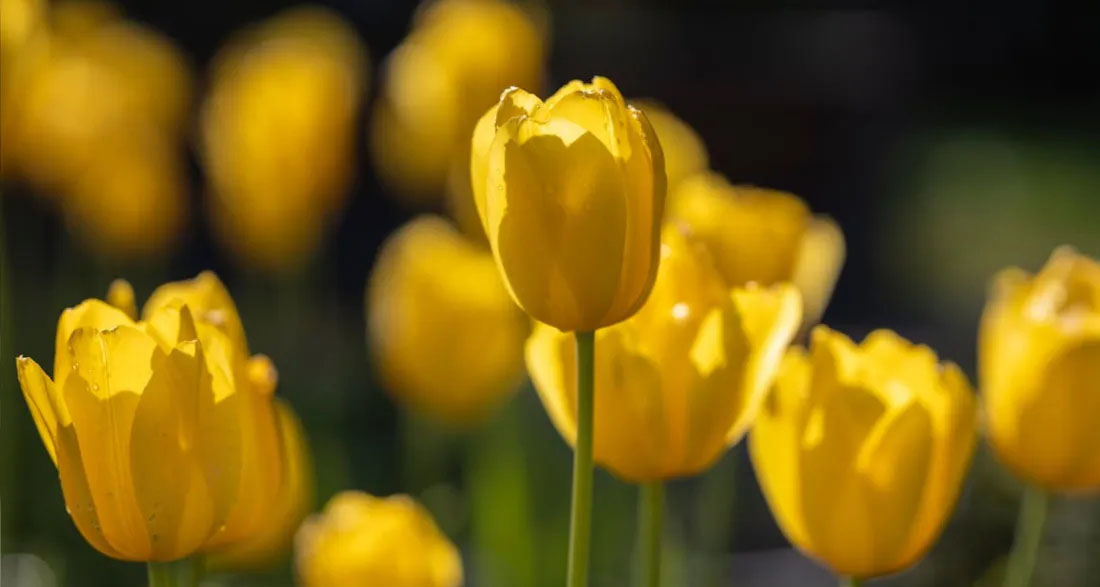
My husband, Jack, brought me a yellow tulip every single Sunday for 32 years. It didn’t matter the weather, the season, or how tired he was—there was always a tulip waiting for me. After he passed away, someone continued the tradition.
Every Sunday, for three years, a single yellow tulip appeared on his grave. I had no idea who it was. When I finally found out, it was the last person on Earth I would have guessed.
The first Sunday after Jack’s funeral, I went to the cemetery alone.
I carried his favorite coffee mug in my tote bag, the one with the crack along the handle that he refused to throw away for 11 years. I sat down beside his headstone, the cool stone pressing against my hands, and I talked to him about nothing in particular.
That had always been the best kind of conversation—the kind where words didn’t matter as much as just being together.
I went back the next Sunday. And the Sunday after that. And every Sunday since.
We had been together for 32 years. I was 59 when I lost Jack. Our children were grown and living across the country, and for the first time since we were very young, it was just me in the house. It was quiet. Too quiet. Hauntingly quiet.
Sundays were the hardest.
Jack had always been a Sunday person. He made breakfast while I shuffled around in my robe. He read the paper out loud to me, whether I wanted to hear it or not. And every Sunday, without fail, he returned from his morning walk with a yellow tulip.
“They look like sunlight, darling!” he would say. “And sunlight is what you look like when you smile!”
I used to roll my eyes at him. Now I would give anything to roll my eyes at him just one more time.
The tradition started the Sunday we met. I was carrying groceries home and dropped the bag on the sidewalk right in front of him. Jack crouched down to help me gather everything and held out a yellow tulip he had just bought.
I stared at him like he’d said something in a foreign language. Then I smiled.
And that was how 32 years of Sundays began, all from that one moment on a sidewalk.
“It hurts,” I whispered to the wind, “so much to see that flower again after my Jack is gone.”
The tulips started appearing about two weeks after the funeral. I almost didn’t notice the first one. I had brought candles and was arranging them when I saw a single yellow tulip leaning carefully against Jack’s headstone. Someone had placed it there, deliberately, with care.
I asked our children first. They hadn’t been to the cemetery. I asked Jack’s friends from the hardware store where he had worked for 30 years. I asked the men who came in every Saturday morning to argue about the same five topics, loving every minute of it.
I asked our neighbors. I asked the women from Jack’s Sunday walking group—the ones who brought more food to his funeral than anyone could eat.
No one knew anything.
And still, every Sunday, there was the flower, freshly trimmed, leaning just so, as if the person placing it wanted Jack to know they had taken the time to do it right.
A year passed. Then two.
I kept asking people I hadn’t spoken to in years: former colleagues, old friends from the neighborhood, anyone who might remember Jack’s Sunday tulip tradition. Every single person said the same thing: “It wasn’t me, Shirley.”
By the third year, the mystery became part of my Sunday routine. I no longer asked anyone. I would arrive, see the tulip, and feel an unnamed comfort. Somewhere out there, someone else remembered Jack like I did.
But I needed to know who.
“Are you seriously going to sit in a cemetery and wait?” my daughter asked when I told her my plan over the phone.
“I prefer to think of it as an early arrival,” I said.
She laughed, and it sounded exactly like her father.
The following Sunday, I arrived at the cemetery at 7 a.m., a full hour earlier than usual. I found a bench behind a row of oak trees with a clear view of Jack’s headstone, pulled out my coffee thermos, and waited.
At 8:15, I heard the sound of a bicycle on the path.
He was maybe 16—a lanky boy in a gray hoodie, earbuds in, bike leaning against the railing. He reached into the front basket, pulled out a single yellow tulip, and placed it against Jack’s headstone with the exact care and angle I had seen for three years.
Then he stood there, hands in his pockets, head slightly bowed. I felt something I couldn’t name—not gratitude, not yet. Something stranger, like recognizing a song you haven’t heard in years.
I knew this boy.
His name was Nick. He lived four houses down. If Tom and Jerry had lived on our street, it would’ve been Jack and Nick—the two most mutually irritating people you could imagine.
It started with the window. Nick was 11, playing baseball in the street, when the ball went straight through our kitchen window.
Jack taped a note to the ball: “PROPERTY OF THE WINDOW BREAKER. PLEASE RETURN TO OWNER.” Nick left it there for three days. Jack left it a week longer, just to see who would take it. Finally, Nick did.
Then came the rollerblades. Nick came flying around the corner and nearly knocked Jack off his feet at the mailbox. Jack grabbed the lamppost and glared at him.
“Boy,” Jack said, “I am too old and too slow to dodge you.”
Nick said nothing and skated away. Jack muttered for two minutes, shaking his head.
They argued constantly. Nick once called Jack’s car embarrassing. Jack said it had more character than both of them combined. Loud, endless, comical arguments. And yet, Nick was here, placing a yellow tulip every Sunday for three years.
I waited until he turned to leave and walked up behind him. He spun around, startled. I genuinely thought he would run.
“Please,” I said softly. “Stay.”
He looked at me, then at the grave, then back at me. He didn’t run.
“Was it you, every Sunday, all three years?” I asked.
He nodded, eyes fixed on the grass.
“Yes, Shirley. It was me.”
“Why? You two argued constantly.”
He was quiet for a long moment. Then, finally: “You wouldn’t understand.”
Nick looked up, eyes wet. “Jack saved my life.”
“Saved your… life?” I gasped.
It was three months before Jack passed. Nick had stepped off the curb with his headphones in and phone in his hand.
A truck came barreling down. Jack, returning from the flower shop with a yellow tulip, grabbed Nick by the jacket and yanked him back onto the sidewalk. The tulip fell, crushed under the truck wheel.
Jack’s expression was the same as always—completely unimpressed.
“Do you have any idea,” he said, “who I was supposed to argue with if you got yourself hit, kid? And who was going to embarrass my oversized pants in front of the neighborhood boys?”
Nick started crying. Jack put his arm around him and walked him to the diner. Corner booth. Two glazed donuts.
Coffee. They talked for an hour. Jack never lectured, never scolded. He asked about Nick’s life, family, school, dreams, struggles—the first adult to do so without telling him what the answer should be.
Afterward, Jack stopped at the flower shop. One yellow tulip, every Sunday, stem trimmed just so.
“Why yellow?” Nick had asked.
“My wife is the reason I know what sunlight looks like up close,” Jack said. “I’ve done this every Sunday for 32 years.
It started the day I met Shirley. She dropped her groceries, and I gave her this tulip. She looked at me like I spoke another language. And then… she smiled. Thirty-two years… that smile never changed.”
Nick stood at the grave, hands pressed together.
“When Jack passed away,” he said, “I just kept thinking about all the arguments, all the careless things I said. I never said thank you properly. I just kept thinking about how I treated him, and then… how he just… grabbed me like I mattered.”
I blinked quickly, tears stinging.
“You don’t have to be ashamed of loving someone who was your friend, dear,” I said, taking his cold, teenaged hands.
“He talked about you the whole time at the diner,” Nick whispered. “Every ten minutes… always something about you.”
I laughed through tears. “That sounds exactly like Jack!”
The next Sunday, I arrived at the cemetery at the same time as Nick. He was already at the headstone, holding two tulips. He handed me the second one without a word.
I placed it beside his, then set down a small white box tied with kitchen twine—Jack’s favorite lemon pie from the bakery on the corner—and stood back.
There we were: a sixteen-year-old boy Jack had saved, and the sixty-year-old woman Jack had loved. Neither of us needed to speak. For the first time in three years, I wasn’t the only one bringing Jack flowers.
He was holding two tulips instead of one.