

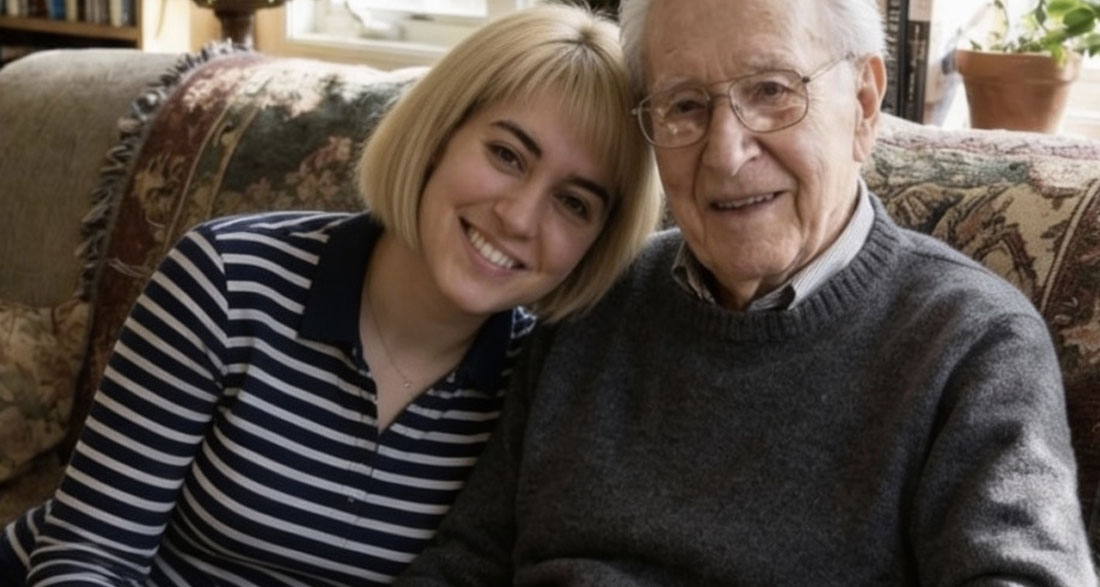
Two weeks after my grandfather’s funeral, my phone rang. The number was unfamiliar, and for a moment, I almost ignored it. Something, though—a whisper in my gut—made me answer.
The voice on the other end was calm. Too calm. Like someone who had rehearsed every word, choosing them carefully.
“Your grandfather wasn’t the man you thought he was,” the woman said.
My knees gave way, and I had to sit down. My heart was hammering. I didn’t know it yet, but that single phone call would shake the foundation of everything I had ever believed about the man who had raised me, protected me, and loved me more than anyone else in the world.
When I was six, my parents died.
I don’t remember much from that day—just flashes: the smell of coffee lingering in the kitchen, voices low and hurried, the way everyone seemed to stop talking whenever I entered the room. I was surrounded by adults, yet I had never felt more alone.
And then I heard it.
“Foster care.”
The words hit me like a cold knife. I didn’t fully understand what they meant, only that they were terrifying. Losing my parents had already stolen my world, and now foster care threatened to take away the last thing I had left.
I didn’t cry. I didn’t scream. I was too afraid to do either.
Then my grandfather arrived.
He was already sixty-five, his hands rough and scarred from decades of work, his posture slightly bent, but his eyes fierce and unwavering. He walked into that room of arguing adults, slammed his hand on the table, and said firmly, “She’s coming with me. That’s final.”
And just like that, my world had a center again.
From that day forward, he became my everything.
He gave me the bigger bedroom and took the smaller one himself. He learned to braid my hair, staying up late at night watching tutorials on his old laptop. Every morning, he packed my lunch, carefully slicing sandwiches just the way I liked them.
He came to every school play, no matter how small my part, and squeezed himself into tiny chairs at parent-teacher meetings, grumbling under his breath but always smiling.
To me, he wasn’t just my grandfather. He was my superhero.
When I was ten, full of conviction and innocence, I told him, “When I grow up, I want to help kids like you helped me.”
He hugged me so tightly I could barely breathe. “You can be anything you want, kiddo. Anything at all,” he whispered.
But love doesn’t put food on the table or pay bills.
We lived simply. No vacations, no fancy meals, no surprise presents. Our house was old, our furniture secondhand.
“Grandpa, can I get new clothes?” I’d ask sometimes, my voice hopeful. “Everyone at school has those jeans.”
He’d sigh and shake his head, a soft, sad smile on his face. “We can’t afford it, kiddo.”
I hated those words. I hated being the girl in thrift-store clothes, the one whose phone barely worked when everyone else had shiny new ones. I hated feeling embarrassed, angry, and guilty all at once—angry that we didn’t have more, guilty for resenting the man who had given me everything he could.
At night, I cried into my pillow so he wouldn’t hear. I didn’t want him to know that his fierce, unwavering love sometimes didn’t feel like enough.
Then one winter, everything changed.
He got sick.
It started small—a cough, some fatigue—but soon his body betrayed him. He lost weight. He moved slower. Sometimes he winced as if the pain were trying to hide from me. One day, halfway up the stairs, he stopped, clutching the railing. My heart hammered in panic.
We couldn’t afford a nurse. We barely had enough to eat some days. So I became his caretaker.
He tried to hide the truth. “It’s just a cold,” he said with a tired smile, brushing off my worried gaze. “You focus on your exams, okay?”
But I could see it in his eyes. He was slipping away.
One night, I held his hand, my voice trembling. “Please… let me take care of you for once.”
He smiled faintly, weak but warm. “You already do, kiddo,” he whispered.
That last spring was the hardest season of my life. I balanced my final semester of high school with cooking, cleaning, helping him to bed, and sitting beside him through nights that felt endless. Each morning, when I saw how pale he had become, panic gripped my chest so tightly I could hardly breathe.
One evening, as I helped him back from the bathroom, he stopped me. His hands trembled, and his eyes held a strange mix of sadness and urgency.
“Lila,” he said quietly, “I need to tell you something.”
“Later, Grandpa,” I said quickly. “You’re exhausted.”
But later never came.
Three nights later, he died in his sleep.
I found him there, still and peaceful, and yet something inside me shattered.
Graduation passed in a blur. My friends celebrated with parties and pictures, but I couldn’t join them. I sat in the house he had left me—our house—surrounded by his belongings, trying to remember how to breathe in a world without him.
The bills began to pile up almost immediately. Electricity. Water. Property taxes. I didn’t know where to start.
He had left me the house, but no income. I thought about getting a job, but the idea felt impossible. I couldn’t sleep. I couldn’t eat. Selling the house crossed my mind, but the thought of strangers living in his room twisted my stomach into knots.
Then, two weeks after the funeral, my phone rang.
“Hello, is this Lila?” a woman’s voice asked. “My name is Ms. Reynolds. I’m calling from the bank regarding your late grandfather.”
I froze. Bank calls never bring good news. My mind raced through debts, overdue bills, secrets I couldn’t pay off.
“Did he owe money?” I asked, trying to steady my voice.
There was a pause. “We can’t discuss details over the phone,” she said gently. “Could you come by this afternoon?”
“Yes,” I whispered.
When I arrived, Ms. Reynolds met me at the door. She was middle-aged, her eyes kind but professional. She led me into a small office that smelled faintly of coffee and paper.
“Thank you for coming in,” she said, folding her hands neatly. “I know this must be a difficult time.”
I couldn’t hold back. “Please… just tell me how much he owed. I’ll pay it off. I’ll figure it out.”
Her eyes softened. “He didn’t owe anything, dear. Quite the opposite, actually.”
I blinked. “What do you mean?”
She smiled gently. “Your grandfather was one of the most consistent savers I’ve ever met. Every month, rain or shine, he deposited money into a trust he set up in your name eighteen years ago.”
I shook my head. “That can’t be right. We barely made it through each month. Some winters we couldn’t even afford heat.”
“He never missed a payment,” Ms. Reynolds said. “He told me once that he was saving for something more important than himself.”
She reached into a drawer and handed me an envelope. My name was written in his familiar, looping handwriting.
“He wanted you to have this when you came in,” she said.
My hands trembled as I opened the envelope. Inside was a letter.
My dearest Lila,
If you’re reading this, it means I’m not there to walk you to campus myself, and that breaks my heart. I’m sorry, kiddo.
I know I said “no” a lot. I hated saying it. But every time I said we couldn’t afford something, it was because I was saving for this—for you.
You told me once you wanted to help kids like I helped you. I never forgot that. This trust should cover your education, your books, and a little extra so you won’t have to worry for a while. The house is yours. Take care of it—and yourself.
I’m so proud of you, my girl. I’ll always be with you.
All my love,
Grandpa
I cried so hard that I couldn’t see the paper anymore.
When I finally looked up, Ms. Reynolds was watching quietly, a small, understanding smile on her face.
“How much…” I began, my voice shaking. “How much did he save?”
She turned her computer screen toward me. “Enough to pay for four years of college—tuition, housing, food, everything. Plus a little extra to get you started afterward.”
For a long moment, I couldn’t speak.
All those years of thrift-store clothes, meager dinners, wishing for things we couldn’t have—they hadn’t been poverty. They had been love. Fierce, quiet love that hid behind frugality.
I spent the next week researching universities, just like he would have wanted. I applied to the state’s top social work program, the one I’d secretly dreamed of attending.
Two days later, the acceptance email arrived.
That evening, I sat on the porch under the fading sunset, the letter folded neatly in my hands. The world was quiet except for the hum of cicadas and the occasional creak of the old porch swing.
“I’m going, Grandpa,” I whispered. “I’m going to help kids, just like I promised. Just like you helped me.”
Tears came again, but this time, they felt light. They felt like freedom.
He had lived simply so I could dream freely. He had given up comfort so I could have opportunity. Every “no” he ever said had really meant “I love you.”
I looked up at the stars and smiled through my tears.
“You really did it, Grandpa,” I said softly. “You saved me.”
For the first time since he died, I felt like I could breathe again.
The house no longer felt like a weight pulling me down—it was a foundation, his final gift. I could almost hear his voice in the breeze, teasing and gentle:
“Go on, kiddo. You’ve got a whole world to change.”
I stood, clutching the letter to my chest. For years, I had thought scarcity defined us. Now I understood: love had been our wealth all along.
And I was determined to spend it well.