

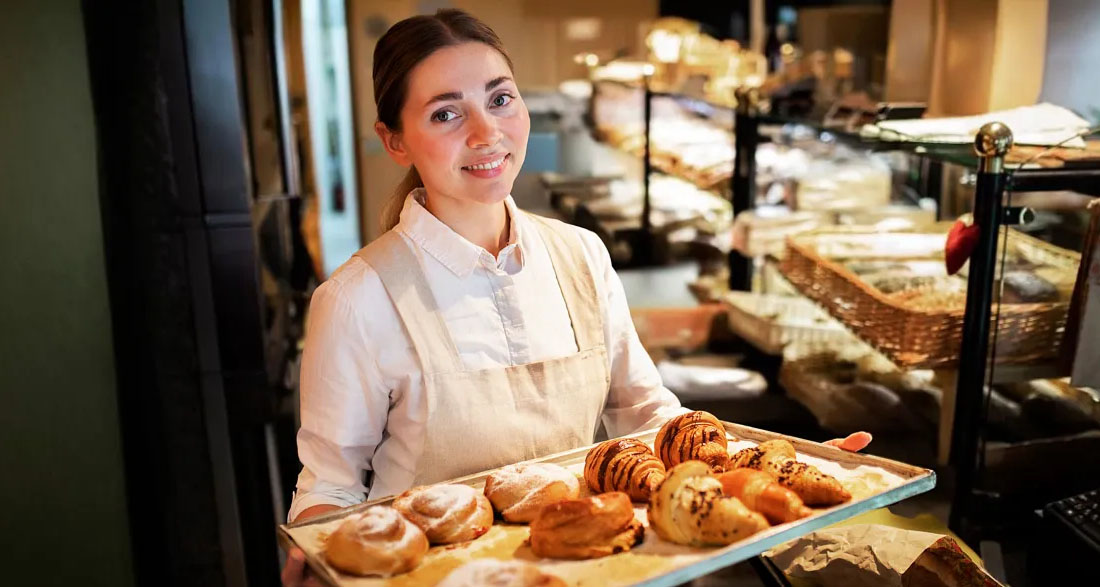
It was almost closing time, and the little brass bell above the bakery door jingled softly. That sound had become my favorite part of the day—a quiet promise that someone out there still believed in the comfort of warm bread and a kind face.
I was wiping down the counter when I saw him. A boy, maybe eleven or twelve, stood in the doorway. His jacket hung loosely on his thin shoulders, the cuffs frayed, the fabric worn. His sneakers were soaked through, leaving tiny wet prints on the mat.
He didn’t step fully inside. One foot stayed on the mat, the other outside, as if he wasn’t sure he was allowed to cross the threshold.
For a long moment, he didn’t speak. His eyes stayed on the floor, tracing the linoleum like it might hold the answer to some question he didn’t dare ask.
Finally, in a soft voice, he said, “Miss… if you have any old bread… or stale rolls… could I… please have one? I haven’t really eaten today, and my stomach is… noisy.”
He said it like he’d rehearsed it a hundred times, like he’d asked a hundred strangers before, always hoping, always bracing for a “no.”
My chest tightened. I should have asked him where he came from. I should have asked why he was alone, why his clothes were too small, why his words sounded so careful, so practiced for a child.
But all I could think was:
God, he’s just a child. And he’s hungry.
His fingers curled into his sleeves, his eyes fixed on the floor. I swallowed hard and tried to steady my voice.
“Sweetheart,” I said gently, walking around the counter. “Come on, come sit here. It’s much warmer inside.”
He blinked at me, uncertain. The expression on his face was unreadable, like he wasn’t sure if it was safe. Slowly, he stepped toward the little table by the heater, moving as if he expected someone to yell at him or stop him.
I made a cup of hot chocolate, the kind with whipped cream and cinnamon, and set it in front of him.
“I’m Lily,” I said, keeping my voice light. “What’s your name?”
He hesitated, weighing whether he could trust me.
“Marco,” he finally said.
“Well, Marco,” I said with a smile, “tonight you’re going to have something fresh. Not stale, not cold… just warm and delicious. You pick whatever you want from the case.”
His eyes widened, shining with disbelief. “Really? You’d do that?”
“Really,” I said. “Go ahead, take your pick.”
He looked over the pastries carefully, as if memorizing each one. Then he pointed to an apple turnover, a cherry tart, and a chocolate twist.
“Brilliant choices,” I said, placing them on a plate. I noticed how his eyes followed every move, how he seemed almost afraid to believe this kindness was real.
“Thank you,” he murmured. “You’re really nice.”
While he ate, I packed a brown paper bag with extra rolls and the last sandwich I’d planned to take home. He ate slowly, savoring each bite, as if trying to make the warmth last longer.
When I handed him the bag, his face lit up like Christmas morning.
“Are you sure? Wow… thank you, ma’am. This really helps.”
“Where’s your mom, honey? Do you have somewhere to stay tonight? Can I help?”
Marco’s expression changed instantly. Panic flashed in his eyes, and before I could stop him, he bolted out the door, clutching the bag.
The bakery was silent again. I stood there, heart racing, unsure what to do. Call someone? The police? Child services? I had a feeling that would only frighten him further. And I couldn’t let that happen.
The next evening, just before closing, the bell chimed again.
I looked up from restocking the napkins. There he was—Marco, clutching the same paper bag from the night before. His hair was damp, his jacket thin against the cold.
“Please,” he said quickly, “don’t call the police. Can I… can I trust you?”
“Yes,” I said softly. “You can trust me. I promise.”
Marco’s shoulders stiffened, his grip tightening on the bag. “No one can know, ma’am. If they find out… they’ll take me away. Put me in foster care. And I can’t leave my mom.”
That was when I understood. He wasn’t afraid of me. He was terrified of losing her.
“Okay, sweetheart,” I said gently. “Let’s have some hot chocolate and food, and you can tell me what’s going on. Deal?”
He hesitated, then nodded.
Over croissants and warm chocolate, Marco slowly shared his story. His mother, Miranda, was very sick. She was too weak to leave bed most days. He took care of her the best he could, cleaning the apartment, finding food when possible, sometimes helped by neighbors—but not much anymore.
“If anyone finds out, ma’am,” he said quietly, “they’ll take me away. I won’t leave her.”
Then came the moment that broke me:
“Could I… maybe work here?” he asked. “I can sweep, do dishes… I don’t need money. I just… want bread for me and my mom.”
“Marco,” I said gently, tears pricking my eyes, “you’re too young for that. But… maybe I can bring food to your mom instead. Would that be okay?”
He stiffened. “No. She doesn’t like people seeing her like that.”
I nodded. Silence settled, but I didn’t leave it there. That night, I packed another bag—rolls, a thermos of soup, croissants, and a few soft cookies. I handed it to him with a quiet smile.
“Come back anytime, Marco,” I said.
And he did. Every few days, always just before closing. Some nights he shared stories about his mom. Other nights he was silent, and I didn’t press. I just made sure he always left with something warm in his hands.
Three weeks later, Marco came in with a small, shy smile.
“My mom,” he said, “she wants to meet you.”
“Really?”
“Yes,” he nodded. “She said it’s only right. You’ve been helping us, and she wants to say thank you.”
That evening, I packed a basket with pastries, rolls, and a thermos of chowder and followed him through the dark streets to a worn, tired apartment building. Marco led me up narrow stairs into a small room. A woman lay under a thin blanket. Her face was pale, but her eyes were clear.
“Mom, this is Lily,” he said.
“I’m Miranda,” she said softly. “Marco, go wait outside for a bit. The ladies need to talk.”
When he left, Miranda turned to me, calm and clear-eyed. “I’m dying, Lily. Stage four. We’ve tried everything.”
I gripped the basket tighter, my throat dry.
“I didn’t know what to expect,” she continued. “But Marco told me you were kind. You listened. You didn’t treat him like a problem.”
She reached for my hand. “Do you have children, Lily?”
“No,” I whispered.
“Then I’m asking you to take mine. Take him under your wing. He’ll need someone soon.”
That night, I barely slept, thinking of Marco’s first night, soaked shoes, quiet desperation. The warmth of my grandmother’s kitchen came to mind, the smell of yeast and bread—but maybe true safety was this: a child holding onto hope, and someone brave enough to catch it.
The next day, a social worker arrived. “I’m Spencer,” he said kindly. “Miranda wants you to care for Marco. I’m here to make it official.”
Marco held my hand. “My mom says you’ll take care of me until she gets better. Thank you.”
I knelt, arms open. He stepped right into them.
Two weeks later, he was officially my foster son. Miranda went into treatment. She sold her few belongings to give Marco a chance at the future.
Marco started school again, nervous but hopeful. He called me “Auntie Angel” and brought home drawings of the bakery, stick figures labeled “Auntie Angel and Me.”
Every weekend we visited Miranda. Slowly, she grew stronger. When the doctors saw progress, hope returned. Marco thrived, too, growing taller, louder, funnier. When the court restored Miranda’s parental rights, he was almost fifteen.
We celebrated at the bakery, laughter and sugar filling the air. “Don’t forget me,” I teased.
“I never could. You saved us, Auntie Angel,” he said.
Years later, they still visit every Sunday. Miranda brings flowers; Marco brings stories of school and dreams. The bakery is small, warm, alive with memories. The brass bell still chimes, and sometimes, just for a second, I expect to see Marco at the door again—cold, exhausted, clutching a paper bag.
“Do you ever think about that first night?” I asked once.
“All the time, Aunt Lily,” he said. “That night changed everything.”
And I knew exactly what he meant. The warmest thing I ever made wasn’t bread. It was a home.