

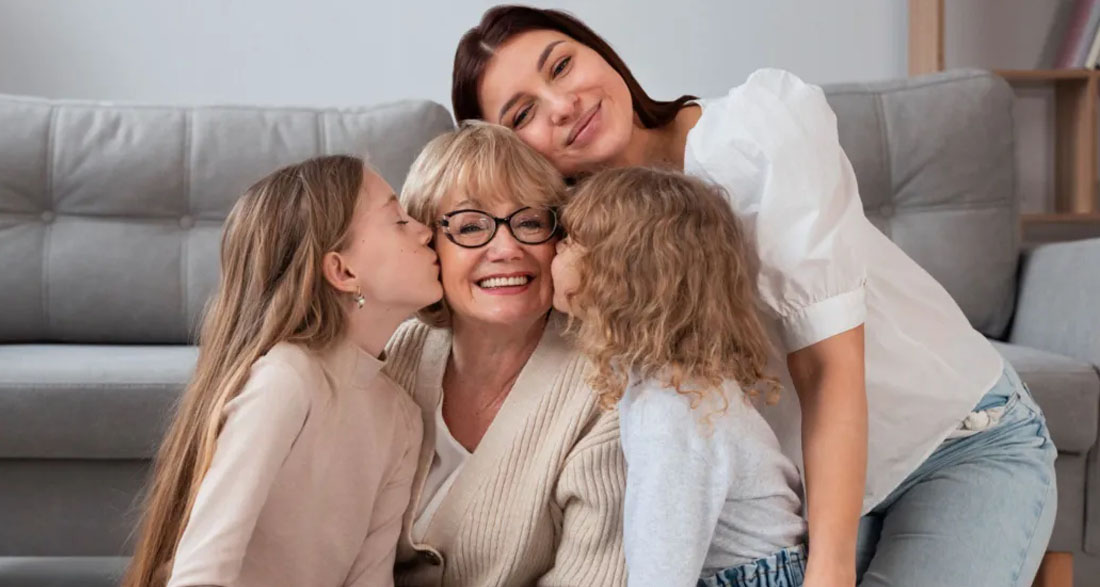
Six months ago, my life split into two: before and after. My name is Carolyn. I’m 71, and six months ago, everything I knew about my family changed forever.
My daughter, Darla, and her husband had gone on a work trip, leaving their four children with me for the weekend. They never came home. The plane had engine failure. No survivors. Just like that, my daughter and her husband were gone.
I suddenly became both mother and grandmother to Lily, nine, Ben, seven, Molly, five, and little Rosie, who had just turned four. Lily, Ben, and Molly understood enough to grieve. Rosie didn’t. She kept asking, waiting for her parents to walk through the door.
“How come Mommy isn’t home yet?” Rosie asked one morning, her little hands clutching mine.
I swallowed hard and smiled, hiding the tears. “She’s on a very long trip, sweetheart. But Grandma’s here. I’ll always be here.”
It was a lie. A lie wrapped in love. But it was the only way I could keep Rosie from falling apart completely.
The first few weeks were unbearable. Nights were full of crying. Lily refused to eat. Ben wet the bed for the first time in years. I was drowning in grief, worry, and exhaustion. My pension wasn’t enough to keep us alive. I had to work.
At 71, nobody wanted to hire me. But I managed to find a job at a diner on Route 9. I wiped tables, washed dishes, and took orders. In the evenings, I knitted scarves and hats to sell at the weekend market for extra money. It wasn’t glamorous, but it kept a roof over our heads.
Every morning, I dropped the three older kids at school and Rosie at daycare.
Then I worked until 2 p.m., picked them up, made dinner, helped with homework, and read bedtime stories. Six months passed like that—slowly, painfully. We began to find a rhythm, but the grief never left. It just learned to sit quietly in the corner.
I told myself I was doing enough, keeping them fed and safe. But deep down, I wondered if I was failing my grandchildren.
One morning, I dropped the kids off and was halfway to work when I realized I’d forgotten my purse. I turned around and drove back. When I got home, I heard a knock at the door.
Through the window, I saw a delivery truck. A man in a brown uniform stood on the porch.
“Are you Carolyn?” he asked when I opened the door.
“Yes?”
“We have a delivery for you. It’s very large and very heavy. We can bring it inside if you like.”
“What delivery?”
He gestured to the truck. Two other men were already pulling something out. It was enormous—like a small refrigerator—wrapped in brown paper. There was only one label: To My Mom. My address. Nothing else.
It took all three men to carry it inside. I cut through the tape carefully and opened the top flap. On top was a sealed envelope. My name was written in Darla’s handwriting.
I sat down on the couch and tore it open. The letter was dated three weeks before she died. The first line made my heart stop:
“Mom, I know you’re probably confused right now. But if this box has been delivered to you, it means I’m no longer alive.”
I couldn’t breathe.
“There are things you never knew about me. I have to tell you the truth. You’ll understand everything once you open the package.”
I set the letter down and looked back at the box.
Inside were dozens of smaller boxes, each carefully labeled in Darla’s handwriting: one for Lily’s 10th birthday, one for Ben’s first day of middle school, one for the day Molly learned to ride a bike, and one for Rosie’s fifth birthday. Gifts for every milestone until they turned 18.
She had planned for everything. She’d known she wouldn’t be there.
At the bottom of the box was another envelope. Inside was another letter:
“Mom, I’m sorry I didn’t tell you sooner. I wanted to protect something. Please visit this address. He’ll explain everything.”
Below it was an address in the city, two hours away. I glanced at the clock—9:30 a.m., work at 10. But I couldn’t go. Not now. I called my boss, explained it was an emergency, and drove to the address.
The address led me to a small house on the edge of the city. I knocked. A man in his late 30s opened the door.
“Can I help you?” he asked.
“My name is Carolyn. I’m Darla’s mother. I received a package this morning with this address.”
His face changed. “Carolyn? Yes. Please come in. I’ve been expecting you.”
Inside, he gestured to the couch. “I’m William. I was your daughter’s doctor.”
“Doctor?”
“Yes. Please, sit.”
He pulled out a folder. “Your daughter was diagnosed with stage four cancer a year ago. Aggressive. Less than a year to live.”
Everything inside me froze. “What?”
“She came to me after experiencing symptoms. We ran tests. She wanted you to be protected. She didn’t want you to watch her fade.”
I couldn’t speak.
“She bought those gifts for her children over several months,” William continued. “She wanted them to have something from her for every important moment in their lives.”
“Why didn’t she tell me?”
“She wanted to. But you had already survived too much. She couldn’t make you watch her suffer.”
I looked up. “Lily’s birthday is next week.”
“I know. That’s why I sent the box. She wanted you to have this.”
He handed me a small box. Inside was a gold locket with a photo—me and the kids hugging last summer at the lake. Tears streamed down my face.
“Did her husband know?” I whispered.
“No. She planned to divorce him when they returned. He didn’t know, and the crash ended everything before she could say a word.”
I drove home in a daze, thinking about why Darla had wanted me to have the box instead of him. Something was missing. Some truth she hadn’t told William.
That night, after the kids were asleep, I noticed Molly clutching her drawing book. As I tucked her in, it slipped to the floor. A page fell open. Four stick-figure children, two adults labeled Mommy and Daddy—and another figure labeled Mommy 2.
I couldn’t sleep. Who was Mommy 2?
The next morning, at breakfast, I asked casually, “Sweetheart, who’s Mommy 2 in your picture?”
“That’s the lady who used to come over when Mommy was at work,” Molly said.
“What lady?”
“The one Daddy would hug.”
“Did Mommy know about her?”
“I don’t know. But one day Mommy yelled, and the lady didn’t come back anymore.”
I spent the next two days digging. I called Darla’s neighbor about the nanny.
“Oh, you mean Jessica?” the neighbor said. “She was around for a while. Then she disappeared. I think Darla fired her.”
I got Jessica’s contact information and went to her apartment. She answered the door, nervous.
“Carolyn? Darla’s mother?”
“I know about you and my son-in-law,” I said.
She looked down at her hands. “I’m sorry.”
“How long?”
“Six months. It started after I’d been working for them a year.”
“And my daughter found out?”
“She walked in on us. She fired me that day.”
“Did he love you?”
“I don’t know. I think he was just… lonely.”
“He had a wife. And four children. He wasn’t lonely. He was selfish.”
I walked out.
When I got home, I stared at the box. Darla hadn’t told her husband about the cancer because she didn’t trust him.
She wanted me to protect her children’s memories. Finally, I understood. I made a choice: I would never tell the kids what he had done. Darla had trusted me with that burden, and I would carry it.
That weekend was Lily’s 10th birthday. I brought out the box labeled For Lily’s 10th Birthday. She opened it carefully. Inside was a journal. On the first page, in Darla’s handwriting, it said:
“My darling Lily, I’m so proud of the young woman you’re becoming. Write your dreams here. I’ll always be cheering you on.”
Lily held it to her chest and cried. So did I. Darla had left behind more than gifts. She left the hardest truth of all: love means protecting the people you love—even from the ones they trust most.