

The Room of Dolls
On a warm Friday evening in Baltimore’s Inner Harbor, the city moved like a cheerful dance. Tourists licked salt from soft pretzels, buses groaned as they pulled away from curbs, and gulls sliced through the golden light above the water.
James Randall walked among it all as if underwater—present, but unseen. His polished Oxfords reflected the city, but nothing touched him. Five years of endless meetings and business deals had reduced life to a long, colorless hallway. He kept moving because stopping would mean feeling.
James had become a master at ignoring the world: the smell of rain on warm brick, the music of street performers, the way real laughter caught in your throat. Even the weight of his Rolex—Cassandra’s last gift, carefully wrapped for a birthday they never got to finish—felt like nothing.
Then he heard it. A little girl’s cry. Not the sharp shriek of anger, but a tiny, heavy sound—the kind that apologizes for existing. It reached him before he could look away.
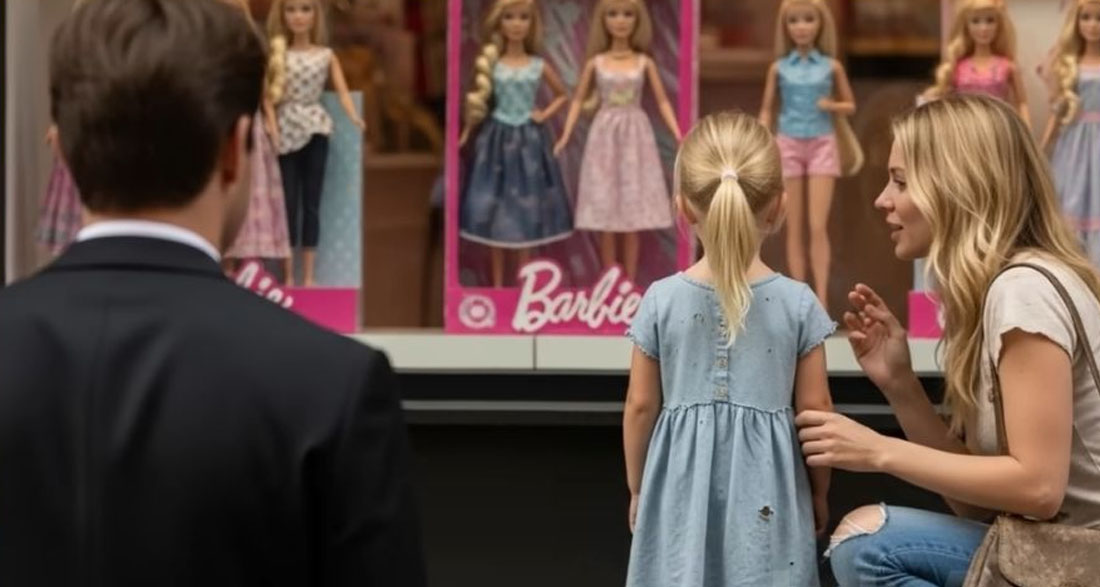
He turned and saw them outside a bright toy-store window: a young woman kneeling on the sidewalk, holding a girl with a yellow ribbon in her ponytail. Behind them, pink boxes displayed dolls dressed as ballerinas, astronauts, and glittering mermaids. The mother’s T-shirt was clean but tired, and the set of her jaw spoke of months lived in tight budgets.
“I just want one,” the girl whispered, her voice quivering. “For my birthday. Just one. Everyone else has one.”
“I’m trying, honey,” her mother said, pressing her forehead to the child’s. Her voice cracked. “We need the money for rent and groceries. I’m so sorry.”
James knew he should keep walking. Pain was a door he kept locked. But something slipped its foot in the jamb and wouldn’t let it close. Cassandra’s laugh drifted from memory—the daughter they never had, the shelves of Barbie dolls she collected since she was five.
Before he realized it, he was moving toward them.
“Excuse me,” he said. The woman’s head snapped up—green eyes wide, red-rimmed, full of wary dignity. She drew the child behind her.
“I’m sorry to intrude,” James continued, surprised at how soft his voice sounded when it wasn’t commanding a boardroom. “My name’s James. If you’ll let me, I’d like to buy your daughter a birthday present.”
“We don’t accept charity,” she said, firm but not unkind.
“It isn’t charity,” he said gently. “Today would have been my wife’s birthday. She loved dolls—had a whole collection. We never got a chance to share it with a child. It would mean a great deal to me to do something kind in her name.”
The little girl peeked out. “Mommy, his wife liked dolls,” she whispered, as if it proved he was good. “That’s sad.”
The woman—Tracy, he would later learn—looked at him, then at her daughter. Her pride softened, making room for hope.
“All right,” she said finally. “Thank you.”
Inside the store, colors and lights dazzled. Brenda—the girl—walked to the Barbie aisle as if entering a cathedral. Her fingers hovered over the boxes like she was studying precious art.
“Do you have a favorite?” James asked, crouching beside her.
“That one,” she breathed, pointing at a mermaid doll with shimmering blue and violet scales. “She goes on quests. She helps people.”
“Excellent choice,” he said. Her smile unlocked something in him, like a window stuck shut for years finally letting sunlight in.
At the register, Tracy stood straight. “You don’t know what this means,” she whispered. “People walk past. You didn’t.”
“Most days,” he admitted. “I do.” He surprised himself with the truth.
Outside, Brenda hugged the doll to her chest, then flung herself around James’s waist. “You’re my favorite person,” she declared.
He hadn’t been hugged like that in years. Carefully, he wrapped his arms around her.
“Happy almost birthday,” he whispered, letting the words land where grief had lived too long.
That night, he canceled all meetings and walked through the lit streets, really walking. He noticed the harbor’s dark mirror, music spilling from restaurants, the air fragrant with Old Bay.
Back at his mansion in Roland Park, he stood before the bedroom he hadn’t entered in half a decade—Cassandra’s room. He didn’t open it. He just laid his palm against the door and didn’t pull away.
Three weeks later, a chalkboard menu led him into a small café near Randall Industries. He told himself he just needed fresh air. He told himself a CEO could wait in line. He told himself he wasn’t hoping.
“Be right with you,” called a woman from behind the espresso machine.
He knew the voice before seeing her.
“James,” Tracy said, cheeks flushed. She wore a brown apron over jeans, determination etched into her face.
“What do you recommend?” he asked.
“Americano. Simple. Strong.”
“Perfect,” he said, meaning more than coffee.
“How did Brenda like her birthday?” he asked.
“She adored it,” Tracy said, worry lines softening into light. “She drew you something. I didn’t think I’d see you to give it to you.”
It was a crayon masterpiece: three stick figures under a sun. One in a black suit. One with yellow hair. One tiny, ponytailed, holding a mermaid. The block letters read: “Thank you, James. You are nice.”
He folded it like a precious deed and placed it in his briefcase.
“If you want to say hello on Saturday,” Tracy blurted, “we feed the ducks at Patterson Park around two.”
“I’ll be there,” he said. Keeping a promise felt good.
Saturdays became a ritual. Bread in paper bags, ducks jostling like tiny bankers, Brenda narrating the world with scientific precision. James relearned ordinary verbs—pushing swings, tying laces, telling jokes. He discovered Brenda’s laugh, the way Tracy’s shoulders relaxed when someone else carried part of her load.
“Do you ever feel guilty for being happy again?” Tracy asked one crisp day, while Brenda explored a flowerbed.
“Every day,” he said. “Less than I used to. She’d want me to have happiness, not this half-life.”
Tracy nodded, keeping a piece of him safe.
Six Saturdays later, the phone rang: unknown number. Tracy answered, panicked.
“James, it’s Brenda. We’re at Baltimore General. Leukemia… I can’t lose her.”
The world snapped into focus. James ran.
“I’m here,” he said, gathering Tracy before she could crumble. “I’m here.”
Doctors spoke policy; James spoke solutions. Words like “transfer” and “attending” left his lips with authority. He phoned Johns Hopkins, arranged every resource, personal guarantees—anything for Brenda.
“You can’t—” Tracy started.
“It’s nothing,” he said. “Please let me.”
“Why?”
“Because with you and Brenda, I feel like a person. She hugged me like I mattered. I can help. I must.”
Brenda held her mermaid doll through every procedure. When she asked if she would die, James said firmly, “No. We are going to do everything. You are going to get better.”
He did everything. Meetings moved, calls taken in hallway corners, journals read at midnight, good questions asked at rounds. He became the person doctors respected, the person nurses smiled at, coffee in hand.
“Stubborn,” Tracy said one evening. “Overbearing. Impossible.”
“Caring,” he offered.
She laughed for the first time in weeks. “Caring,” she agreed, letting her shoulder touch his.
Four months later, Dr. Sheffield’s smile filled the room.
“Remission,” she said. Tracy sobbed. James held her, letting his own tears fall.
“Did you keep your promise?” Brenda asked.
“I helped,” he said. “Your doctor made you better. You made you better.”
“You helped a lot,” she said, hugging him. Something inside James broke open—clean and true.
He brought them to his house temporarily. “She can’t come back here yet,” he said.
“This is what we have,” Tracy replied.
“Have mine,” he said. “Until she’s strong.”
Love won.
The Randall mansion learned to echo again. Laughter returned. James converted a room into a lavender paradise for Brenda—shelves ready for books, toys, and dreams. He rediscovered what it felt like to come home.
Three months later, the date returned—the one that hurt the most. Outside the master bedroom, Tracy asked, “What do you need to move forward?”
“To open this,” he said.
She laced her fingers through his. “Of course.”
The door creaked open. Inside: Cassandra’s room, dolls lined like a museum, memories intact.
“She could tell you the story behind every one,” James said.
“She must have been wonderful,” Tracy whispered.
“She was,” he said. “And I love you.”
Tracy’s hand tightened in his.
“I want a life with you and Brenda,” he said. “Adoption papers. Vows. Birthday cakes. Science projects. All of it.”
“What about this?” she asked, gesturing to the room.
“It stays. But it becomes what she wanted: to be shared.”
Brenda peeked in. “Are you two getting married?”
“If your mother says yes,” he said.
“Please say yes,” Brenda begged.
Tracy laughed through tears. “Yes,” she said, holding them both.
Spring came. They married in a garden of magnolias. Brenda scattered petals with precision, beamed, and watched James twirl her after the kiss. The past and present merged.
James turned Cassandra’s room into a library and sitting room. The dolls found a “For Play” shelf. On Saturdays, he told Brenda stories of each doll, of Cassandra, of love passed forward.
A year later, Patterson Park remained theirs. Bread still disappeared in tiny flocks of ducks. Tracy placed James’s hand on her stomach.
“We’ll need a double stroller,” she said, eyes shining.
He laughed, cried, and kissed her. “Cassandra would be thrilled,” Tracy whispered.
They told Brenda. She considered it seriously. “I’ll teach the baby to share,” she promised.
James laughed. “We’ll start with the For-Play shelf.”
That night, James stood in the doll room. Photographs watched from the walls—moments frozen, love preserved.
“I didn’t forget,” he whispered. “There’s room.”
He turned off the light, closed the door, and it felt full.
In bed, Tracy slid his hand back onto her belly. “This is home,” she murmured.
“It is,” he said.
James thought about the sidewalk, the toy-store window, the mermaid doll, the brave mother, the girl with a yellow ribbon—and the doors he had finally opened.
The human heart isn’t emptied and refilled. It’s a house you keep building. Love multiplies. Shelf by shelf. Room by room.
James Randall fell asleep with the past behind him and the soft future in his hand. Morning came, pancakes waited, ducks awaited in the park—and James woke grateful he had once stopped and decided to live.