

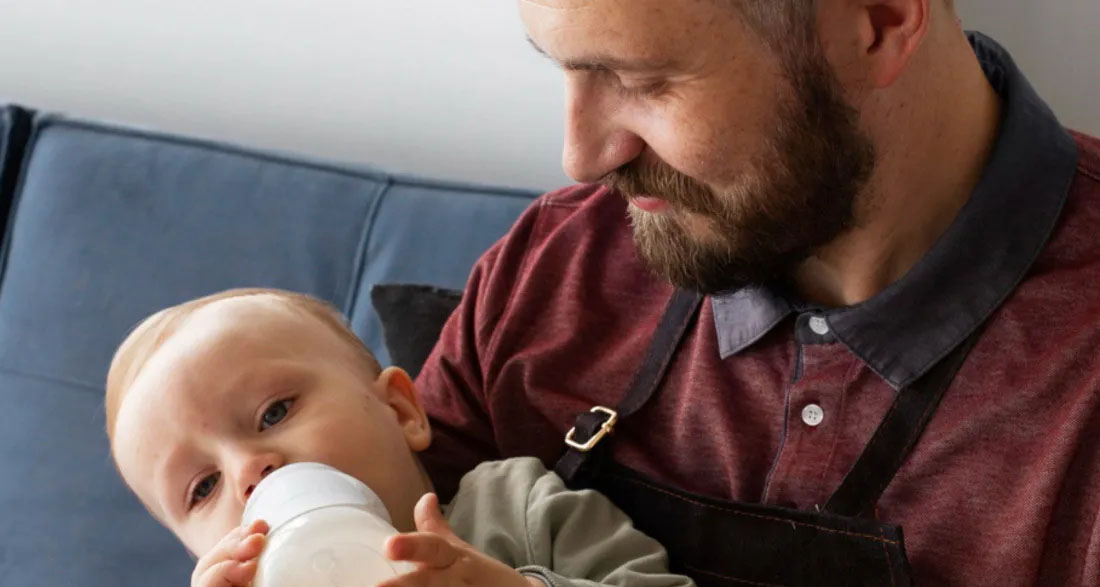
I’m a widowed single father who lost everything a year ago. One ordinary morning, while cutting through the woods on my way to a work call, I heard a baby crying. What I found stopped me cold, and when I discovered who the baby’s parents were, the truth hit me like a freight train.
My name’s Mike, and I’m 36. A year ago, my wife died in a way that still doesn’t feel real when I say it out loud. Lara… she died in a car accident on a Tuesday night.
One moment we were texting about whether our baby son, Caleb, needed new pajamas, and the next, I was standing in a hospital hallway, holding a diaper bag I didn’t even know what to do with anymore.
A drunk driver had slid through a stop sign on icy roads and hit her head-on. She never made it home.
Caleb is a year and a half old now. He’s all elbows and energy, the kind of toddler who laughs at his own jokes and climbs furniture like it’s an Olympic sport. Some mornings, he’s the only thing that makes the house feel alive.
That particular morning, I dropped Caleb off at my sister’s place because I had back-to-back plumbing calls scheduled. After leaving him there, I headed toward my first job—a neighbor had been complaining about a leaking pipe.
The quickest route was the narrow trail through the woods behind our neighborhood. I’ve walked that path a hundred times with my toolbox, thinking about nothing more dramatic than what fittings I’d need. It was just an ordinary morning. Same path, same quiet, same routine.
Until it wasn’t.
About two minutes into the trail, I heard something that made my blood run cold.
A baby’s cry.
At first, it was faint, almost swallowed by the wind. But once I realized what it was, my whole body froze. There were no other people around, no stroller, no voices… nothing that made sense.
The sound was coming from off the path. I pushed through thorny bushes, my boots slipping on damp leaves, and that’s when I saw it.
An infant carrier, tucked low under the branches, like someone had tried to hide it.
For a second, I just stood there, my brain refusing to process what I was seeing. And then I saw her tiny face.
A newborn baby girl, wrapped in a thin pink blanket that looked completely inadequate for the weather.
Her lips were tinged blue, her cheeks blotchy from crying, and the second I touched her hand, I felt how cold she was.
My brain didn’t even form a coherent thought. My body just moved.
I lifted the carrier, pulled the blanket tighter around her, and started running straight toward my home. I didn’t care that I probably looked insane, sprinting down a gravel road with a baby in my arms. All I knew was that she was freezing.
I burst through my front door and laid her carefully on the couch. My hands were shaking so badly I almost couldn’t undo the blanket.
“There you go,” I whispered over and over. “You’re okay. You’re safe now.”
I grabbed a small space heater from the hallway closet and wrapped her in one of Caleb’s thick baby towels. Then I ran to the kitchen.
I still had bottles, formula—everything from Caleb’s newborn days—the stuff I couldn’t bring myself to throw away.
I mixed a bottle so fast I spilled powder all over the counter, tested it on my wrist, and pressed it gently to her mouth. She latched on immediately, as if she had been waiting for someone to care at last.
I sat on the floor holding her close, watching her swallow and breathe, and slowly, she stopped shaking. Only then did I grab my phone and call 911.
“My name’s Mike,” I said. “I found a newborn in the woods. She was freezing, so I brought her home and fed her. She’s alive. Please send someone.”
The paramedics arrived faster than I expected. They didn’t scold me for bringing the baby home first. If anything, they looked relieved.
One of them checked her temperature, then looked up at me. “You did the right thing. If you’d left her out there, she could’ve slipped into hypothermia fast. You probably saved her life.”
I just stood there, numb. Before they left, I asked the same questions over and over:
“Is she going to be okay? Where are they taking her?”
“She’s safe now,” a caseworker said gently. “That’s what matters.”
But the second the door closed, the house felt too quiet again. Caleb was still at my sister’s, and I sat alone on the couch, replaying how cold the baby’s hands were, how quickly she latched onto the bottle, and that blanket—a thin pink blanket with an embroidered “M” in the corner.
It didn’t feel random. It felt like a clue someone had left behind on purpose.
I barely slept that night. Every time I closed my eyes, I saw her tiny face. I kept thinking about that embroidered “M.”
And then another thought crept in: maybe someone didn’t want to leave her there.
The next afternoon, there was a knock at my door. Not a casual neighbor knock—a careful, hesitant one.
When I opened it, a woman stood on my porch. Late 20s, maybe 30. Hair pulled back messily. Eyes red and swollen. Hands clenched so tightly I could see the white of her knuckles.
It felt like a clue someone had left behind on purpose.
“Hi,” she whispered. “Are you… Mike?”
“Yes.”
She swallowed hard. “Did you find a baby yesterday?”
Something about her face hit me like a memory I hadn’t touched in years. I knew that face. Not from my life now. From Lara’s old photos.
“Wait…” I said slowly. “Marissa?”
Her body went still. Mouth trembled. “You know me?”
Marissa had been Lara’s best friend in college. I’d seen her in their old photos dozens of times, though we’d never met. Then life happened. People moved, jobs changed, friendships faded.
I barely managed to breathe, “Oh my God… it’s you.”
Now she was standing on my porch, face full of panic. Her eyes filled with tears. She whispered, “The baby you found… she’s my daughter.”
I didn’t make her repeat herself. One look at her face told me this wasn’t a cruel stunt.
She walked into my kitchen, sat down, and the words poured out.
“I wasn’t trying to abandon her. I was trying to protect her,” she said, voice shaking. “The father comes from a family with money and influence. When I told him I was pregnant, he ignored me for months. I gave birth to Mila.
Then he showed up two weeks ago with his parents. They said I wasn’t ‘stable enough’ to raise a baby alone. They had lawyers ready. They said they’d take her.”
“So you panicked?” I asked.
She nodded. “I didn’t know where to go. I thought if I could get Mila into protective care first, they couldn’t grab her. I left her where someone would find her fast. I stayed nearby the whole time.”
Her confession shook me.
“I saw you take her. I never imagined you’d call the police so quickly.” She wiped her face. “I’m sorry. I hated myself for it. But I didn’t see another way out.”
I looked her in the eyes. “Marissa, I understand you were scared. But you left a newborn in the woods. What if I hadn’t come through that trail?”
“I know,” she said, crumpling.
“Don’t ever do something like that again,” I said gently but firmly. “There are shelters. Fire stations. Safe-surrender laws exist for this.”
She nodded, tears streaming down. “I know. I wasn’t thinking straight.”
“Did you go to anyone for help after?” I asked.
“Legal aid. The night you found her. They told me to come forward, but I was terrified.”
“Okay,” I said. “Then we do this the right way. Today.”
We didn’t drag it out. That same day, I helped Marissa call a family lawyer. We met her the next morning.
By that afternoon, the baby’s father was sitting across from us, looking like a man who hadn’t slept in a week. He didn’t bring his parents this time.
The second Marissa walked in, his face changed.
“I’m sorry,” he said before anyone even sat down. “I didn’t know my parents were threatening you. They went behind my back.”
Marissa stayed silent.
He leaned forward. “I’m not taking Mila from you. I don’t want that. I was scared, and I let them control everything. But this is your child. I get that now.”
The lawyer laid it out calmly: Mila stays with Marissa legally and permanently. The father pays child support and medical costs. Visits happen on Marissa’s terms. His parents have no influence. He signed everything without arguing.
“I’m not taking Mila from you. I don’t want that,” he said again. “I’m going to do this right. I promise.”
It wasn’t a fairytale moment. But it stopped the fear.
A month passed. Life returned to its usual rhythm—Caleb throwing toys, me juggling work and diapers.
Then, one Saturday morning, another knock at my door.
Marissa stood there, holding Mila. This time, she didn’t look panicked. She looked steady, strong.
Mila was bundled in a soft cream sweater, cheeks pink and full. Healthy, warm, safe.
Marissa smiled. “Hi. I just wanted you to see her. Really see her.”
I stepped aside and let them in. Mila blinked up at me, and something in my chest went tight.
She reached into her bag and handed me an envelope. “I know you didn’t do any of this for a reward,” she said. “But I need you to take this.”
Inside were two things: a folded paper and a small key fob for a brand-new pickup truck.
I stared at it.
“Marissa, I can’t…”
“Yes, you can,” she said firmly. “Mike, you ran home with my baby. You warmed her. You fed her. You didn’t leave her there. You saved her life. And you helped me keep her. You gave me a chance to be her mom.”
I tried to argue, but she shook her head. “Lara loved you. She loved me too. I can’t give her anything now… but I can do this. So take it.”
I looked at Mila, then at Caleb waddling into the room. Fighting her on it would be like refusing someone’s gratitude.
So I nodded. “Okay. Thank you.”
Marissa smiled, wiping her eyes. “Thank you. For everything.”
Sometimes life hands you moments you never saw coming. I didn’t go into those woods looking to be a hero. I was just trying to get to work. But finding Mila changed something in me and reminded me that even in grief, there’s still room to show up for someone else.
And maybe that’s what Lara would’ve wanted all along.