

I used to think Sundays were the safest days of my life.
Before my daughter vanished, Sundays smelled like cinnamon, vanilla candles, and fresh laundry.
Nana would turn her music up too loud, grab a spatula like it was a microphone, and sing at the top of her lungs while flipping pancakes. Syrup would drip down the counters, and she’d just laugh and say, “It’s called decorating, Mom!”
That was ten years ago.
Ten years since the last Sunday we had together.
Ten years of setting a plate for her at the table anyway… and then quietly scraping it clean, untouched.
Ten years of hearing the same sentence over and over again.
“You have to move on, Natalie.”
But I never did.
And deep down, I never wanted to.
That Sunday, I went to the flea market because the house felt too quiet. The silence in my living room has weight. It presses down on my chest. So I go where there’s noise — people talking, radios playing, vendors arguing over prices.
“You have to move on, Natalie,” I could still hear people saying in my head.
The flea market was busy, bright, alive. The sky was clear, the air cool. For a second, it almost felt normal.
I was halfway down a narrow lane lined with worn books and old CDs when I saw it.
At first, I told myself I was mistaken.
It couldn’t be.
But there it was.
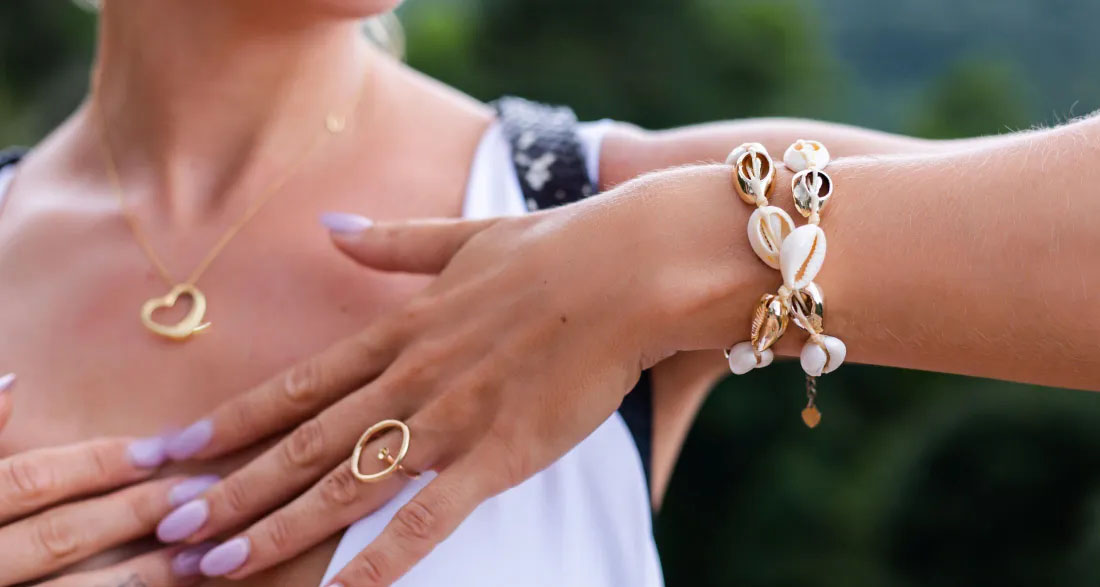
A gold bracelet with a thick band and a single teardrop-shaped stone in the center. Pale blue. The exact shade of Nana’s eyes when she was little and would look up at me and say, “Mom, watch this!”
My hands started shaking.
I picked it up. Put it down. Picked it up again quickly, like someone might snatch it away.
I turned it over.
The engraving was faint but still there, scratched gently into the back of the clasp:
“For Nana, from Mom and Dad.”
My knees almost gave out.
I leaned across the folding table. “Where did you get this? Who sold it to you?!”
The man behind the table barely looked up from his crossword puzzle. “Where did I get what?”
“This bracelet,” I said, my voice breaking. “Where did you get it?”
He sighed and scratched his chin. “Young woman sold it to me this morning. Tall. Slim. Big ol’ mass of curly hair.”
My heart stopped.
That was her.
That was Nana.
He raised an eyebrow at me. “But no more questions. Two hundred dollars. Take it or leave it.”
“Take it or leave it.”
I didn’t even hesitate. I pulled the cash from my purse with trembling fingers and handed him the $200.
I held that bracelet all the way home like it was a lifeline.
For the first time in ten years, I was holding something she had touched.
Recently.
Felix was in the kitchen when I walked in.
He stood with his back to me, pouring the last of the coffee into a chipped mug we’d owned since the year Nana was born.
“You were gone a while, Natalie,” he said, not turning around.
I walked closer, my heart pounding so hard it hurt.
“Felix,” I whispered. “Look at this.”
He finally turned. “What is it?”
“You don’t recognize it?”
His eyes dropped to my palm. The moment he saw it, his jaw tightened.
“Where’d you get that?” he asked sharply.
“At the flea market. A man was selling it. He said a young woman brought it to him this morning. Tall. Slim. Big curly hair.” My voice trembled. “Felix… it’s hers.”
“You bought it?” he asked, almost accusing.
“Yes, I bought it!”
I flipped it over and held the engraving up to his face. “Look. ‘For Nana, from Mom and Dad.’ We had this made for her graduation. She wore it the day she left.”
He stepped back like the bracelet burned him.
“Good lord, Natalie,” he muttered.
“It’s her bracelet!” I cried.
“You don’t know that.”
“Yes, I do! I do know!”
He slammed the coffee mug down so hard it spilled over the rim. “You’re doing this again? I can’t keep going down this road, Natalie.”
“Doing what?”
“Chasing ghosts!” he snapped. “You don’t know where that bracelet’s been. People steal things. They pawn them. Someone probably dug it out of a donation bin.”
“It has the engraving,” I whispered.
“You think that means something? You think that proves she’s alive?”
“It means she touched it. Recently. Isn’t that worth something to you?”
He ran a hand through his hair, frustrated.
“She’s gone,” he said coldly. “You need to let her be gone.”
“But what if she’s not?”
He didn’t answer.
He just walked out of the room, leaving the coffee steaming and the air thick with something ugly and unspoken.
That night, I didn’t eat.
I curled up on the couch with the bracelet pressed against my chest. My mind replayed the last morning I saw her — Nana barefoot in the kitchen, laughing while trying to toast a waffle and tie her curly hair up at the same time.
She couldn’t pronounce Savannah when she was little. She’d say, “I Nana!” and it stuck.
Savannah to the world.
Nana to me.
And she was still mine. Somewhere.
I fell asleep holding that bracelet against the ache I never healed.
The pounding on the door woke me before sunrise.
Too loud. Too urgent.
I was still in my robe when I opened it.
Two police officers stood there. Behind them, three patrol cars lined the curb. Across the street, Mrs. Beck stood on her porch whispering, “That poor woman… ten years.”
“Mrs. Harrison?” the older officer asked gently.
“Yes?”
“I’m Officer Phil. This is Officer Mason. We’re here about a bracelet you purchased yesterday.”
My stomach dropped. “How do you know about that?”
“We need to talk,” he said. “It’s about Nana. Or Savannah, as she was legally named.”
Felix appeared behind me. “What the heck is this?”
“We’d like to come inside,” Officer Phil said calmly.
“You can’t just barge in here,” Felix snapped.
Officer Mason spoke up. “Sir, this relates to an active missing person case. The bracelet matches evidence logged under your daughter’s file. She disappeared on May 17th, ten years ago.”
“That’s not evidence,” Felix said quickly. “It’s junk. Circumstantial.”
“Sir,” Phil interrupted, his voice firm, “we’re going to need you to step outside. It’ll be easier if we speak separately.”
My heart began racing.
“Where is the bracelet?” Phil asked me softly.
I pointed to the table.
Mason picked it up with gloved hands and sealed it in an evidence bag.
“It was documented in the original report,” Phil explained. “Your daughter was confirmed to be wearing it the night she vanished.”
“But how did you know it was me?” I asked.
“That flea market stall has been under surveillance,” Phil said. “Stolen goods. When my officer recognized the bracelet, he called it in. The vendor sold it to you before we could intercept.”
Felix scoffed. “So what?”
“So he remembered her,” Phil replied. “She was the only one asking about the woman who sold it.”
My voice shook. “So… she’s alive?”
Phil looked at me carefully. “It means someone had it recently. That’s all we can confirm right now.”
He sat down and asked questions.
“Did she ever mention wanting to leave?”
“No.”
“Was there tension at home?”
“No. I mean… normal arguments. Nothing serious.”
Then he asked quietly, “Ma’am, did your husband ever tell you Nana came home that night?”
The world tilted.
“What? No. She never came home.”
“There was a tip,” Phil said. “An anonymous caller claimed they saw her enter this house the night she disappeared.”
“That can’t be true,” I whispered.
Outside, I heard Felix yelling.
“You’re harassing my wife!”
Then Officer Mason’s voice cut through the air. “Sir, how did you know the bracelet had been in a pawn shop?”
Silence.
“As far as the file states,” Mason continued, “your daughter was wearing it when she disappeared. No one officially saw her again. So how would you know it ended up being sold?”
I stepped outside, my robe fluttering in the wind.
Felix’s face was pale.
“Natalie, don’t,” he said weakly.
“Don’t what?” I demanded. “Don’t ask questions? Don’t hope?”
“Stop twisting this!”
“I’m twisting nothing,” I said. “You’ve been crushing my hope for ten years.”
The lead detective arrived with a warrant.
Officers searched the garage. His office.
Finally, the detective faced him. “We received a tip years ago that your daughter returned home that night.”
Felix didn’t deny it.
“She did,” he muttered.
My heart stopped.
“She came home,” he said, staring at the ground. “She had her bag. She said she needed to talk to you.”
“She wanted to see me,” I whispered.
“She found the transfers,” he said. “The savings accounts. She figured out I was having an affair. I was sending our money to someone else.”
“And she was going to tell me?” I asked.
He nodded. “She said you deserved to know. She said you should leave me.”
“You threatened her,” I said slowly.
“I told her if she told you, you’d be in danger. I panicked. I didn’t mean it—”
“You made her think she had to disappear to protect me.”
He said nothing.
“She was 23,” I said, my voice shaking. “With her whole life ahead of her.”
Two officers stepped forward and cuffed him.
“We’re bringing you in for obstruction, financial fraud, and intimidation,” the detective said.
As they led him away, Felix whispered, “She said she loved you more than anything. That’s why she left.”
The next morning, I packed a bag.
My sister’s guest room was ready.
I left everything behind — except the bracelet.
Before I closed the door for the last time, I called Nana’s number again.
Voicemail.
“Hi baby,” I said softly. “It’s Mom. I never stopped looking. You were right to run if you felt scared. But I know the truth now. And if you’re out there… you don’t have to run anymore.”
My husband buried the truth for ten years.
Now it’s my turn to dig my daughter back out of it.
And this time, I won’t stop.