

On the edge of selling my late grandfather’s diner, I never expected one last meal to change everything.
But that’s exactly what happened when a quiet old man with a tiny, scruffy dog walked through the door—and the note he left taped to the glass the next morning made me question everything I thought I’d lost, and what was still worth holding on to.
If someone looked at my life on paper, it would read like a list of losses.
I wake up at 4:30 a.m. every morning in a house that echoes too loudly, the wrong way. It’s too big for just me, too important to sell, and too heavy with memories. The third bedroom down the hall still smells like strawberry shampoo, like a little girl’s laughter hangs in the air, frozen in time.
My daughter isn’t coming back. Eliza never will.
And my husband? He used to leave the hall light on, just in case she came home. After the accident, he stopped opening that bedroom door. Then he stopped coming home at all. Grief hollowed us out until we were strangers, sharing the same space without really being in it.
One afternoon, he left a note on the kitchen table next to the salt shaker and a half-finished grocery list. Divorce papers tucked beneath it, already signed.
So yes—my daughter is gone. My husband is gone.
And the only thing I had left was a diner.
The diner wasn’t cute or charming. It was small in the way that made your knees pop when you slid into a booth, the seat cushions hissing like they were sighing.
The floor creaked no matter how many times I scrubbed it. There was a burn mark in the linoleum where my grandfather had dropped a tray of fried chicken and tried to pretend it had always been there.
The coffee tasted like memory—strong, bitter, comforting. And it was mine.
Grandpa Henry had opened the place when the neighborhood smelled of baking bread and motor oil, when neighbors knew each other’s names, and you could yell across the street to call your kids in for dinner. He’d stand behind the counter in a stained apron and grin at me.
“We don’t just feed people’s stomachs, kiddo,” he’d say. “We feed their hearts.”
Then he’d slap a plate of pancakes onto the counter like he was dealing cards at a casino.
When he died, I stood alone in that empty diner for hours before deciding to buy it myself. It felt like madness, but also like love.
“I don’t know if this is smart,” I told my best friend Susan while filling out the paperwork.
“You’re keeping your roots in the ground, Laura,” she said, half-smiling. “That counts for something.”
And for a while, it did.
Then came the condos, the chain coffee shops, the $15 avocado toast. Bills didn’t care whose name was on the deed—they just needed to be paid.
Rent went up, eggs got more expensive, the power company sent warnings in bold red letters. I maxed out credit cards, skipped my own meals, and cleaned the kitchen myself because I couldn’t afford staff anymore.
I was drowning. And finally, I called a broker. Maybe love wasn’t enough to keep the roof over my head.
The night it happened, bitter cold settled into the city like it wanted to stay. It wasn’t just cold on the skin—it got into your bones. Outside, everyone moved fast, heads down, coats zipped tight, rushing from one heated space to another.
But inside my diner, everything was dead quiet. The neon “OPEN” sign buzzed, tired and pink over empty booths, trying to convince itself that life still lingered here.
“Laura, what are we going to do?” I whispered to no one. “We cannot sustain this place anymore…”
I sat at the counter, pretending to take inventory, scribbling numbers that meant nothing, just to feel useful. The heat groaned behind me.
And then—the bell rang.
A simple sound, cheerful even, and my heart leapt like I’d been caught doing something I shouldn’t. I hoped it was the buyer. But no.
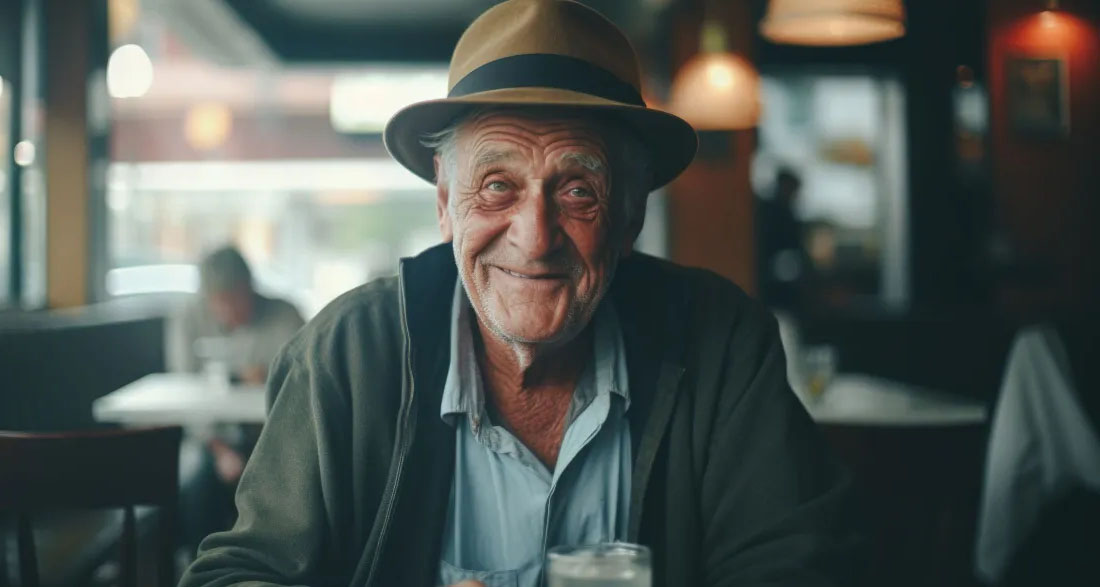
An old man stood in the doorway, unsure, leaning on a cane and gripping the doorframe like it was a lifeline.
His coat hung off his thin frame, sleeves too long, one pant leg pinned oddly. And beside him, trotting nervously, was the tiniest dog I’d ever seen—mismatched fur, oversized ears, like a child’s stuffed animal come to life.
“Evening, ma’am,” he said softly. “What’s the cheapest thing on the menu?”
I saw him counting in his head, and my grandfather’s voice whispered in my mind: We feed people, kiddo. Not empty wallets.
I stepped out from behind the counter.
“Why don’t you sit down?” I said. “I’ll fix you something good, I promise.”
“I don’t want charity,” he said, eyes darting. “I’ve got a little. I can pay something.”
“It’s not charity,” I said, wiping my hands on my apron. “You can pay me by keeping me company. It’s been a slow day.”
He hesitated, then nodded, a flicker of pride crossing his face.
“Thank you,” he said softly. “Pickles and I just wanted a place to rest…”
I cooked like I used to when Eliza was alive, like the meal mattered. Meatloaf with extra onions, ketchup glaze on top, hand-whipped mashed potatoes, sautéed green beans with garlic, warm bread with butter. I set aside a little plate for Pickles, the dog.
When I brought everything out, the dog looked at me like I’d performed magic.
“For me?” the man’s voice caught.
“For you,” I said. “And this is for him.”
Pickles devoured it, like heaven on a plate.
We talked—well, I talked. I told him about losing my daughter, about my husband leaving, about gripping Grandpa’s chipped coffee mug and whispering into the air for guidance. He didn’t interrupt or give advice. He just nodded and said,
“That must have hurt.”
Eventually, he stood, pulled out a few wrinkled bills, and shook his head.
“No,” I said. “You paid already. Your company was more than enough.”
He paused, searching my eyes.
“Thank you, sweetheart. For the food… for allowing Pickles inside. And… for seeing me.”
And then, he left. The bell jingled once behind them, and I thought that was the end.
That night, locking the diner felt heavier than usual. My key scraped against the lock like it didn’t want to turn. I stood there for a moment, coat pulled tight, watching my breath curl in the cold, empty street.
At home, I left the lights off. The layout hadn’t changed in twenty years. I dropped my keys in the bowl and went straight to the bathroom. The water took forever to warm. When it finally did, I stepped under the hot stream and sobbed—really sobbed—for the first time since Eliza’s funeral.
“Gramps, help me,” I whispered, letting the water carry my tears.
Eventually, I wrapped myself in a towel and padded to Eliza’s room. Everything was the same. I curled on her bed, whispering,
“Please… I just need one good thing.”
The next morning, streets dark and heavy with the threat of snow, I approached the diner, thinking about Pickles. I reached for the keys—and then stopped.
Taped to the glass was a white envelope, corners curled from the weather. My name was written on it. On the back, in unsteady handwriting:
“From Henry.”
My heart froze. Grandpa’s name.
Inside, a $10 bill and a letter:
“Dear Laura,
I hope you don’t mind me writing. My name is Henry…”
I hadn’t asked his name the night before. And now, reading it in his own hand, I realized I had missed something important.
He wrote about everything—the factory accident that took his leg, the cancer that took his wife Marie, the addiction that took his son. He wrote about the loneliness that stole the rest. And then he wrote about me:
“You reminded me that I still matter, darling. Not as a burden, but as a person. Please don’t stop being who you are. You filled two plates and two hearts. That is no small thing.”
I taped the letter to the register.
When the broker called later, I answered.
“Arum,” I said. “I’m not ready to sell. I think I’m supposed to stay. I’ll sell my wedding jewelry. I’ll make it work.”
And I did.
“I’m not ready to sell. I think I’m supposed to stay.”
Because sometimes, one unexpected meal, one quiet old man, and one tiny dog can remind you of what really matters—and that love, sometimes, is enough to hold everything up.