

I’m a single mom, 50 years old, just trying to keep the lights on and give my son a shot at a better life. Most days, I trade sleep and pride for paychecks that barely stretch far enough.
Last week, something happened that still leaves me shaking my head. I still can’t decide if it was the kindest moment I’ve ever lived—or the cruelest trick life has played on me.
I work nights. Brutal, soul-draining nights. The kind where your legs ache, your uniform smells like bleach, and you wonder if your heart can handle another 16-hour shift.
My teenage son is smarter than I ever was. It’s just us and Tim, our old cat, in a cramped one-bedroom apartment that always smells faintly of old spaghetti and litter.
He doesn’t complain—not about the space, not about the hand-me-down furniture, not even about the fact that I’m never really awake when I’m home.
But I see it in his eyes sometimes—the worry that I’m breaking myself just to keep us afloat.
That morning, I was walking home after one of those shifts. The cold stabbed at my face, and holiday lights blinked overhead like they were mocking me. That’s when I saw her.
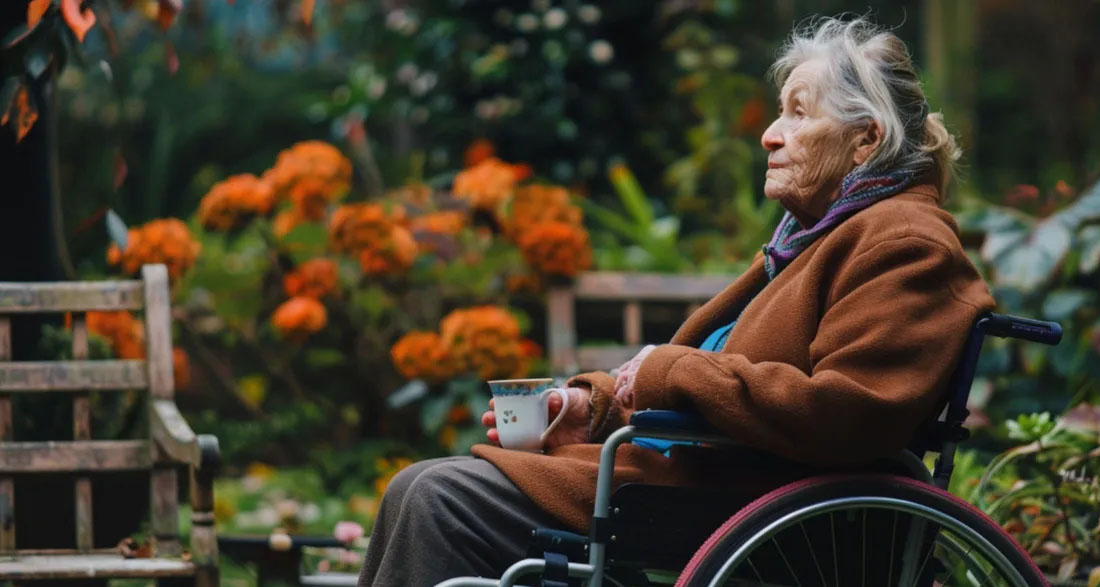
She was a skinny, frail old woman, maybe 80, slumped in a beat-up wheelchair. No coat worth mentioning. Just a thin jacket, worn gloves, and a blanket that looked like it had lost its warmth decades ago.
Her hands shook, her cheeks were dull and gray. She had that look people get when nobody has seen them for a while, when the world has moved on without them.
She looked at me softly and said, “I just need something to eat, sweetheart. Doesn’t have to be much.”
Nobody stopped. People rushed past her like she wasn’t even there. One man in a business suit stepped around her wheelchair as if she were trash. A woman with shopping bags glanced at her, then quickly looked away, like poverty was contagious.
I’d been invisible like that before.
I’m not a hero. I live paycheck to paycheck. Sometimes not even that. Rent eats half my soul, groceries are a daily juggling act, and Christmas? It’s usually a cruel joke. I hadn’t even figured out a gift for my son this year.
But I couldn’t walk away.
There was something about her—about the quiet way she existed in a world that ignored her—that cracked something open in me. I didn’t think about my bills, my empty bank account, or the little hope I had left for Christmas.
I bought her a warm meal from a corner café and wheeled her to sit with me under one of those fake outdoor heaters, pretending warmth.
Between bites, she told me small things about herself.
She had no family, no visitors. Just winters that kept getting colder. Her name was Margaret, or maybe Martha—I was so exhausted I couldn’t even catch it. But I remember how she ate—slowly, carefully, like every bite mattered. Like she hadn’t tasted warmth in years.
At one point, she reached across the table and patted my hand. Her eyes met mine. “You’re tired,” she said softly. “You carry too much.”
I blinked back tears. Nobody had ever said that to me. Nobody had looked past my uniform, past my exhaustion, to see the person barely holding herself together underneath.
I tried to laugh. “We all carry something, right?”
She squeezed my hand gently. “Some carry more than their share.”
Before I left, I did something I’ll never forget. I reached into my bag and pulled out my last $100. That was it. No backup, nothing for groceries, nothing for heat, maybe not even a gift for my son. But in that moment, keeping it felt wrong.
I placed it in her hand. She looked at it like it was glowing.
“Thank you,” she whispered. And for just a second, her whole body softened.
I walked away thinking, Okay, that was a good thing. That’s it.
But the next morning… everything changed.
Snow dusted the sidewalks like powdered sugar. I passed the metro station, expecting nothing, and then I saw it—a sleek, black car parked where yesterday she had sat. Tinted windows, shiny, massive, the kind of car you only see in movies.
The back door opened, and there she was. But this wasn’t the frail, cold woman from yesterday. She sat upright, her coat warm and expensive, her gray hair perfectly curled. She waved at me like we were old friends.
“Sweetheart,” she called. “Come here.”
I froze. “You’re… okay?”
She smiled. “More than okay. Get in.”
I hesitated. “Wait… what’s going on? You were… poor yesterday.”
She laughed softly. “You passed.”
I blinked. “Passed what?”
“I’ve been running a little test,” she said calmly. “Sitting at that station, watching people. Seeing who stops, who pretends not to see me, who walks past.”
My stomach dropped.
“People ignored me. Some told me to get a job. One teenager took a photo and laughed. But you… you fed me. You gave me money. You listened.”
“And?” I asked slowly.
“And… I’d like to offer you a position. Caretaker. Full salary. Housing stipend. Health benefits. A Christmas bonus.”
I couldn’t breathe.
“So you weren’t hungry? You weren’t cold? You weren’t alone? You aren’t… poor?”
“I was testing integrity,” she said with a shrug. “I have more money than I’ll ever need. What I don’t have is trust. I needed someone who wasn’t trying to impress a rich old woman.”
I shook my head. “Lady, that was my last hundred bucks! MY LAST! I gave it because you looked like you needed it—not because I wanted a job.”
She studied me like I was a puzzle. “Kindness shouldn’t be conditional on whether someone deserves it, dear.”
That snapped something inside me. “You played dress-up with suffering,” I said, my voice shaking. “You wore it like a costume.”
“This world has grown selfish,” she replied. “I needed to know who still cared.”
“Then volunteer,” I said, voice firm. “Don’t turn the sidewalk into your stage.”
She paused. “Are you refusing the job?”
I said yes.
I got out of the car, closed the door, and walked away. Not because I didn’t need the money—I needed it more than air—but because my kindness was mine. I wouldn’t let someone else claim it as an experiment.
Two days later, an envelope arrived in my mailbox. No return address. Just my name, neatly written.
Inside, a letter:
Dear friend,
Our conversation has stayed with me. I still believe in what I was trying to do, but I underestimated what $100 means to someone like you.
I used my influence to find you. I apologize for the intrusion, but I needed to make this right.
You reminded me that generosity isn’t performance. It’s a risk.
Merry Christmas.
Taped to the bottom were ten crisp $100 bills.
I sat on my kitchen floor and cried like I hadn’t in months—not because I liked her, not because I understood her—but because somehow the universe had looked at me and said, I saw what you did. It mattered.
I bought my son a gift that felt real. I donated the rest to the shelter down the street, because not everyone pretending to need help is pretending.
I still wonder every time I see someone alone on the sidewalk: Is this a test?
But that’s not the point. The point is who I am when nobody’s watching. Even if someone is.
Kindness isn’t something you perform for an audience. It’s something you do when it costs you. When it hurts. When you’re not sure you can afford it, but you give it anyway. That’s the only kind that matters.