

I was walking home from work one evening, my mind tangled in thoughts of bills, deadlines, and everything I needed to do that night.
The streets were quiet, and the chill of early spring made me pull my coat tighter around me. I turned the corner onto the town square street, and suddenly, a sound stopped me dead in my tracks.
It was a melody I knew as well as I knew my own heartbeat. A song I had made up for my daughter Lily, years ago, when she was little—before she vanished from our lives 17 years ago.
I remembered it perfectly: a tiny lullaby about sunlight dancing over fields of flowers, a song meant to chase away nightmares and fill her dreams with warmth. I never shared it with anyone else. No one else would know it.
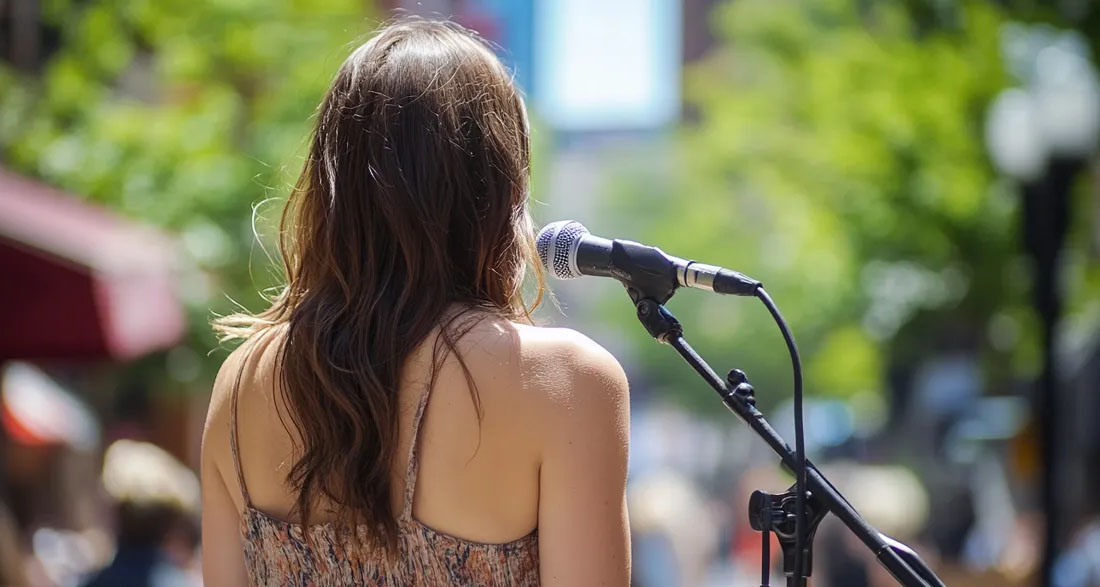
But here it was, floating through the air, sung by a young woman standing across the square. Her eyes were closed, her lips curved in a serene smile, completely lost in the music.
The song pulled memories from the depths of my heart. I could see Lily in my mind’s eye, laughing, twirling around the living room, her tiny hands clapping along to my voice. She had been the center of our world, and her sudden disappearance left a hole in our hearts that never healed.
My legs moved forward almost on their own. My mind screamed that it couldn’t be true—that this was impossible—but my heart ignored it.
The woman had dark hair that fell in soft waves around her face. There was something painfully familiar about her. Her smile—it was like a photograph I’d kept hidden in my wallet for years. A dimple on her left cheek reminded me of my wife, Cynthia.
Could this really be Lily?
As I drew closer, she finished the song and opened her eyes. The applause of the small crowd surrounded us, but my world narrowed down to her. She noticed me staring but quickly looked away, smiling at the people around her.
“Thank you all for listening! Have a great day!” she called cheerfully.
Then her eyes met mine again, and she froze for a moment, sensing the odd expression on my face.
“Looks like you didn’t like my performance,” she said, stepping closer. “Was I that bad?”
“Oh, no, no,” I stammered, trying to steady my voice. “I… that song… it’s special to me. Very special.”
“Really?” she asked, tilting her head. “It’s super special to me too. It’s one of the few memories I have from my childhood. I’ve been singing it ever since I can remember. It’s the only thing I have left from back then.”
She looked like she might leave, but I couldn’t let her. “What do you mean by that?” I asked, my voice tight.
She glanced at her watch, hesitated, and then said, “It’s a long story… maybe some other time.”
“Please,” I urged, my heart hammering. “I want to hear it. I’ll buy you a coffee, and we can talk if you don’t mind.”
She studied me for a moment, then nodded. “Well… sure, why not?”
We walked together to a nearby café and slid into a corner booth. Every detail about her—her eyes, her smile, even the way she held her hands—felt like a missing piece of home.
“You have a beautiful voice,” I said quietly, trying not to shake too much.
“Thank you,” she replied with a gentle smile. “I was just passing through town for work when I heard that band playing. They asked if anyone wanted to sing, and I… I just had to.”
“That song… where did you learn it?” I asked, my throat tight.
She sighed, staring at her coffee. “I didn’t exactly ‘learn’ it. It’s the only thing I remember from my childhood. I used to sing it, hum it… all the time. My adoptive parents said it was like my own little anthem.”
“Adoptive parents?” I asked, barely keeping my voice steady.
She nodded. “Yeah. I was taken in when I was five. They told me my real parents had died in a car accident. They even showed me newspaper clippings.” Her eyes softened, glistening with unshed tears.
“They were kind, gave me toys, and treated me well. But I always missed my real parents. Over time, I started to believe my adoptive parents were my only family. But deep down, I felt like something was missing. I always had a nagging feeling that maybe they weren’t telling me the whole truth.”
My hands shook in my lap.
“And… did you ever find out?” I asked carefully.
“I tried,” she said. “When I got older, my adoptive parents tried to make it official. They wanted to legally adopt me.
They asked if I wanted to stay, and I said yes. But when I turned 18, I started questioning everything. I tried to find my real parents, but the information I had wasn’t enough. Records didn’t match any missing children. I had so few details to go on.”
She paused, looking down at her hands. “Now all I have is this song. It’s the only thing that reminds me of them.”
The pieces were starting to fall into place in my mind.
I took a deep breath. “Do you remember anything else? Anything about your real parents? Besides this song?”
She laughed nervously. “It’s all blurry. But I remember being happy… before everything changed. I think my name was… Lily? Maybe. But I’m not sure. My adoptive parents called me Suzy, and that’s all I responded to after a while.”
My heart skipped a beat. “M-my daughter… her name was Lily too.”
Her head shot up, eyes wide. “Are you serious?”
I nodded, tears threatening to spill. “She went missing when she was five. That was 17 years ago. We never found any answers, but we never stopped hoping. My wife’s name is Cynthia.”
Her lips trembled. “My… my mom’s name was Cynthia too,” she whispered. “I remember it because she made me say her name and my father’s name all the time. Are you… John?”
“Yes,” I said, taking her hand. “I’m John.”
We sat in stunned silence, just looking at each other. And then the dam broke. Tears streamed down our faces, and we clung to each other, years of longing, confusion, and grief flooding over us in waves.
“Dad?” she whispered, her voice shaking.
“Yes, Lily,” I managed. “It’s me… it’s us.”
After a few minutes, I asked her if she wanted to meet her mother. Her nod was hesitant but eager. My hands shook as I called a taxi, feeling like the world was unreal.
During the ride home, we were quiet. I kept staring at her, trying to take in every detail, every feature that mirrored the little girl I had lost.
When we arrived, I asked her to wait by the door. I knew Cynthia would need a moment to process this miracle. But she didn’t wait long to notice something had changed.
“What happened? Are you alright?” Cynthia asked, concern and fear in her voice.
I touched her shoulders. “Cynthia, there’s something I need to tell you.”
Then I told her everything—the song, the chance meeting, the memories, the truth.
“Oh God… oh God,” she cried, tears streaming down her face. “No… no. It can’t be. That’s impossible, John!”
I held her hands firmly. “It’s true, Cynthia. Our Lily’s back.”
“Where is she? Where’s our Lily?”
“She’s here, behind the door,” I said, tears blurring my vision.
Cynthia bolted from the chair and flung open the door. There she stood—our little girl, grown now, hesitant and wide-eyed.
“Mom?” Lily asked softly.
“Oh my God… my baby,” Cynthia sobbed, gathering her into her arms.
They clung together, crying, holding onto years of lost time. I watched them, my chest swelling with a joy I hadn’t thought I’d ever feel again.
We sat together, sharing stories of the years we missed. Lily told us about her life, her struggles, and how that song had kept her connected to a past she barely remembered. We told her how much we had waited, hoped, and loved her all these years.
Finally, Cynthia asked softly, “Lily… would you be willing to confirm it… with a DNA test?”
Lily smiled, a gentle, knowing smile. “I understand, Mom. I’d like that too.”
A week later, the test confirmed what our hearts already knew. Lily was ours. We were hers.
Our home, once silent and heavy, now overflowed with laughter, tears, and stories. Each day felt like a small miracle.
I’ll never forget that ordinary evening, walking home from work, when a little lullaby brought back what we had thought lost forever—a family reunited, against all odds.