

I’m the maintenance guy everyone in this fancy gated community pretends not to see. Most days I sweep their sidewalks, unclog drains, and sleep in a tiny storage room, listening to whispers and rumors about what a “dangerous” man I am—until one freezing morning, everything changed.
My name’s Harold. I’m 56. I’m the maintenance guy at Ridgeview Estates. I also live here—not in a house, of course, but in a storage room behind the maintenance office.
Metal door. One thin cot. A hot plate I’m not supposed to have. Mop buckets on one side, my boots on the other. Stretch my arms, I can almost touch both walls. It’s not the life I imagined at 56.
I used to have a small house. A wife who snored when she was extra tired. A daughter who insisted on wearing glitter shoes with everything, no matter the occasion.
Then, one winter night, black ice and a drunk driver stole them both. My world cracked. I woke up in a hospital bed with broken ribs and a doctor who couldn’t look me in the eye. After that, I faded out of my own life. Jobs slipped away. Apartments slipped away. I moved quietly. Spoke less. It felt easier if no one noticed me.
Ridgeview Estates hired me five years ago when I was out of options.
“The pay’s not great,” the manager said, “but it’s steady. You can crash in the storage room if you need.”
I needed it. So now I sweep sidewalks and unclog drains for people whose cars cost more than I’ve made in ten years. Most of them don’t see me. They walk by, glued to their phones or lost in headphones.
When they do notice, it’s rarely kind.
“You missed a spot,” one will say.
“There’s a smudge on my window,” another complains.
“Hey, can you not blow leaves near my Tesla?”
Some are worse. One man once told his kid, loud enough for me to hear:
“Don’t stare at him. Just ignore it and keep walking.”
Like I was a stray dog. And then there are the rumors.
“He’s weird.”
“He never talks.”
“I heard he went to prison.”
“Don’t let your kids near that guy.”
For the record, I’ve never been to prison. I’m just… quiet. Grief does that.
I keep my head down. I work. I sleep. I refill the bird feeder behind the maintenance shed. I don’t expect kindness.
Then came that morning.
It was cold, just after sunrise. Frost on the grass. The air so sharp it burned my lungs. I was doing my first sweep of the walking path, broom in hand, checking for fallen branches and trash.
A storm had gone through the night before, leaving sticks and debris scattered everywhere. There’s a stretch along the “natural landscaping”—trees and bushes planted to look wild. That’s where I saw him.
I bent to move a big branch and heard it: a tiny sound, like someone’s breath catching. I froze. Then again—a soft, shaky whimper.
“Hello?” I called, straightening. “Anyone there?”
Nothing. Just the wind.
Then from the bushes to my right, another tiny sound. Closer this time.
“Anyone there?”
I walked toward the shrubs, heart thumping.
“Hey,” I said, trying to sound calm. “If you’re hurt, I can help, okay?”
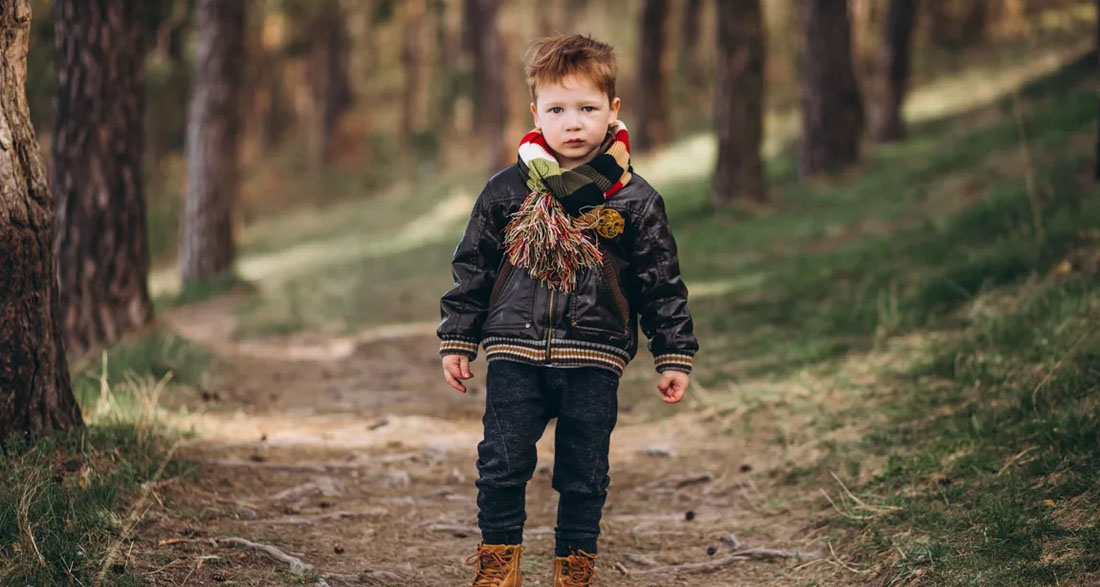
Branches rustled. I pushed them aside. And there he was—a little boy, maybe four or five. Bare feet. Thin pajama pants soaked from dew. Jacket unzipped. Hair plastered to his forehead. Shivering so hard he looked like he might break in two. Cheeks streaked with dried tears.
His eyes were wide but unfocused. Sliding past me like I was too bright to look at. He wasn’t yelling. Just making tiny, broken sounds like crying hurt too much.
My stomach dropped. I’d seen that look before. My daughter was autistic. When she got overwhelmed, she’d shut down. Hands over ears, trying to make the world smaller. I hadn’t seen that expression in years.
I dropped to one knee but stayed back. I didn’t want to scare him.
“Hey, buddy. You’re okay. I’m not gonna hurt you.”
He flinched and clamped his hands over his ears.
“Too loud, huh?” I murmured. “Alright. We’ll do this slowly.”
I sat down in the cold dirt, leaving space. Took off my heavy jacket and slid it closer, not onto him.
“You look cold. This jacket’s warmer than those pajamas. You can grab it if you want. No rush.”
He rocked slightly, eyes darting.
“Can we try breathing?” I asked. “In… and out… slowly.”
I exaggerated a breath—loud inhale, loud exhale. Repeated.
After a moment, I saw his chest trying to follow mine. Shaky, but moving.
“That’s it. You’re doing great, kiddo.”
Slowly, he lowered one hand, then the other. He eyed the jacket. Fingers crept forward, grabbed the sleeve, pulled it over his shoulders, burying his face in the collar. That tiny trust hit me harder than any insult I’d heard in years.
“You’re safe,” I said. “I’ve got you.”
I called the gatehouse, then 911.
“Found a little boy on the walking path. Maybe five. Cold, not talking. I’m with him.”
Dispatch told me to keep him warm and stay put. So we sat in the bushes. My butt frozen, knees screaming, small kid breathing in my jacket. He scooted closer, reached out two fingers to touch my sleeve. Just rested them there.
“My name’s Harold,” I murmured. “You don’t have to talk. I’ll do the talking ’til your mom gets here.”
Sirens got closer. Security arrived, then paramedics. They wrapped him in a foil blanket, checked him over, and took my statement.
“Gate on the east side sticks sometimes,” I told them. “He probably wandered out.”
One paramedic nodded. “His name’s Micah. Mom’s at home freaking out.”
Right before they shut the ambulance doors, he twisted to look at me. I raised my hand. His tiny fingers reached up to tap my sleeve once more. Then they were gone.
By noon, I knew the basics: Micah, five, mostly nonverbal, slipped out while his mom thought he was still in his room. The gate was half-open. I went back to sprinklers and unclogging leaves.
I finished my shift. Ate a can of soup in my storage room. Laid down on my cot.
Then, pounding on my metal door.
“OPEN UP!” a woman screamed. “I KNOW YOU’RE IN THERE!”
I shot up. Nearly fell off the cot.
The banging kept coming. Fist on steel. Over and over.
“Hold on! I’m coming!” I shouted.
The door flew inward. A woman—sweatshirt, leggings, messy bun, tear-blotched face—stood there. Elena. Micah’s mom.
“You,” she snapped, jabbing a finger, “what did you do to my son?”
“My—Micah? He’s home, isn’t he? The paramedics said—”
“Don’t lie to me!” she shouted. “My neighbors told me everything about you. They said you’re unstable. That you’ve been in prison. That you creep around at night. I know what you’re hiding!”
I felt sick. “I—that’s not—”
“And the police tell me my son was found near your route?” she went on. “Near you? What am I supposed to think? That you tried to kidnap him?”
Tears spilled down her cheeks.
Old me would’ve ducked my head. Apologized just for existing. But something held me. I raised my hands slowly.
“Ma’am, I understand you’re scared. But I didn’t hurt him. I would never hurt any child. I found him.”
“You expect me to just believe that?”
“I found him in the bushes. Cold. Barefoot. Soaked. He wasn’t talking. Just making tiny sounds.” I breathed. “I sat down, gave him my jacket, called for help, and waited. That’s it.”
She stared at me. Trying to see through me.
“My neighbors said you’re an unknown quantity,” she whispered, voice softening. “But… you found him.”
“I know what losing a family feels like,” I said quietly. “I wouldn’t wish that on anyone.”
Her shoulders slumped.
“My daughter was autistic,” I added. “When she shut down, she looked like Micah. Same hands over ears, same breathing. I knew he wasn’t being ‘bad.’ He was overwhelmed.”
She blinked. Took a deep breath. “I would never take someone’s kid,” I said. “But I get why you’d think that.”
“Oh God,” she whispered. “What have I done?”
“I came here ready to— I don’t even know,” she said. “And all you did was help him.”
She wiped her face, ashamed but calmer.
“It’s alright. Fear makes people jump to bad places,” I said.
“It’s not alright,” she said. “You kept my son safe. I screamed in your face.”
I nodded. “He grabbed my sleeve. Held on until the paramedics took him.”
She looked into the storage room—cot, tiny heater, photo of my wife and daughter.
“You live here?” she asked softly.
“Yeah. Cheapest spot in Ridgeview.”
“That’s not funny,” she muttered. “And it’s not right either.”
“You want me around your kid, after all that?”
“Yes. You’re the man who sat in the dirt and kept my son safe.”
I had to look away. “I’d like that,” I whispered.
She smiled. Tired but real. Held out her hand.
“I know who you are,” she said.
“I’m Elena,” she said, like we hadn’t already yelled at each other.
“Harold,” I said, shaking it. “Nice to properly meet you.”
Now, a couple of months later, I walk the path near their house a few evenings a week. Micah’s often on the porch, rocking. When he spots me, he trots down and stops in front of me.
He doesn’t say my name. Just taps my sleeve with two fingers.
“Hey, buddy,” I say. “You ready?”
We walk slowly. Leaves crunch. Sometimes he bumps me on purpose. Sometimes he holds my sleeve for three steps, then lets go.
Elena walks with us, talks about therapies, schedules, meltdown days. Sometimes she asks about my daughter and listens when my voice gets rough.
One afternoon she said, “People still gossip about you, you know.”
“I figured.”
“I correct them,” she added. “Every time.”
Micah reached for my hand. Not just sleeve. Hand. Small fingers wrapped around two of mine.
I said nothing. Just kept walking.
For years, I was invisible. The shadow. The rumor.
Now, to one little boy and his mom, I’m something else.
For the first time in a long, long time, I don’t feel invisible.