

I’ve been a cop for more than ten years, and most night calls melt together in my memory. Faces blur. Streets blur. Fear repeats itself in different shapes.
But one 3 a.m. “suspicious person” call didn’t blur at all.
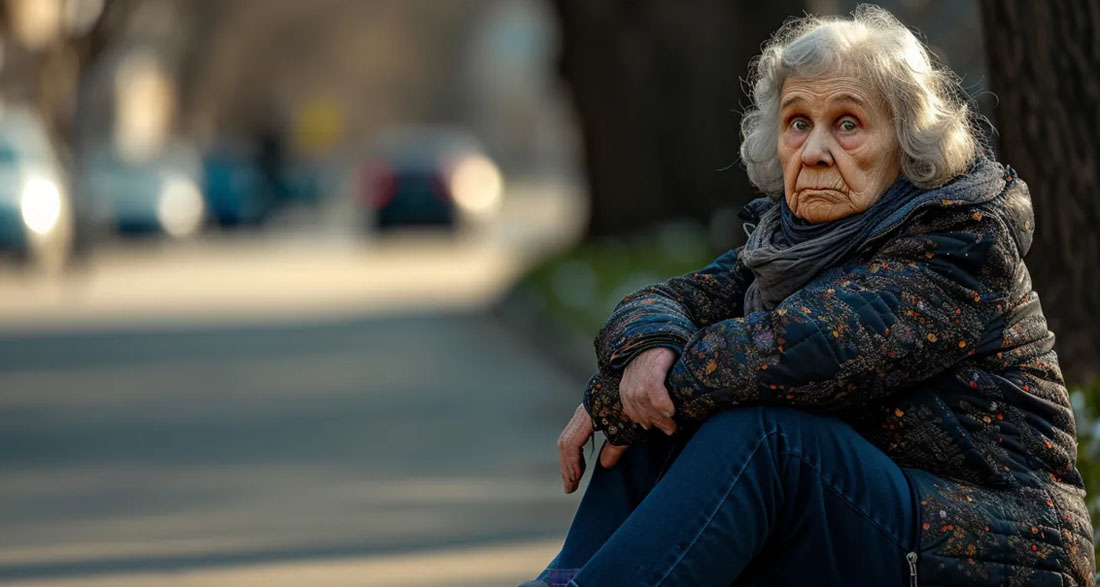
It started with an old woman standing under a flickering streetlamp in a thin nightgown.
It ended with me questioning everything I thought I knew about who I was and where I came from.
I was adopted when I was young. For most of my life, that fact sat quietly in the background, like an old chair you never move but always know is there.
I didn’t really remember my biological parents. Not clearly. Just broken pieces.
A woman humming softly.
The smell of cigarette smoke.
A door slamming hard enough to shake the walls.
Before I was adopted, life was chaos. Foster homes. Different last names. Trash bags used as suitcases. Rules that changed the moment I thought I understood them.
Then, when I was eight years old, something rare happened.
A couple adopted me and did the impossible thing—they loved me like I was theirs, without ever making me feel like I was charity.
My adoptive dad, Mark, taught me how to shave, how to change a tire, how to look a man in the eye when shaking his hand. My adoptive mom, Lisa, came to every school play, even when my role was literally “Tree Number Three” standing in the background.
I grew up safe. I grew up fed.
For a kid like me, that meant I grew up lucky.
But the paperwork around my adoption was always a disaster.
Sealed records. Missing pages. Notes that said things like “case transferred” and “agency dissolved.” When I turned eighteen and started asking questions, I got polite shrugs. When I pushed harder—writing letters, showing up in person—I hit walls.
That was part of why I became a cop.
Sure, I wanted to serve and protect. But there was something deeper. Somewhere in my story, someone hadn’t shown up for me.
I wanted to be the guy who did.
At forty-four, with thirteen years on the job, I thought I had seen everything night shift could throw at me.
I was wrong.
At 3:08 a.m., dispatch sent me to a quiet neighborhood. A “suspicious person” wandering around. Residents were nervous. Cameras were probably rolling. Everyone already assumed the worst.
I rolled up expecting a thief. Maybe someone drunk. Maybe someone high.
Instead, under a buzzing streetlamp, I saw an old woman barefoot in a thin cotton nightgown. She was shivering so hard her knees kept nearly giving out.
The moment my cruiser lights hit her, she flinched like I had struck her.
She looked straight at me—right through me—and whispered,
“Please don’t take me. I didn’t mean to.”
That wasn’t simple confusion.
Her hands were ice cold when I took them.
So I did something that might have looked wrong on paper but felt right deep in my bones.
I shut off the strobes. I stepped away from the car. I sat down on the curb so I wouldn’t tower over her. I took off my jacket and wrapped it around her shoulders.
She clutched my sleeve like it was the only solid thing left in the world.
“I can’t find my home,” she cried. “It was right here. They took it.”
Time was scrambled in her head. But the emotion wasn’t.
The emotion was sharp. Real. Painful.
I spoke softly. Slowly. I didn’t rush her into the back seat. I just sat with her.
She talked about a house that might have existed fifty years ago. About a husband who was “working late.” About a baby she “couldn’t keep safe.”
Over and over, she whispered one name like a prayer and a wound at the same time.
“Mom… Cal… Cal… I’m sorry, Cal…”
My name wasn’t Cal.
Paramedics were already on the way, so I called the number engraved on her medical bracelet. Her name was Evelyn.
When her daughter arrived—Tara, late forties, hair wild, eyes swollen with panic—she ran toward us shouting,
“Mom!”
Evelyn’s eyes filled with tears.
“I lost him again,” she whispered. “I lost Cal again.”
Tara knelt beside her.
“No, Mom. You’re okay. You’re safe.”
She looked up at me, tears spilling over.
“Thank you,” she said. “I thought she was gone.”
I tried to lighten the moment.
“As an adopted kid, I know what it’s like to get lost in unfamiliar neighborhoods,” I said with a weak smile. “If you need anything, call me.”
As they helped Evelyn toward the ambulance, she turned back toward me. For one clear second, the fog lifted.
“Don’t leave him,” she said. “Not again.”
Then she drifted away again.
I went home after my shift ended. I showered. I sat fully dressed on my couch and stared at the wall.
Something told me this wasn’t over.
At 10:17 a.m., there was a hard knock on my door.
Tara stood there holding a shoebox. Her eyes were red like she hadn’t slept.
“This is going to sound insane,” she said.
She came inside and set the box on my kitchen table.
“My mom kept asking for you all morning. She kept saying ‘Cal.’ And then I found this.”
Inside was a thin folder with official state letterhead.
A hospital intake sheet.
My birth year.
1988.
Mother: Evelyn B.
Male infant.
First name: Caleb.
There were yellowed envelopes too, addressed in looping handwriting:
To: Caleb B.
From: Evelyn B.
Most were stamped RETURN TO SENDER. Some were never mailed.
“My mom had a son before me,” Tara said quietly. “Nobody ever talked about him.”
She swallowed hard.
“I got these files by mistake. The state messed up. Again.”
She met my eyes.
“I’m not saying you’re him. That would be insane. But you’re the right age. She called you ‘Cal’ before you gave your name. And these records—something feels crossed.”
I did what any semi-functional adult would do.
I denied it.
“It’s a coincidence,” I said. “Wrong file. Wrong guy.”
She nodded, but left the box anyway.
After she left, I called Lisa.
“Who is my real mom?” I asked.
There was a pause.
“We were told you didn’t have anyone,” she said softly.
Mark took the phone.
“Whatever this is,” he said, “you’re still our son.”
We ordered DNA tests.
Waiting was torture.
Then Tara texted: “It’s back.”
We met at a park. She handed me her phone.
The report listed one name under “Close Family”:
Tara B. – Sister.
She covered her mouth and cried.
“So it’s true,” she whispered. “You’re Caleb.”
We went to Evelyn’s house.
She sat in a recliner, wrapped in a blanket.
Tara knelt beside her.
“Mom… remember the name you kept saying? Cal?”
Evelyn looked at me.
Her face folded, and tears poured out.
“Caleb?” she whispered.
I took her hand.
“I’m here,” I said. “I’m right here.”
“I tried,” she sobbed. “They said you were safe.”
“I know,” I told her. “It wasn’t you. It was the system.”
She started humming.
The same melody I’d carried my whole life.
Life didn’t magically fix itself.
Some days she knew me. Some days she didn’t.
But the guilt softened. The fear had a face now.
Tara and I learned how to be siblings as adults. Awkward coffee dates. Late-night texts. Shared history that should have existed but didn’t.
Months later, another “suspicious person” call came in.
I shut the strobes off before stepping out.
Because I learned something that night under the streetlamp:
Sometimes the suspicious person isn’t a threat.
Sometimes it’s someone’s whole world falling apart.
And sometimes, if you’re very unlucky and very lucky at the same time,
you aren’t just protecting a stranger—
You’re protecting the last loose thread of your own story long enough to finally tie it back together.