

It was Christmas Eve, and all I wanted—after everything—was a single gallon of milk for Santa’s cookies.
Just one.
That was it.
I had been awake since five in the morning, rushing through a twelve-hour shift at the hospital. By the time I clocked out, my scrubs smelled like antiseptic, latex gloves, and stale coffee from a breakroom no one had bothered to clean since Thanksgiving.
My shoulders were tight, my lower back throbbed, and my feet hurt so badly it felt like the pain had traveled straight up into my teeth.
I was exhausted in a way sleep couldn’t fix.
But I couldn’t let Sophie down.
My daughter was seven—the real kind of seven. The kind that still left a carrot for the reindeer. The kind that double-checked the chimney to make sure Santa wouldn’t get stuck. The kind that truly believed Santa preferred warm milk, not cold, because “he’s been flying all night, Mom.”
That morning, before school, she had written a note in bright crayon and taped it to the fridge. The letters were uneven, the spelling imperfect, but the meaning hit me right in the chest.
“Dear Santa,
Thank you for coming even when you’re tired.
Mom says tired people are the kindest.”
So yes—milk was non-negotiable.
When I walked into the store, it was nearly empty, which felt like its own small Christmas miracle.
The lights were dimmed slightly, and soft music played overhead. Of course, it was “Silent Night.” Not the cheerful version—no, this was the slow, fragile instrumental kind. The kind that sounds extra sad when you’re already worn thin.
I grabbed the milk quickly, moving past red clearance tags and half-crushed boxes of candy canes. All I could think about was taking off my shoes and sitting down for just five quiet minutes.
The checkout lines were short. I chose the one closest to the exit. There was only one customer ahead of me.
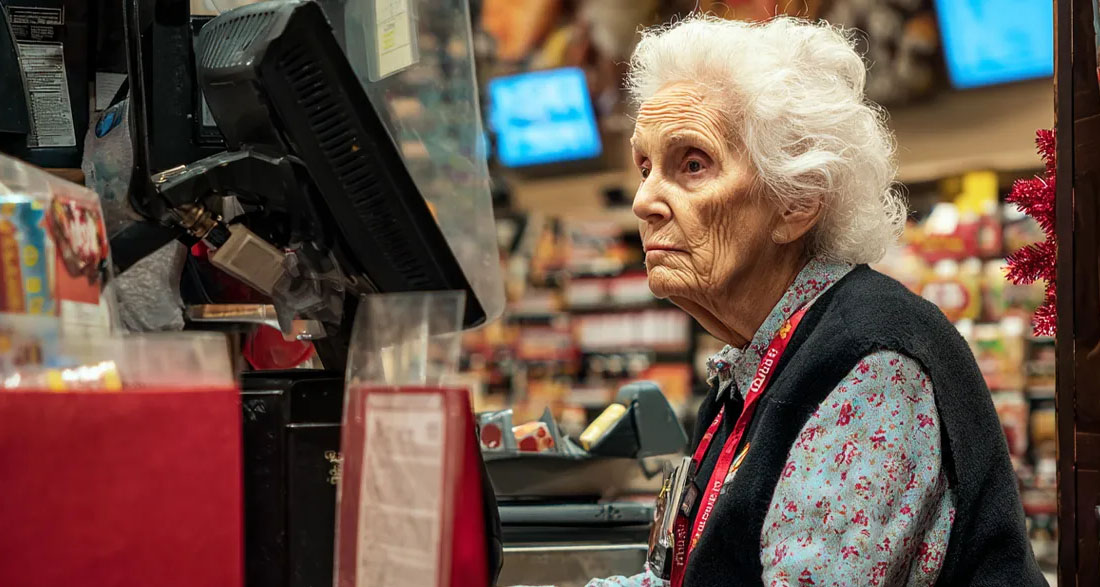
The cashier was an elderly woman, probably in her seventies. Her silver hair was pulled back with a thin headband, and her hands trembled slightly as she worked the register. Her smile was gentle, but her eyes looked heavy—like she had been carrying something invisible all day long.
Everything felt calm.
Still.
Until it wasn’t.
A sharp voice sliced through the music like broken glass.
“Are you kidding me? You’re too slow!”
Everyone turned.
A woman in a blinding white fur coat stood at the front of the line, drowning in perfume and impatience. Her arms were crossed tightly, her mouth twisted into something cruel. She stared at the cashier like she had personally ruined Christmas.
The cashier flinched.
“I’m sorry, ma’am,” the older woman said softly. “The system is just loading.”
“Loading?” the woman snapped. “Do you think we have time to waste? It’s Christmas Eve! This isn’t rocket science. How hard is it to scan a bar code?”
She turned toward the rest of us and rolled her eyes, clearly expecting agreement.
“Honestly,” she scoffed. “People like this shouldn’t be allowed to work in public. It’s ridiculous.”
The cashier’s hands shook more now. She fumbled with a bag of yams, nearly dropping it. I watched her try to steady herself, watched her shoulders curl inward.
My stomach twisted.
Maybe it was the shift I’d just finished. Maybe it was the pain in my back. Or maybe it was Sophie’s note replaying in my head—tired people are the kindest.
Whatever it was, I couldn’t stay silent.
I stepped forward and placed my milk on the belt, slowly and deliberately.
“Ma’am,” I said calmly, “it’s Christmas Eve. Maybe take a breath. Maybe just be… kind.”
She spun around, shocked.
“Excuse me?” she snapped. “Who do you think you are?”
“Someone who believes kindness is free,” I replied, taking a steady breath.
Her eyes narrowed.
“You have no idea who I am.”
“Then maybe start acting like someone worth knowing,” I said. “It’s Christmas. Try spreading some cheer.”
For a moment, she just stared. Then she laughed sharply—fake and loud.
“Pathetic,” she muttered, grabbing her bag. Her heels clicked angrily as she stormed out, muttering under her breath.
When she left, the store felt strangely quiet again. The music floated back into focus. The cashier didn’t look at me at first.
Her hands were shaking badly now.
“You didn’t have to do that, dear,” she said softly.
“Yes, I did.” I reached for a chocolate bar near the register and placed it on the belt. “Merry Christmas.”
Her lip trembled.
“You’re the only person who’s been kind to me today,” she said. “Everyone else has been in such a rush.”
She paused, swallowing hard.
“I’ve been here since ten this morning. My husband passed away a few years ago. We never had children—it just… didn’t happen. I don’t have any family nearby. And today…”
Her voice cracked.
“No one even looked me in the eye.”
My throat tightened.
“I used to be a teacher,” she added suddenly. “First grade. Before Roger got sick. After he died, I stayed here. Keeps me busy.”
“I’m so sorry,” I said quietly. “No one should feel invisible.”
She smiled, but it was fragile.
“I’ll be okay. I just need to get through tonight.”
I hesitated, then said what felt impossible not to say.
“You shouldn’t spend Christmas Eve alone. Come have dinner with us.”
Her head snapped up.
“Oh honey, I couldn’t possibly—”
“My name is Clara,” I said gently. “I have a daughter. Sophie. She’s seven. She loves Christmas. We have ham, mashed potatoes, and paper snowflakes for Santa. There’s plenty of love.”
I wrote down my address, reading her name tag.
“Ruth,” I said. “We’d love to have you.”
She took the paper carefully, like it might disappear.
On the drive home, Sophie hummed along to the radio.
“Who’s coming for dinner?” she asked.
“A friend,” I said. “Someone who needs some Christmas love.”
“Like in the movies?”
“Exactly like that.”
But as the night passed, Ruth never came.
By nine o’clock, the pie burned slightly at the edges.
“Maybe she forgot,” Sophie whispered.
“Maybe,” I said, heart heavy.
We went to bed quietly.
The next morning, a sharp knock came at the door.
A police officer stood there.
“Are you Clara?”
“Yes.”
“It’s about Ruth.”
She had suffered a heart attack in the parking lot.
“She was smiling,” he said. “She left something for you.”
Inside the box was a letter… and a key.
“You gave me Christmas again,” Ruth wrote.
She left us her house.
Months later, Sophie and I stood in that kitchen—safe, warm, hopeful.
“Mom,” Sophie said, watching cookies bake. “Can we get a puppy?”
I laughed.
“We’ll see.”
“I’ll name her Angel,” she said. “Or Ruth.”
And for the first time in a long while, the future didn’t feel scary.
It felt full.
Of kindness.
Of warmth.
And of love.