

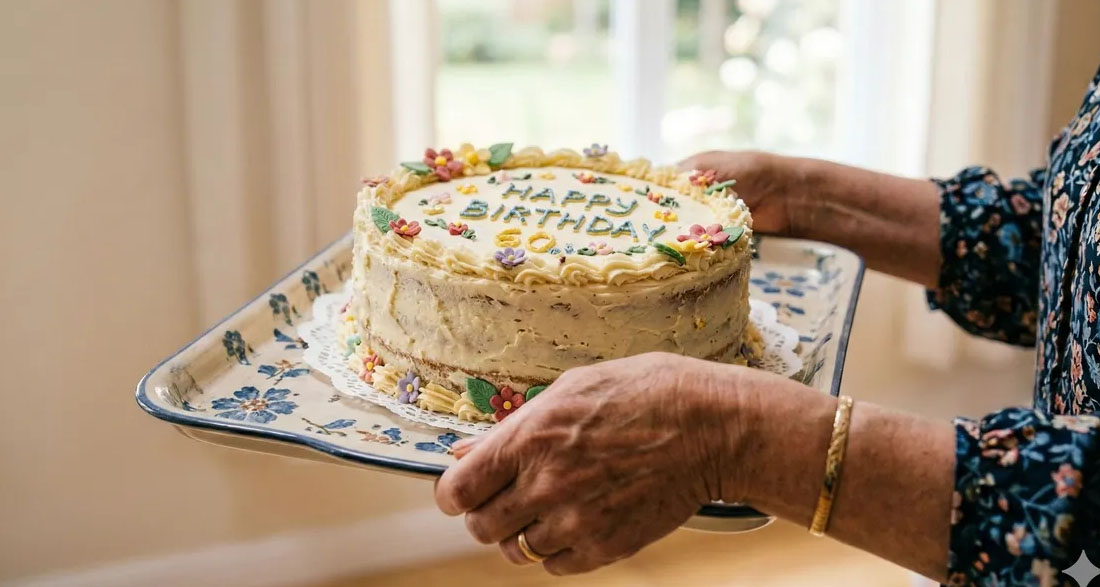
I thought turning 60 would feel warm. I imagined the smell of food, the laughter of my six kids filling the house, the clatter of plates, voices overlapping, stories being told. Instead, the house stayed too quiet.
The food went cold. Every minute that passed made the empty chairs feel louder, more mocking. By the time the knock finally came, it didn’t sound like family at all.
I had waited four hours for my children to arrive. Four hours to sit in a house that should have been alive with chaos, with seven place settings, a table carefully prepared, and a stomach full of hope. Instead, I sat completely alone.
When I married their dad, he had loved the idea of a big, noisy family.
“A loud house,” he’d laugh, ruffling my hair. “A table that’s never empty.”
And I believed him. We had six children in ten years. Mark, Jason, Caleb, Grant, Sarah, and Eliza. Four boys, two girls, and enough noise to shake the walls. Enough laughter, enough chaos, enough love to fill any empty space.
But then, one day, their father decided it was too much. He found a woman online—far away—and within months, he packed a suitcase and left, claiming he needed to “find himself.” And just like that, our loud, full life became quiet and empty.
Tonight, I tried to recreate what we had lost. I cooked their favorite meals. I set the table for seven, using my best plates, the cloth napkins ironed so carefully, hoping the night would feel like it mattered. I even lit candles, small flames flickering in the quiet.
At four, I peeked through the blinds like a nervous child. At five, I texted the group chat: “Drive safe.” No response.
At six, I called Mark. Voicemail. Jason. Voicemail. Caleb. Voicemail. Eliza. Voicemail. Grant. Straight to voicemail, as if the phone didn’t even ring.
By seven, the food was cold. By eight, the candles burned low. By nine, I sat at the head of the table, staring at six empty chairs. I tried to tell myself I was being dramatic, but the silence felt personal, deliberate. I buried my face in the napkin I had ironed that morning and cried.
Then, a knock. Not a soft, tentative knock. A firm, official knock. My heart leapt, but not with hope—fear edged in.
I wiped my face and opened the door. A young, serious, clean-cut police officer stood there.
“Just listen to me and get in the car,” he said quietly.
“Are you Linda?” he asked.
I nodded, my throat suddenly refusing words.
He held out a folded note. “This is for you.”
My name was on it. The handwriting made my hands go numb. Grant. My wild, unpredictable, stubborn Grant. I unfolded the note under the porch light.
Mom, don’t call anyone. Don’t ask questions. Just listen to him and get in the car.
“I can’t discuss details here,” the officer added.
I froze. My mind screamed. Grant was the one I worried about when my phone rang late at night.
“Ma’am, I need you to come with me,” the officer said gently, but firmly.
I couldn’t hold it back. “Is my son alive?” My voice cracked.
His eyes flicked away for just a fraction of a second—long enough to feel like a knife to my chest.
“Please,” I whispered. “Is Grant alive?”
He swallowed hard. “Ma’am, I can’t discuss details here. I just need you to come with me.”
I glanced back at the house. The table was set. The food waited. The candles were dying.
“My children were supposed to be here,” I muttered.
“I’m sorry,” he said softly.
I should have called Mark again, demanded answers, but instead, I grabbed my cardigan, locked the door, and got into the cruiser. The back seat smelled of disinfectant and old fear. The door closed with a heavy click, and my stomach dropped like a stone.
“Just tell me if my son is okay,” I demanded.
“Where are we going?”
“Not far,” he said.
“Not far where?”
“Someplace safe,” he said, glancing in the rearview mirror.
“Safe from what?” My voice rose. “Did Grant get hurt? Did he do something?”
“Ma’am,” he said, calm but firm. “Please.”
“Don’t ‘please’ me. Just tell me if my son is okay.”
He paused, then quietly: “You’ll have answers soon. I promise.”
My phone buzzed. A text from Mark: Mom please don’t freak out. Just trust us. Trust us. After four hours of silence.
I typed back: WHERE ARE YOU? Delivered. Not read.
I stared at the back of the officer’s head. “Are they in danger?”
He didn’t answer immediately. Then, softly: “Yes, ma’am.”
My heart lurched. “Are they in danger?”
“No,” he said.
“Then why am I in a police car?”
We drove in tense silence until he turned into a parking lot. A community center. The one where I had cheered from hard bleachers at soccer games, basketball games, talent shows. Cars I recognized—Mark’s SUV, Sarah’s sedan, Jason’s truck—parked out front.
“What is this?” My mouth went dry.
The officer parked, came around, and opened my door. He offered his hand. I shook my head and climbed out on my own, legs shaky. He guided me toward the entrance. Through the glass, I saw movement.
Caleb went pale.
I stopped. “If this is some kind of joke—”
“It’s not,” he said firmly.
The lights snapped on. A banner stretched across the gym: HAPPY 60TH MOM. Balloons, streamers, a cake that looked too perfect. And five of my children stood there, frozen in a mix of excitement and guilt.
I stood very still. “So… you were all here.”
Mark stepped forward. “Mom, wait—”
“I waited four hours,” I said. “Four.”
Jason blurted, “We weren’t ignoring you!”
“Where is Grant?” I demanded.
Eliza’s eyes filled. “We thought—”
Sarah snapped, “Why is there a cop with you? What happened?”
I looked from face to face. “I sat alone at that table,” I said. “Like an idiot.”
Mark’s face crumpled. “Mom, we were trying to keep it a surprise. Grant said he’d handle the pickup part.”
My heartbeat raced again. “Where is Grant?”
Jason frowned. “He said he’d be here by seven. He was supposed to get you.”
Sarah whipped her head toward Mark. “He’s late!”
Mark checked his phone. “Not answering.”
I turned back to the officer. “You gave me a note from my son. You drove me here. Where is he?”
Another police cruiser rolled in. Headlights cut through the glass. Footsteps approached. And then… Grant walked in. A police uniform, badge shining on his chest.
“No way,” Jason shouted.
“Grant,” Sarah whispered.
Caleb just stared.
“Okay,” Grant said, hands raised, a grin on his face. “Before anyone murders me… Happy birthday, Mom.”
“What are you wearing?” I demanded.
“A uniform,” he said, swallowing.
Mark choked out, “You’re a cop.”
“Yes,” Grant said.
Sarah exploded. “You’re out of your mind! She thought you were dead!”
Grant flinched. “Mom, I’m sorry. I didn’t think—”
“You didn’t think,” I said sharply.
He nodded, shame all over his face. “I thought it would be a quick scare, then a surprise. I didn’t know you were sitting at home for hours.”
“I was,” I whispered.
He explained quietly, “I didn’t tell you about the academy because I didn’t want people to treat me like I’d fail.”
I laughed bitterly. “And you thought I would?”
“No. You’re the only one who didn’t,” he said fast.
His eyes glistened. “I wanted to show you I’m not him. I wanted you to be proud.”
I reached out and touched his badge. Solid. Real. My anger softened, just a little.
“You did this,” I whispered.
“Yeah,” he said, lip trembling.
Tears came anyway. Because my wildest kid had done something good. Because my hardest kid had tried.
“I thought you were gone,” I said.
“I’m here,” he whispered, stepping into my arms. “I’m here.”
Behind us, Sarah’s voice softened. “Mom, I’m sorry.”
“We wanted it to be perfect,” Mark added.
Jason cleared his throat. “Yeah. We messed up.”
Eliza hugged me tightly. “We wanted it to be perfect.”
“There’s no perfect,” I said, wiping my cheeks. “There’s just showing up.”
Grant looked me in the eye. “No more disappearing,” he said.
“Deal,” I heard each of them whisper in turn.
Grant covered my hand. “Deal,” he said softly. “And I’ll prove it.”
The candles on the cake were fresh, the music loud and ridiculous, the house alive with voices again. A loud house. A table that wasn’t empty. Not perfect. Not the past. But for one night… I wasn’t alone.