

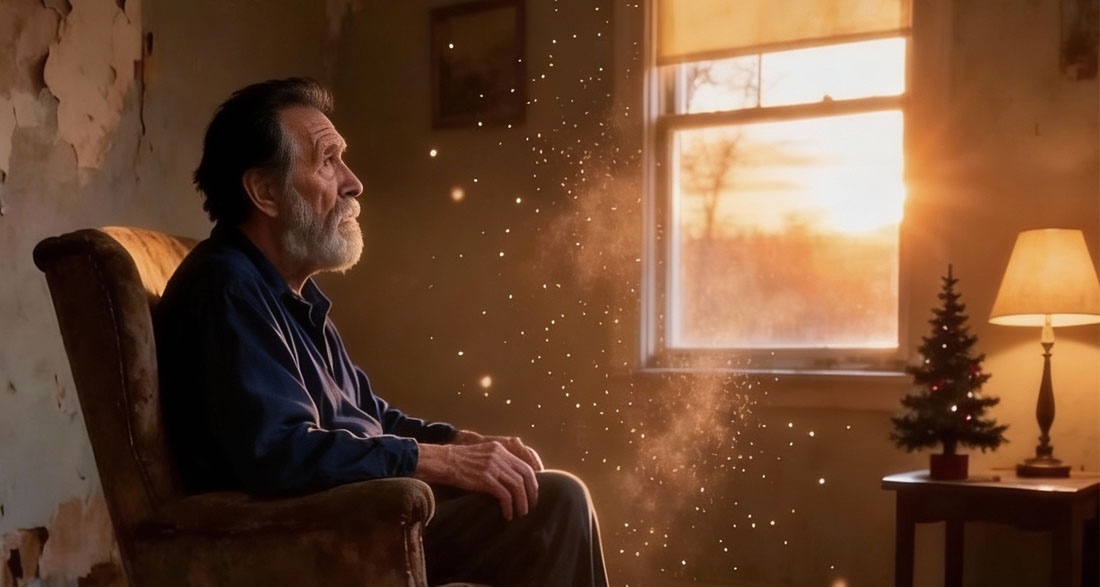
I didn’t argue when my son told me I wasn’t welcome for Christmas. I just smiled, nodded, and wished him well, even though I felt something inside me quietly crack. It wasn’t loud or dramatic—just a tiny fracture deep in my chest, like a faint echo of pain that refused to vanish.
He spoke softly, his words calm but firm. “This year, we want a quiet Christmas,” he said, “just our little family.” I knew exactly what that meant. And I didn’t argue.
Years of small sacrifices flashed through my mind, like an old slideshow I hadn’t asked to see—late bills I’d covered for him, the furniture I helped him buy when he moved out, the countless times I said yes when I should have said, “You’ll figure it out.” But I didn’t mention any of it.
I kept my dignity, smiled gently, and left.
Driving home, the streets were alive with sparkling lights. Every house seemed to glow, their front yards full of reindeer, Santas, and cheerful snowmen. It should have made me happy. It should have felt like Christmas magic.
But to me, it all looked like someone else’s celebration, a happiness I wasn’t part of. The radio played soft Christmas songs—the kind that used to make me hum along—but now, they only echoed hollowly in my chest.
I told myself this was adulthood: children grow up, start their own lives, and sometimes traditions change. I told myself I was fine. But the silence waiting for me at home felt heavier than any argument we could have had.
I didn’t call friends. I didn’t pour a drink. I didn’t even cry, though the urge was there. Instead, I sat at my desk, opened my old laptop, and stared at documents I had been avoiding for months—bank statements, bills, receipts.
Each number, each line, was proof of years spent giving more than I could afford, not just in money but in heart. Every gift, every favor, every solution I had offered had come from love. But somewhere along the way, love had become expectation.
Gratitude had faded, replaced by habit. My support had become invisible, a safety net my son no longer saw. And in trying so hard to stay needed, I had let myself vanish.
That night, I made a decision. Not in anger, not as a punishment, but in exhaustion and clarity. I decided to stop giving what I could no longer spare—not because I didn’t love my son, but because I finally loved myself enough to stop bleeding quietly for others.
I didn’t make a speech, I didn’t demand apologies, I didn’t seek revenge. I simply stopped. I stopped sending money. I stopped offering solutions before he even asked. I stopped carrying burdens that weren’t mine.
Two days later, my phone buzzed like a persistent alarm. Eighteen missed calls. His name flashing again and again. I almost laughed—strange how quickly silence can make someone panic.
His messages shifted from confusion to frustration, then to a trembling kind of pleading. When I finally answered, he sounded different—like the boy I used to know, not the man who had told me to stay away.
“Mom… are you okay?” His voice was tight, hesitant, but there was something fragile in it, something that hadn’t been there before.
We talked. Not about his needs, not about what he wanted. For the first time in years, we talked about us, about what had been happening between us. No yelling, no demands. Just raw honesty that cut deeper than anger ever could.
He apologized—not perfectly, not fully, but sincerely. And I listened. When it was my turn, I spoke the truth. “I’ve created this dynamic as much as you did,” I said.
“I said yes too many times, hoping love would keep us balanced. I was scared to let you stand on your own because I didn’t trust myself to stop being the one who fixed everything.”
He didn’t interrupt. He didn’t defend himself. He just listened. And for the first time, I wasn’t trying to prove my worth. I was simply stating it.
The weeks that followed were strange. The quiet in my life felt unfamiliar, like walking through a house where furniture had been moved—you bump into emptiness at every turn.
I had spent so long filling every silence with care for someone else that peace felt almost wrong. But slowly, my mind and heart began to settle. I cooked for myself again, not because I had to, but because I wanted to.
I slept through the night without waking to fix someone else’s problems. I noticed small, beautiful things—the morning sunlight hitting the kitchen counter, the whistle of the kettle, the rhythm of my own breathing.
My son adjusted too. The first months were awkward. He called less often, and when he did, the conversations were short. But I could see him trying. He began solving problems without my guidance, making decisions I used to make for him. And though part of me ached to intervene, I didn’t. I let him wobble, learn, and find balance on his own.
Spring arrived, and we met for lunch—the first time we had seen each other since that December conversation. I was nervous. He looked tired but grounded, older somehow. We started with small talk, testing the waters, easing into what had once felt too hot to touch.
Then, mid-bite, he said quietly, “I didn’t realize how much you did for me. I thought it was just… how things were.”
I nodded. “That’s how it happens,” I said. “We both forget it’s a choice.”
Something shifted that day. Our conversations grew balanced. He stopped expecting, I stopped overgiving. We learned to meet each other as two adults, not as rescuer and rescued.
By summer, I felt lighter. I spent weekends doing things I had put off for years—walking by the sea, visiting old friends, even joining a small book club at the library. My life wasn’t busy, but it was mine. For so long, I measured my worth by what I gave. Now, I measured it by how I lived.
When December returned, I wasn’t sure what to expect. Then my son called, early in the month, his voice careful, calm. “Mom, we’d love for you to come for Christmas this year. If you want to.”
There was a pause, heavy with everything we’d lost and everything we’d learned. “I’d like that,” I said.
The day came quietly. No grand reunion, no speeches. Just family. The house smelled of pine and cinnamon, laughter came naturally, and for the first time, I wasn’t performing. I didn’t hover in the kitchen or rush to make everything perfect.
I sat, watching the tree lights flicker, feeling a peace I hadn’t known in years. Not because everything was fixed, but because everything was honest.
Later, driving home, the streets sparkled with holiday lights again. But this time, they didn’t look like someone else’s happiness. They felt like markers of a life still being built—a life that included me, not as the foundation everyone stepped on, but as part of the structure itself.
I realized then that change doesn’t always come with shouting, slamming doors, or dramatic gestures. Sometimes it comes quietly, in the simple, steady choice to stop shrinking so others can stretch comfortably. To stop proving your worth by how much of yourself you give away.
Love, I learned, doesn’t mean saying yes to everything. It doesn’t mean breaking yourself so someone else doesn’t have to bend. Real, grown-up love makes room for boundaries. It makes room for truth.
Now, when I talk to my son, there’s respect in his voice, a humility born from realizing someone’s care was never guaranteed. I don’t need to hold it over him. We are learning together what family looks like when it’s balanced, when love doesn’t feel like debt.
Sometimes, I still feel that old ache—the one from the Christmas he told me not to come. But I don’t push it away anymore. It’s part of the story, part of the price of growing. It reminds me how easy it is to give too much, and how quietly a person can disappear when they do.
But it also reminds me how beautiful it can be to come back—to yourself, to peace, to love that no longer hurts to hold.
And that, I realized, is the real gift. Not the apology. Not the invitation. But the quiet, steady strength that comes from finally choosing yourself.