

I had lived next door to Harold Peterson for so long that it felt strange to imagine a time when he wasn’t part of the background of my life.
When I first moved in, he was a tall man with broad shoulders, hands that always smelled faintly of wood and oil, and a quiet way of moving that made you notice him even before he spoke.
Harold wasn’t just a carpenter—he was a man who understood wood, who treated it like it had feelings. He’d run his fingers along a beam before cutting it, nodding to himself like it had told him a secret. I used to watch him from my window, fascinated.
Over the years, I watched him change in small, quiet ways. His brown hair turned gray, then almost white. His confident walk slowed, then became careful, then unsteady. One day a cane appeared.
Later, a walker. Finally, the wheelchair that he had resisted for so long, the one he said he would “never need.” I watched his wife, Margaret, fade faster than he did. She had always been small, soft, with a laugh that carried across the yard on summer evenings.
When she died, the house felt empty, hollow, like sound didn’t want to stay there anymore.
His children came less and less. First every few weeks, then months, then only on holidays—sometimes not even then. They always had reasons: work, school, a long drive, a cold… something more important than him. I could see how each excuse cut Harold, even if he tried not to show it.
The porch was the first thing that truly showed how bad things had gotten. Harold had built it himself, years ago, strong and simple, with wide steps and a sturdy railing. Time and neglect, though, were cruel.
The boards rotted, one step sagged, the railing loosened and finally broke. When Harold started using the wheelchair, someone had thrown together a rough ramp.
It was barely enough to get in and out, made of scrap wood, uneven, dangerous. I worried every time I saw him roll over it. One board creaked so loudly it sounded like it might snap at any moment. I offered to help, but Harold would shake his head and smile tiredly. “I don’t want to be a bother,” he’d say.
Then the letter came.
I saw it in his hand when he came back from the mailbox, shoulders slumped, face pale. He didn’t say a word.
The next morning, I found him sitting on the porch, staring at it like it had come from another world. Finally, he told me the city had inspected the house. The porch and ramp were unsafe. If they weren’t fixed, the city could condemn the property. They might even make him leave.
Harold had called his children right after reading the letter.
I didn’t hear the calls, but I saw the aftermath. His face had lost something—light, hope, a little piece of pride. He told me what they said, quietly, almost as if he were repeating someone else’s words.
“They said it’s not worth fixing,” he said, voice low. “Just… be careful, they said. It’ll probably be sold after I’m gone anyway, so why spend money now. One even said maybe the city stepping in would ‘simplify things.’”
I could see how those words hurt. It wasn’t just about the porch—it was the silent message that his life, his safety, and his home didn’t matter to them.
That evening, I noticed his lights were on late. I looked out my window and saw him inside, clutching a framed photograph of Margaret. His shoulders shook as he wiped at his eyes, embarrassed to cry even with no one watching. I felt a rush of helplessness—and anger. Something had to be done.
I didn’t plan it. I just knew I couldn’t let him face this alone. A few blocks away was a motorcycle club that people whispered about. Loud engines, leather jackets, tattoos. I had always crossed the street to avoid them, nervous even at the thought. That night, I walked there anyway.
The place was quieter than I imagined. A few bikes parked outside, warm light spilling from the windows. I hesitated, then went in.
They all looked up. Big men, rough faces, curious rather than hostile. I told them about Harold. I told them he was a veteran, a man who had helped his neighbors for decades, a man who built things with care. I told them about the porch, the city letter, and the children who wouldn’t help.
The leader, I guessed, listened closely. When I said Harold’s name, something changed in his face. “Harold Peterson?” he asked slowly. “The man who helped my dad when he lost his legs? Built him a ramp, barely charged anything?”
“Yes,” I said.
The room went quiet. Then he nodded. “He did that when no one else would. I’ve never forgotten it.”
“Let’s go,” he said.
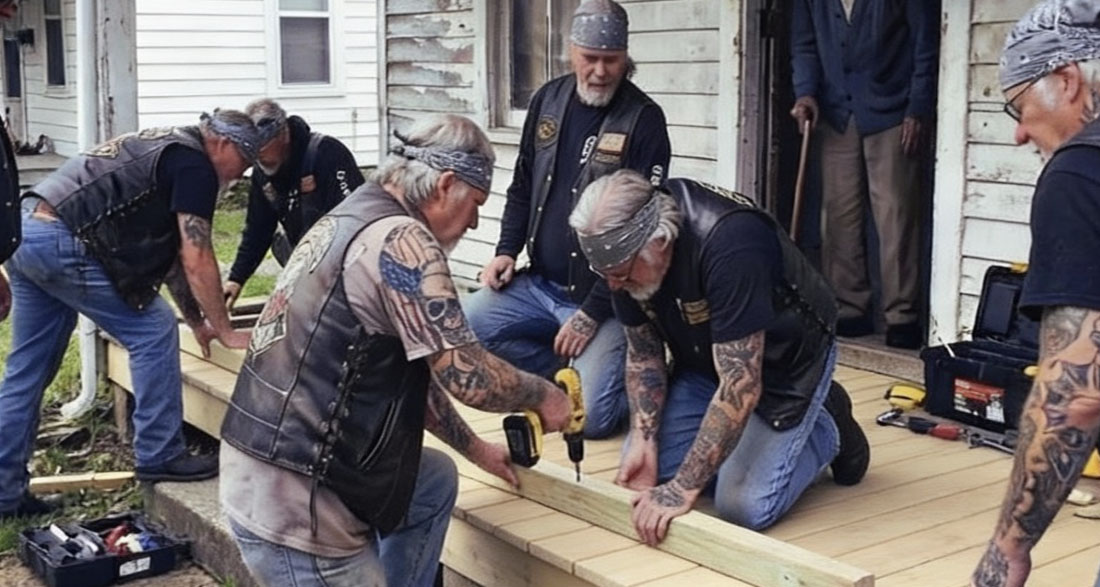
An hour later, trucks arrived at Harold’s house. Men carried lumber, tools, and lights. No shouting, no loud music—just work.
Harold watched from his porch, confused. “I can’t pay you,” he said. “I don’t deserve this trouble.”
“It’s not about money,” one of the men said softly.
They worked three full days. The old porch was torn out completely. A new one rose in its place—wide, sturdy, with smooth boards and solid railings. A proper ramp, strong and safe, replaced the crooked one. Lights were installed so Harold could see at night. Every corner, every board was built to last.
During the work, Harold’s children called. They were furious, threatening police and lawyers. The bikers didn’t flinch—they just kept building. I saw one kneel beside Harold’s wheelchair and speak softly. I didn’t catch the words, but Harold’s face changed. Tears came, but this time there was a smile.
When it was finished, the porch was perfect. Harold rolled onto it slowly, testing the boards. He placed a trembling hand on the railing, then the other, almost afraid it might vanish. Then he looked up, and for the first time in years, he laughed—a small, shaky laugh, but real.
Weeks later, something miraculous happened. Harold’s granddaughter, who had heard about what happened, started visiting.
First for a few minutes, then hours. Then she came again and again. Harold began to spend mornings on the porch, sunlight on his face, waving at neighbors. Some stopped to talk, some waved back. He smiled at all of them.
He wasn’t alone anymore.
And every time I saw him on that porch—built by strangers, inspired by the kindness he once gave—it felt like something quietly powerful was moving through the world.
A force strong enough to hold a man up when everything else had started to crumble, reminding me that sometimes, even in the darkest times, people will show up for one another in ways you could never imagine.