

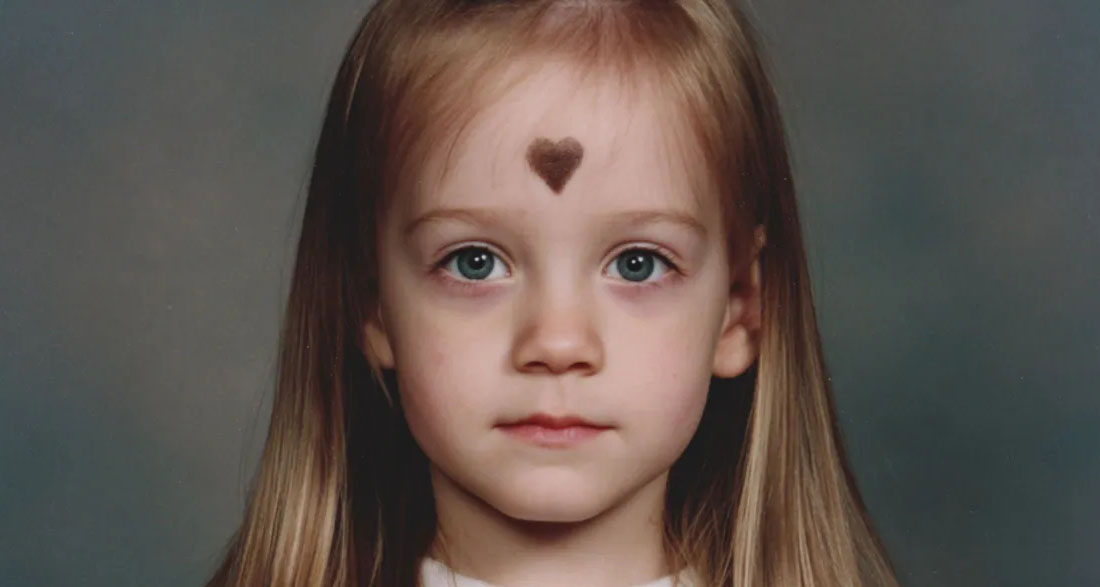
I grew up believing the dark birthmark on my forehead was the worst thing about me.
It sat right in the middle of my forehead, impossible to miss. The kind of mark that made people stare for half a second too long, then quickly look away like they hadn’t been looking at all.
From the time I was little, I learned exactly what it meant to be “different.”
In elementary school, the comments started early.
One afternoon at lunch, a boy leaned across the table, squinted at my forehead like he was studying a riddle, and said, “Did you hit your head?”
Another kid laughed and added, “It looks like paint.”
The table erupted in giggles.
I remember staring down at my milk carton, my face burning hot, pretending I couldn’t hear them. Pretending I was somewhere else. You learn how to disappear like that when you’re young and you have no other choice.
And once it started, it never really stopped.
By middle school, everything got louder. The voices. The cruelty. The confidence kids had when pointing out something you couldn’t change.
One day, a girl I barely knew cornered me in the bathroom. She smiled, but it wasn’t kind. It was tight and sharp.
“You should cover that up,” she said, “so the rest of us don’t have to look at it.”
I told a teacher once. I thought maybe an adult would help.
She sighed and said, “Kids can be mean. Try not to let it bother you.”
I nodded and walked away.
How was I supposed to not let it bother me when it followed me everywhere I went?
At home, my adoptive mom would gently tuck my hair behind my ear and say, “It makes you unique.”
My dad would nod and add, “There’s nothing wrong with you. Not one thing.”
I believed them.
But I also believed the kids.
That’s the part people don’t tell you about love. Love doesn’t stop the whispers in hallways. It doesn’t stop the lingering looks, or the way you feel labeled as “different” before you ever open your mouth.
By the time school picture day rolled around every year, I knew exactly how to pose. Chin slightly down. Face angled just enough. Bangs pulled forward to cast a shadow.
“Hold still,” the photographer would say.
I always did.
In high school, I stopped raising my hand even when I knew the answer. I didn’t want heads turning. I didn’t want eyes on me. Invisibility felt safe, even if it meant shrinking myself.
Once, a boy I liked asked, “Why do you always wear your hair the same way?”
I laughed and said, “Habit.”
He nodded, like that explained everything.
I built my entire personality around not being noticed, and I got very good at it.
For years, I believed the birthmark was the worst thing that had ever happened to me. The source of every insecurity. Every moment of doubt.
I told myself that if I could just erase it, everything else would fall into place. I wouldn’t have to hide. I could finally just be me.
By my twenties, I had a savings account with one purpose: cosmetic surgery.
I worked as a marketing coordinator after college and saved every extra dollar. I booked consultations during lunch breaks, sitting in clean, white offices while doctors talked calmly about “options” and “minimal scarring.” I smiled and nodded and tried not to cry.
The surgery was scheduled for two weeks later.
I told my friend Amber over coffee.
“I finally scheduled it,” I said, barely able to hide my excitement. “In two weeks, this birthmark will be gone forever.”
She studied me carefully. “You’re really excited about this, huh?”
“I think I’ll feel lighter,” I said. “Like I won’t have to think about it anymore.”
She hesitated, then said gently, “You know you don’t need to do that, right? I’ve never thought there was anything wrong with you. But if this is what you want, I’m with you.”
That was enough. I didn’t need her to fully understand. I just needed her not to judge.
I marked the surgery date on my calendar and told myself that everything would be easier after that. New face. New life. New confidence.
Then I got the email.
An interview invitation for my dream job. The kind of job you don’t even let yourself imagine, because hoping feels dangerous.
For a moment, I almost canceled the surgery. My brain couldn’t handle both things at once.
Instead, I did something I had almost never done.
I pulled my hair back.
Looking back now, I know I wouldn’t have done it without that talk with Amber. That one small, brave choice changed everything.
I told myself in the mirror, “If they don’t hire me because of a birthmark, I don’t want the job anyway.”
It sounded strong in my bathroom.
It felt terrifying when I walked into the building.
The office was modern and quiet, all glass and soft colors. I sat across from the assistant, answering questions. It was going well. Really well.
Then the door opened.
My future boss walked in.
He looked confident, in his early fifties, dressed sharply, like someone who was never surprised by anything.
He glanced down at his tablet… then looked up at me.
And froze.
The color drained from his face. He stumbled back like he’d been struck.
“No… no, no,” he whispered. “It can’t be true.”
The assistant stopped typing.
I felt my stomach drop. This was it. The moment I’d feared my whole life.
Then he stared directly at my forehead.
“You’re dead,” he said. “You were supposed to be dead.”
I couldn’t speak. My throat closed completely.
The assistant looked confused. “Sir?”
He waved her out without looking away from me. “Please. Give us a moment.”
When the door shut, he sank into the chair across from me, shaking.
“That mark,” he said quietly. “That exact mark.”
My heart was pounding so hard I could feel it in my hands.
“I’m sorry,” I whispered. “Do I know you?”
He swallowed hard. “No. But I think I know you. I never thought I’d see that birthmark twice in my life. Not after they told me you were gone.”
I clasped my hands together. “I don’t understand.”
He took a deep breath.
“Twenty-five years ago, the woman I loved left town while she was pregnant. She later told me the baby didn’t make it.”
My chest tightened.
“She sent me one photo,” he continued. “The baby had a birthmark. Right here.”
Then he asked softly, “Your mother… is her name Lila?”
“I don’t know,” I said. “I was adopted as a newborn.”
His eyes filled with tears.
“She lied,” he whispered. “She had to have.”
I looked at him, barely breathing. “You think I’m your daughter.”
He nodded.
“Would you take a DNA test?” he asked. “If there’s even a chance… you deserve the truth.”
After a long moment, I said, “Okay.”
We arranged everything that day. He paid for expedited testing without hesitation.
When the results came back, we met at my parents’ house. The parents who raised me. Chose me. Loved me.
The test was a match.
My mom cried. My dad held my hand and didn’t let go.
I said, “I have parents. They raised me.”
He nodded. “I understand. And I’m grateful.”
A few days before my surgery, the clinic called to confirm.
I stood in front of the mirror, my hair pulled back.
The birthmark wasn’t a flaw.
It was proof.
I called the clinic back. “I’m canceling.”
The receptionist said, “Are you sure?”
“I’m sure,” I replied.
I didn’t walk away with everything figured out. I didn’t suddenly love my birthmark.
But I learned it wasn’t a mistake.
It was a map.
And it led me home.
That was enough.