

Tom had spent most of his life believing one thing above all else: work came first.
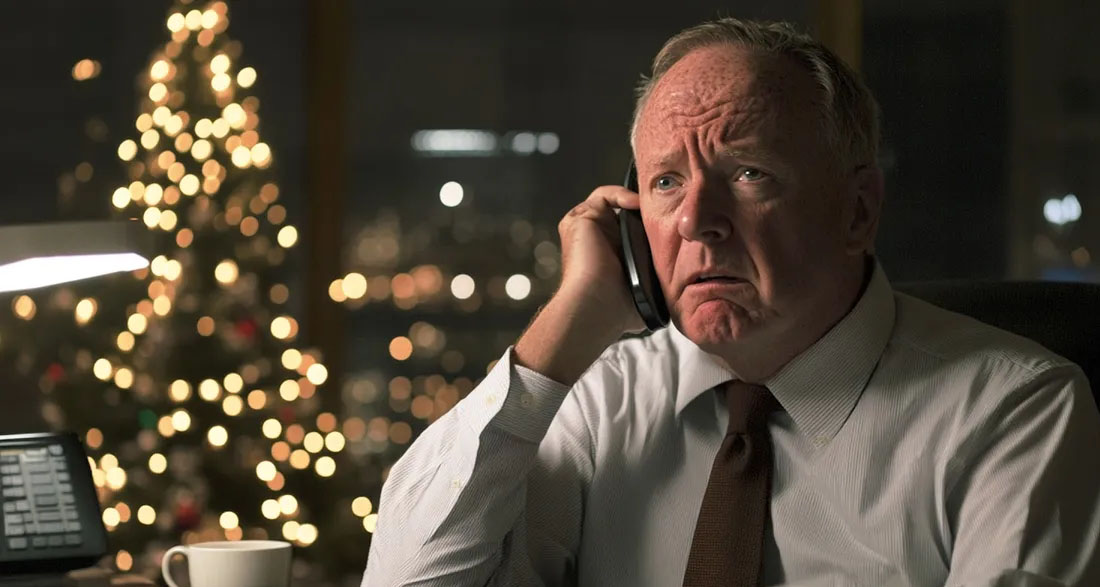
Now, nearly 70 years old, he sat alone in his quiet office, staring at the proof of that belief all around him. The office was spotless, almost too perfect. Papers were stacked neatly, pens lined up just right. There was no laughter, no voices, no reason for anyone to stay—except him.
The only sound was the soft hum of the heater fighting against the winter cold.
In the corner stood a Christmas tree, decorated with small white lights and simple ornaments. It glowed gently, trying its best to bring warmth into the empty room. Instead, it only made the loneliness louder.
The tree felt wrong there. Out of place. Just like Tom felt in his own life.
Everyone else had gone home hours ago. His coworkers had families waiting for them. His friends had retired years back, choosing quiet mornings and grandchildren over deadlines and meetings.
But work was all Tom had left. It was his anchor, the one thing that never abandoned him.
With a tired sigh, he picked up his phone and stared at the contact name he hadn’t deleted, no matter how many times he’d thought about it.
Daisy.
His daughter.
After a moment of hesitation, he pressed call.
“Hello?” he said when she answered, trying to sound confident, even though his heart was already pounding.
“Hi, Dad,” Daisy replied. Her voice sounded distracted, like she was doing ten things at once.
Tom swallowed. “I was just wondering… what does Theo want for Christmas this year?” he asked, forcing a light tone.
“He wants a Furby,” Daisy said.
Tom frowned at the unfamiliar word. “A Furby? What’s that?”
“It’s a toy,” Daisy explained. “It talks, it moves. All the kids at school have one.”
Tom hesitated, already feeling behind, already feeling like an outsider in his grandson’s life. “Would it be okay if I just gave him money instead?” he asked carefully.
There was a pause.
“Uh… yeah, I guess,” Daisy replied, her voice clearly disappointed. The line went dead soon after.
Tom lowered the phone slowly, staring at the screen until it went dark.
He stayed at work a little longer, though he wasn’t really doing anything. Eventually, he gathered his things. His desk, once crowded and chaotic when Daisy was young, now looked sterile. Lifeless.
He locked the office door and stepped into the cold night. The drive home was quiet. The radio played softly, but he didn’t hear a single word.
When he entered his house, silence wrapped around him like a heavy blanket.
He hung his coat by the door and looked around the dim living room. Same couch. Same TV. Same walls that had watched his life shrink year after year.
His wife had left long ago, taking Daisy with her. He had told himself it was temporary. That work needed him. That family could wait.
Family didn’t wait.
Tom changed into his worn sweatpants and sank onto the couch. As the TV flickered on, his eyes drifted to the shelf across the room.
There was a photo of Theo.
The boy was smiling wide, full of joy, full of life. A child Tom barely knew.
Tom sighed deeply, his chest feeling heavy. Missed birthdays. Missed school plays. Missed chances he could never get back.
The next morning, Tom drove to the clinic.
Sitting in the doctor’s office, he already knew what was coming. The same lecture. The same warning.
Dr. Harris entered with a clipboard and a serious look. “Well, Tom, how are you feeling today?” he asked, taking a seat.
“I’m fine,” Tom muttered, avoiding his eyes.
Dr. Harris flipped through the file. “Your tests are mostly okay, but your cholesterol is still too high. We’ve talked about your diet. Are you eating better?”
“No. I ignore it,” Tom said bluntly, crossing his arms.
Dr. Harris sighed. “Tom, you can’t ignore this. You know your heart condition. You need to slow down.”
“I drink water,” Tom said, lifting a bottle. “My daughter sent it. Says it’s fancy.”
“That’s good,” Dr. Harris replied, “but it’s not enough. Have you told your family yet?”
“No,” Tom said coldly.
“Tom, they need to know,” the doctor said firmly.
“I wasn’t a good father,” Tom admitted quietly. “Daisy and I don’t have much of a relationship. I don’t want to drag her into my problems.”
“Are you afraid she won’t help?” Dr. Harris asked gently.
Tom shook his head. “No. I’m afraid she will.”
Dr. Harris stood. “Tom, either you tell her, or I will.”
“You’re supposed to make my life easier, Doc,” Tom said weakly.
“I’m trying to keep you alive,” Dr. Harris replied, placing a hand on his shoulder.
That night, Tom sat in his armchair, phone heavy in his hand.
He stared at Daisy’s name for a long time before pressing call.
“Dad?” Daisy answered, concern slipping into her voice.
“We need to talk,” Tom said softly.
“What’s wrong?” she asked.
He told her everything. About his heart. About the risks. About the truth he’d been hiding.
There was a long silence.
“I’m coming tomorrow,” Daisy finally said. “I’ll take care of it.”
“You don’t have to—” Tom began.
“I’ll see you tomorrow, Dad,” she said firmly, ending the call.
The next day, Daisy arrived like a storm. She called his doctor, asked endless questions, then went straight to the fridge, throwing out every unhealthy thing she found.
Then she sat Tom down.
“Andrew and I talked,” she said. “We want you to come live with us. You’ll have your own guest house. I’ve already found a doctor. Everything’s ready.”
Tom shook his head. “Thank you… but I can’t.”
“Why?” Daisy snapped.
“Because I need to work.”
“Work?” Daisy raised her voice. “Dad, you’re almost 70!”
“Work is all I have,” Tom said quietly. “I don’t know who I am without it.”
Daisy’s voice broke. “What about me? What about Theo? You missed my whole childhood. And Theo doesn’t even remember you!”
“I’m sorry,” Tom whispered.
“I’m done,” Daisy said through tears, slamming the door behind her.
For two weeks, Tom called every day.
“Daisy, please call me back,” he left message after message.
When Dr. Harris told him his condition had worsened, Tom knew time was running out.
Then, the day before Christmas, the phone rang.
“This is Riverside Health Clinic,” a voice said. “We’ve received Mrs. Brown’s body after an accident. You’re listed as the emergency contact.”
Tom froze. “My daughter?”
There was a mix-up.
At the hospital, a receptionist finally said, “It was Sarah Brown, not Daisy.”
Relief and anger crashed into him at once.
Shaking, Tom sat down, realizing how close he’d come to losing everything.
Two hours later, he stood at Daisy’s door—wearing a Santa suit, holding a Furby.
When Daisy opened the door, her eyes widened. “Dad?”
“Merry Christmas,” Tom said softly. “I want to change. I want to be better.”
Daisy stepped aside. “Come in.”
“Theo!” she called. “Look who’s here!”
Theo ran toward him. “Santa!” he shouted, jumping into Tom’s arms.
Tom hugged him tightly, tears streaming down his face.
For the first time in his life, work didn’t matter.
Family did.