

My brother didn’t call our grandmother for five whole years. Not on her birthday. Not when she had her stroke. Not when I carried her down four flights of stairs, arms trembling under her weight.
Then, one ordinary evening during a family video call, someone casually mentioned her $500,000 savings—and suddenly, William appeared, out of nowhere, with gas station carnations clutched in his hand. He thought it would be easy.
Our grandmother, Dahlia, raised us after our parents passed away. She was already in her late 50s and working double shifts at a diner—breakfast and dinner—when she took my brother William and me in.
No matter how tired she was, Grandma always sat at the kitchen table with our homework before even thinking about dinner.
She worked at that diner until she was 69. Alongside it, she quietly built a small home business that grew steadily, a hidden source of pride and security.
I stayed with Grandma after school every day. I was there when her breathing started getting worse, when her legs no longer obeyed her commands, when the doctors insisted she needed fresh air every day no matter how hard it was to get her outside.
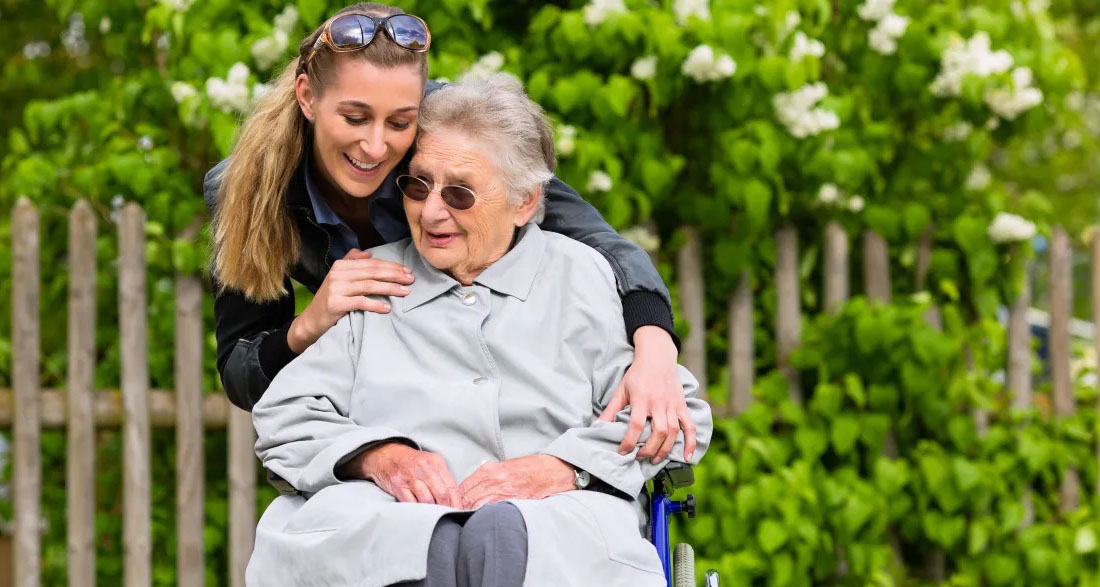
The building had no elevator, so I carried her—down in the morning, up in the evening—her arms around my neck, mine around her waist. We’d sit on the front steps for an hour, just watching the street together, sharing quiet moments in the sun.
Meanwhile, William had left the moment he turned 18. Five years passed, and he didn’t call. Didn’t visit on her birthday. Didn’t sit by her side in the hospital when she had her first stroke. I held her hand as the monitors beeped and her chest rose and fell in fragile rhythm.
Then came the video call. A dozen of us were on the screen, chatting casually.
My uncle mentioned he had been helping Grandma organize some paperwork. My cousin Danny, never known for holding his tongue, blurted out, “Grandma Dahlia got more set aside than any of us knew. Close to half a million!”
There was silence.
Then, after twenty long seconds, William’s face popped up in the corner of the screen. He had been there the whole time, quiet, almost invisible in that tiny square.
“Did she say how it was split?” he asked casually.
I slammed my laptop shut. I couldn’t stomach it. He’d barely been around, and suddenly he was curious about Grandma’s money.
That very evening, William showed up at Grandma’s door. He had gas station carnations, the price sticker still on them.
He burst into tears before even crossing the threshold, babbling about how much he missed Grandma, about everything he had “gone through,” about how he wanted to make it right.
He sat by her bed, held her hand, whispered words I could barely listen to without clenching my fists. And I watched it all from the kitchen doorway, seeing through his performance.
Grandma, Dahlia, looked at him calmly, her eyes twinkling. “I’m leaving everything to you, Willie… if you can prove you understand what it takes.”
William’s shoulders relaxed. He glanced at me, that familiar “I’ve already won” look flashing across his face.
Then Grandma reached under her pillow and pulled out a cream-colored legal folder, tied with string, her name written neatly on the tab. She held it out to him.
“Every dollar will go to you, son. But only if you follow one condition.”
“Anything, Grandma!” he said eagerly.
“You said anything,” she reminded him with a sly smile.
He grabbed the folder, started reading, and his confident face went pale.
“What is this?” he whispered.
“Read it out loud,” Grandma said.
He swallowed hard, then began:
“One week. One week living exactly as I’ve lived while raising Ruby and you. In my apartment. No car. No savings. No outside help. Only the daily tasks assigned to you.
You must cook every meal, clean everything, manage my medications on schedule, and carry me down the stairs in the morning and back up in the evening. You must be present through my difficult nights. Ruby will supervise everything. Her word is final. No exceptions.”
He looked up at me, disbelief written all over his face. “You knew about this?”
I shook my head. “No, I genuinely didn’t.”
“You can’t be serious,” he said, turning back to Grandma.
“You said anything!” she reminded him again.
“Fine, Grandma. One week,” he muttered, gritting his teeth.
“Good luck, dear,” she said softly. “Impress me.”
Day one, and William treated it like a joke.
He burned Grandma’s oatmeal—the same bowl of steel-cut oats she’d eaten every morning for as long as I could remember—because he walked away from the stove to check his phone.
He dumped the burnt oats in the trash without apology, looking at me like I was supposed to fix it. I made him start over.
By day two, he complained about the stairs, the medication schedule, the endless shopping. “Why does she need to go outside twice a day?” he snapped when I sent him to get the walker from the hallway.
“Because Grandma always did!” I replied.
He rolled his eyes but went anyway.
By day three, the joke wore thin. William was exhausted. He confused salt for sugar, ruined Grandma’s coffee, turned her soup into dessert.
By day four, he tried to cut corners, leaving dishes half-done, stacking them wrong, missing her midday medication by forty minutes because he’d been texting. I handed him another list, silently watching.
By day five, he had stopped complaining about each task. He did them—roughly, imperfectly, but he did them. It was more than he had done in the past five years combined.
Day six, laundry. William hung Grandma’s clothes on the line in the courtyard. I sat above on the patio with coffee and my notebook.
Mrs. Calloway from 4B, who had lived in our building for 22 years and known Grandma most of that time, stopped by with her shopping bag. She watched William quietly for a long moment.
“Well, look at that!” she finally said.
William looked over, forcing a small smile. “Just visiting!”
“Funny! Some visits take five years to happen,” she said, then went inside.
He kept working. Quietly. For the first time that week, his effort was honest.
That night, Grandma had a rough one. She needed repositioning at 3 a.m., and I found William awake, standing beside her bed, hands unsure, watching her closely.
“Show me again,” he said.
I showed him. He repositioned her slowly, paying attention. Grandma exhaled, shoulders softened, eyes closing. I went back to my room.
By 6 a.m., he was asleep in the chair beside her bed. He had stayed the whole night without being asked, without supervision. For the first time that week, I wondered if he was still doing it for the money—or if something inside him had started to change.
Day seven. William dropped a dish towel on the table at noon.
“I’m done,” he said.
“You have until this evening,” I reminded him.
“I know when the deadline is, Ruby,” he snapped, eyes on the wall. “I’m just saying I’m done. Stop making this harder than it needs to be.”
Grandma, sitting by the window, spoke gently. “Ruby didn’t make it difficult, dear. That was my life.”
“I know, Grandma,” he replied, turning to her.
“Do you?” she asked.
“I thought showing up was enough,” he admitted.
“That’s because showing up was never part of your plan,” she said softly. “Only arriving was.”
He didn’t answer. Then Grandma dropped the final truth.
“I planned this. I asked your uncle to mention the paperwork. I knew the information would travel. And I knew you would hear it, Willie… and come back exactly like this.”
William sat back, shaken.
“You set me up,” he said.
“I gave you a chance, dear,” Grandma corrected. “A week to understand something. I was willing to set something aside for you, but only if you understood what it takes to be here for someone.”
He looked up. “Then why all of this?”
“Because I needed to see who deserved it,” she said, calm and steady.
William stood, his face hard to read. “You were playing favorites,” he snapped. “You always have. This was never about teaching me anything… You just wanted to prove I wasn’t good enough.”
“No,” Grandma said quietly. “I wanted you to understand what it means to care. Not show up for money. Not pretend. I wanted it to be real. I was still going to set something aside for you. Always.”
“I don’t want it.”
With that, he turned and walked out.
The next morning, Grandma asked me to sit beside her. Shoulders touching, hands held in hers, she looked at me with that same sharp, knowing gaze I had seen my entire life.
“Everything goes to you, Ruby,” she said. “That was always the plan. I just needed your brother to understand what it took for you to be here for me. I hope he finds his way back someday. When he does, it will be up to you to decide if he deserves a share.”
Tears stung my eyes.
“You never made me feel like a burden,” she said, squeezing my hands. “Not once. Not when I couldn’t walk. Not when I couldn’t sleep. Not when I was at my worst. That is worth more than any of this.”
“I didn’t do it for the money, Grandma,” I whispered.
“You never made me feel like a burden.”
She gave me a knowing smile. “I know. That’s the whole point, Ruby.”
It’s been less than 24 hours since it all happened. William isn’t answering my calls. He probably thinks I manipulated Grandma. But love isn’t something you buy. And one day, I hope he realizes what he lost.
He wanted the reward—but he wasn’t ready to live the life that earned it.