

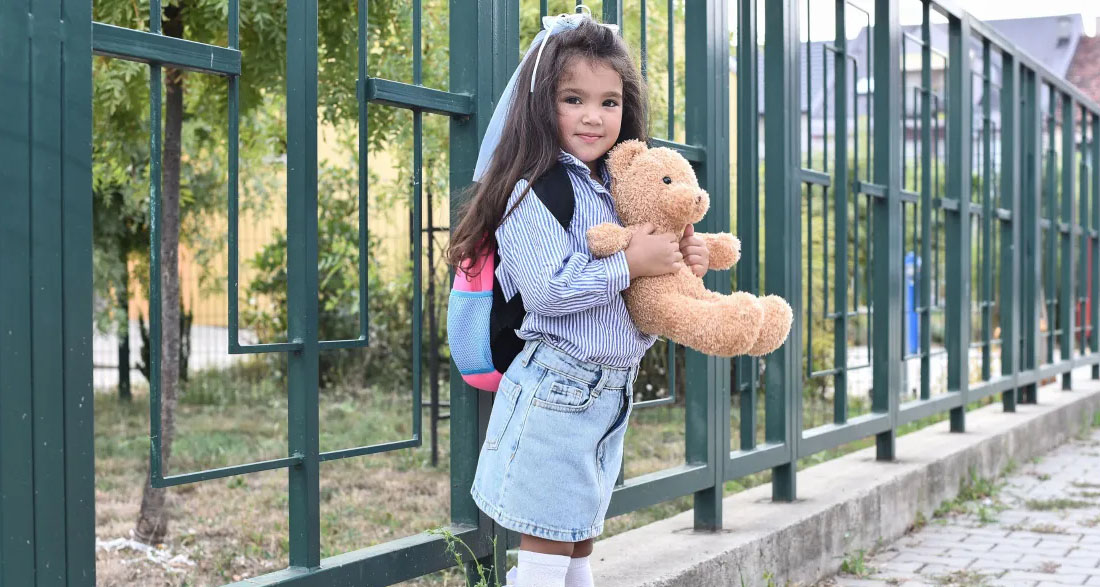
Twenty-one years after my daughter vanished from a kindergarten playground, I told myself I had finally made peace with it. I told myself I had learned how to breathe around the pain. I told myself I had accepted that some questions would never have answers.
Then, on what would’ve been her 25th birthday, a plain white envelope showed up in my mailbox.
Inside was a photograph. And a letter that began with two words that made my heart stop.
“Dear Mom.”
For 21 years, I kept my daughter’s room exactly the same.
Lavender walls. Glow-in-the-dark stars stuck to the ceiling. Tiny white sneakers by the door, toes pointed toward the hallway like she might step back into them at any moment.
If I opened the closet and leaned in close, I could still catch the faint scent of her strawberry shampoo. I used to stand there and breathe it in, eyes closed, pretending she was just downstairs watching cartoons.
My sister said it wasn’t healthy.
“Laura, you can’t freeze time,” she told me once, standing in the doorway of Catherine’s room like she was afraid to step inside. “You’re living in a museum.”
I didn’t even look at her. I just smoothed the blanket on Catherine’s bed and said, “You don’t get to redecorate my grief.”
My sister’s eyes filled with tears. “I just don’t want you stuck here forever.”
“I already am,” I whispered.
She left after that. Quietly. Carefully. Like the room might break if she moved too fast.
Catherine was four when she disappeared.
Four.
She wore a yellow dress covered in little daisies that morning. Two mismatched barrettes clipped into her curls—one pink, one blue—because she insisted that “princesses mix colors.”
That morning, she had looked up at me from the kitchen table and asked, “Curly noodles tonight, Mommy?”
Frank laughed as he lifted her tiny backpack. “Spaghetti with curlies. Deal.”
I remember shouting as they walked out the door, “Catherine! Your red mitten!”
She waved it out the car window and yelled, “I got it!”
If I had known that was the last time I’d see her, I would have run after the car. I would have held her tighter. I would have said a thousand more things.
But the playground looked normal.
That’s the cruel part.
It was ten minutes.
One minute she was standing in line for juice boxes. The next minute she was gone.
When the school called, I was at the sink, rinsing a coffee mug, thinking about absolutely nothing important.
“Mrs. Holloway?” Ms. Dillon’s voice trembled through the phone. “We can’t find Catherine.”
I laughed at first, confused. “What do you mean you can’t find her?”
“I—I turned my back for a second,” she stammered. “She was right there.”
I was already grabbing my keys. “I’m on my way.”
The playground looked normal when I got there.
Kids screamed and ran. The swing squeaked. The sun shone like nothing terrible had happened.
Frank stood near the slide, stiff as a statue, staring at the ground.
A police officer was crouched beside a small pink backpack.
I grabbed Frank’s arm. “Where is she?”
His mouth opened. Closed. Opened again.
“I don’t know,” he whispered. His eyes looked empty.
Her pink backpack lay tipped over in the mulch. One strap twisted. Her red mitten lay in the wood chips, bright and loud like a warning flare.
I picked it up and pressed it to my face. It smelled like dirt. Soap. And her.
A police officer looked up at me and asked, “Any custody issues? Anyone who might take her?”
“She’s four,” I snapped. “Her biggest problem is nap time.”
There were no cameras back then. No clear footage to replay. Just guesses and fear.
Dogs searched the trees. Volunteers knocked on doors. Every siren made my heart leap. Every quiet hour crushed it again.
Detectives sat at our dining table and asked questions that felt like knives.
“Anyone close to the family?” one of them asked.
Frank kept his hands clasped so tight his knuckles turned white. “I dropped her off,” he muttered. “She was smiling.”
The detective lowered his voice. “Sometimes it’s someone you know.”
Frank flinched. It was quick. Almost invisible.
But I saw it.
After the detectives left, I asked him, “What was that?”
He stared at the floor. “Because I failed her,” he said. “That’s all.”
Three months later, Frank collapsed in our kitchen.
He had been fixing the loose cabinet hinge Catherine used to swing on. “Hand me the screwdriver,” he said.
Then his hand went slack. His knees hit the tile so hard the sound echoed in my skull.
“Frank! Look at me!” I screamed, slapping his cheek. “Stay with me!”
In the emergency room, a doctor said, “Stress cardiomyopathy.”
Like he was reading the weather.
A nurse leaned close and whispered, “It’s sometimes called broken heart syndrome.”
I hated her for making it sound soft.
At the funeral, people kept saying, “You’re so strong.”
I nodded like a trained animal.
Later, in the car, I slammed my fists against the steering wheel until my wrists throbbed.
I had buried my husband while my daughter was still missing.
My body didn’t know which grief to carry first.
Time kept moving. Rude. Steady.
I worked. I paid bills. I smiled at cashiers. Then I cried in the shower where the water could hide it.
Every year on Catherine’s birthday, I bought a cupcake with pink frosting. I lit one candle upstairs in her room and sat in Frank’s old rocking chair.
“Come home,” I would whisper.
Sometimes it sounded like a prayer.
Sometimes it sounded like a challenge.
The room never answered.
Last Thursday would have been her 25th birthday.
Twenty-five. It sounded like someone I didn’t know.
I did my ritual. Lit the candle. Whispered the words. Then I went downstairs to check the mail because my hands needed something to do.
That’s when I saw it.
A plain white envelope sat on top of the pile. No stamp. No return address.
Just my name written in careful, neat handwriting.
My fingers shook as I tore it open.
Inside was a photograph.
A young woman stood in front of a brick building. She had my face at that age. But her eyes—
Her eyes were Frank’s. Deep brown. Unmistakable.
Behind the photo was a folded letter.
I opened it.
The first line made the room tilt.
“Dear Mom.”
I read it once.
Twice.
Three times.
“You have no idea what happened that day,” it continued. “The person who took me was NEVER a stranger.”
My hand flew to my mouth. “No,” I whispered.
But the ink didn’t disappear.
“Dad didn’t die. He faked my kidnapping to start a new life with Evelyn, the woman he was seeing. She couldn’t have kids.”
Frank.
Dead in the ground.
Alive on paper.
My brain refused to do the math.
At the bottom was a phone number.
And one final line.
“I’ll be at the building in the photo Saturday at noon. If you want to see me, come.”
Signed, “Love, Catherine.”
I called before I could lose my nerve.
The phone rang twice.
“Hello?” A young woman’s voice. Careful. Thin.
“Catherine?” My voice cracked.
Silence.
Then a shaky breath.
“Mom?” she whispered.
I collapsed into the rocking chair and sobbed. “It’s me,” I gasped. “It’s Mom.”
We spoke in broken pieces.
She told me Evelyn renamed her “Callie” and corrected her if she ever said Catherine.
I told her, “I never stopped looking.”
She answered sharply, “Don’t apologize for them.”
Saturday came.
I drove to the brick building with my hands locked tight on the steering wheel.
She stood near the entrance, shoulders tense, scanning the street like she expected danger.
When she saw me, her face went blank.
Then it broke.
“You look like my face,” she said softly.
“And you have his eyes,” I replied.
I lifted my hand slowly. She nodded once.
My palm touched her cheek.
Warm.
Real.
She inhaled sharply, like she’d been holding that breath since she was four.
We sat in my car with the windows cracked because she said closed spaces made her panic.
She handed me a folder. “I stole copies from Evelyn’s safe,” she said.
Inside were name-change documents. Fake custody papers. Bank transfers with Frank’s name.
There was even a blurry photo of him. Alive.
“I buried him,” I whispered.
“She told me he died too,” Catherine said. “But I remember suits. Paperwork. And her practicing tears in the mirror.”
Her voice hardened. “He left me with her and disappeared.”
“We’re going to the police,” I said.
Her eyes flashed with fear. “Evelyn has money. She makes problems disappear.”
I squeezed her hand. “Not this one.”
At the station, a detective listened with a tight expression. Another officer looked skeptical.
Catherine’s voice trembled as she described the playground.
“He walked me to the car like it was normal,” she said. “He told me you didn’t want me.”
I leaned toward her. “I wanted you every second.”
The detective sighed. “We’ll need more proof to move on a wealthy suspect.”
“Then help us get it,” I snapped.
That night, Catherine received a text.
COME HOME. WE NEED TO TALK.
“She never texts,” Catherine whispered. “She hates records.”
“We don’t go alone,” I said.
We arranged for the detective to wait nearby.
Evelyn’s house was massive. Gated. Perfect. Cold.
“It always felt like a stage,” Catherine murmured.
“Then we stop acting,” I said.
Evelyn opened the door in a silk robe, smiling like she owned the world.
“There you are,” she said to Catherine, like she’d misplaced her purse.
Then she looked at me. “Laura. You look tired.”
“You stole my daughter,” I said.
“I gave her a life,” Evelyn replied smoothly.
“You bought me,” Catherine shot back. “Like furniture.”
“Watch your mouth,” Evelyn hissed.
A man stepped into the foyer behind her.
Older. Heavier.
But unmistakable.
Frank.
“Frank,” I said. The name tasted like poison.
“Laura,” he answered flatly.
“I buried you,” I said. “I held a funeral.”
“I did what I had to do,” he replied.
“You took our child.”
“She was safe,” he said to Catherine. “You had everything.”
“Except my mother,” she said sharply.
Then quieter, “Why did you leave me with her?”
He had no answer.
Suddenly the detective stepped inside.
“Sir,” he said calmly, “according to records, you are deceased.”
Frank went pale.
Evelyn’s smile disappeared.
Catherine’s hand gripped mine. “Can we go?” she whispered.
“Yes,” I said. “Right now.”
After that, everything moved fast and slow at the same time. Charges. Statements. Reporters.
Frank’s second life collapsed under handcuffs and paperwork.
I stopped reading the headlines when they turned Catherine into a story instead of a person.
At home, she stood in the doorway of her old room.
“You kept it,” she whispered.
“I didn’t know how to stop,” I admitted.
She touched one tiny sneaker gently. “No one ever kept anything for me.”
The first weeks were messy.
She checked the locks twice every night. Slept with a lamp on.
Sometimes she snapped, “Don’t hover.”
And I would step back, then cry quietly in the laundry room.
But we rebuilt slowly.
Tea on the porch.
Short walks.
Photo albums only when she asked.
One night, she stared at a photo of herself at three.
“I don’t remember your voice the way I wanted,” she said.
I swallowed hard. “Then we’ll make new memories. As many as you want.”
On her next birthday, we bought two cupcakes.
She lit two candles and smiled softly.
“One for who I was,” she said.
“And one for who I am.”
We sat together in the rocking chair, knees touching.
For the first time in twenty-one years, the room didn’t feel frozen.
It felt alive.