

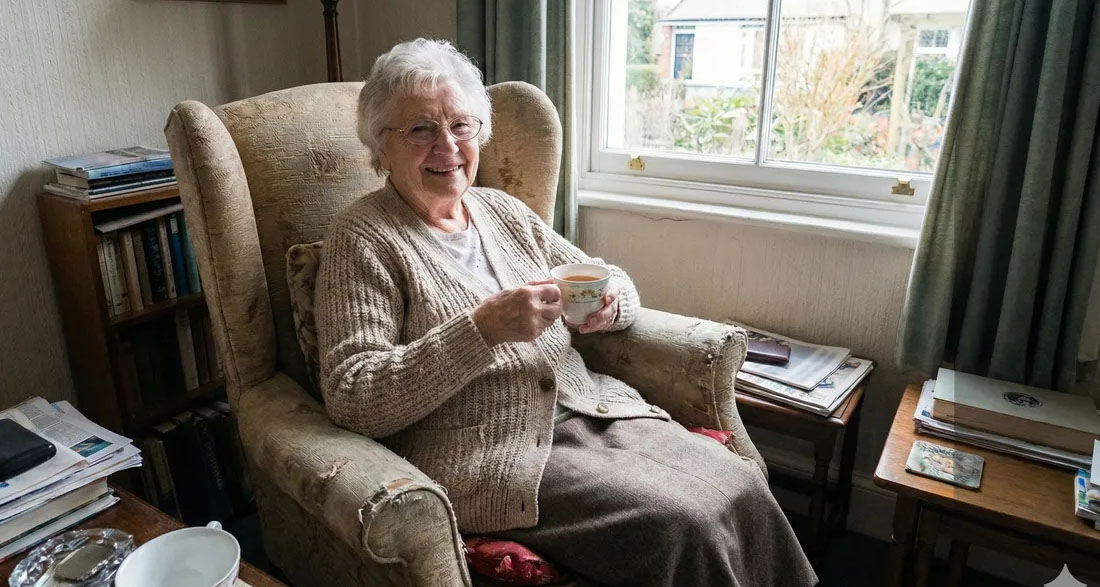
When my grandma died, she left me something I wasn’t ready for—not just her fully paid house, but a mystery that had been quietly growing for years.
The house sat in a neighborhood that looked perfect at first glance. Too perfect. The kind of place where lawns were trimmed like a magazine cover and people smiled just a little too tightly. Even before I moved in, something about it felt… watchful.
Still, I couldn’t let strangers take her home.
So two weeks after her funeral, I packed my things and moved in.
I told everyone it was practical. “It just makes sense,” I said. But the truth was heavier. I couldn’t stand the idea of someone else repainting her walls, ripping out her kitchen, or erasing every memory she had built there over 42 years.
Her porch steps had a slight dip in the middle from where she used to sit every afternoon, sipping iced tea and watching the street. I could almost still see her there.
But now, the porch was empty.
And the silence felt wrong.
The first morning I arrived, I noticed the neighborhood watching me.
Curtains shifted.
Doors opened just a crack.
People pretended to water plants while clearly staring.
Across the street stood Mrs. Keller, in front of her beige house with perfect flowerbeds. Grandma used to call her “the mayor” when she thought no one could hear.
Keller didn’t even try to hide her stare.
“You must be the grandson,” she called out sharply.
I nodded. “Yeah. I just moved in.”
Her lips tightened. “We like to keep things tidy around here.”
There was something in her tone that didn’t sound welcoming at all.
“I’m not here to cause trouble,” I said carefully.
Her eyes swept over the yard, the boxes, the trash bins.
“Your grandmother had… habits,” she said, then turned and walked away without another word.
I stood there, confused—and already uneasy.
That night felt worse.
Every time headlights passed by, shadows slid across the walls like something alive. I barely touched my dinner, a cold piece of lasagna sitting untouched on my plate.
The house didn’t feel like home without her.
It felt like it was holding its breath.
The next morning, I went to her dresser, just looking for towels.
Instead, I found something that made my stomach drop.
Five sealed envelopes.
Each one had a name written in Grandma’s neat handwriting.
Mrs. Keller. Don. Lydia. Jared. Marnie.
On top of them was a small note.
“After I’m gone, deliver these.”
I stared at it for a long time.
“What did you do, Gran?” I whispered.
I promised myself I wouldn’t open them.
It felt wrong. Like reading her private thoughts.
But she had asked me to deliver them.
And I couldn’t ignore her last request.
By midmorning, I stood in front of Keller’s door, holding the envelope.
Before I could knock, the door opened.
She had been waiting.
“This is from my grandmother,” I said, holding it out.
Keller’s eyes flicked to the handwriting.
“That’s… unexpected,” she muttered, taking it carefully, like it might bite her.
Then she shut the door.
Just like that.
No thank you. No questions.
I walked back home, my hands shaking.
I told myself I’d deliver the rest after lunch and be done with it.
But I never got the chance.
Less than an hour later, sirens screamed down the street.
Two police cars stopped right in front of Keller’s house.
My heart dropped.
I stepped outside, and an officer approached me.
“You live here?” he asked.
“My grandma did. She passed away. I just moved in.”
He studied me carefully. “Did you deliver a letter to the woman across the street?”
My throat went dry. “Yes. It was sealed.”
“She called 911,” he said. “Claims it contained documents and a flash drive. She says it was threatening.”
“A flash drive?” I said, stunned. “I didn’t put anything in there!”
He didn’t look convinced.
“Don’t deliver any more letters,” he said firmly. “A detective will speak with you.”
I nodded quickly and went back inside.
My eyes went straight to the dresser.
The remaining envelopes suddenly felt… dangerous.
I couldn’t help it.
I opened one.
Don’s envelope.
Inside was a stack of papers and a USB drive.
At the top was a title, written in Grandma’s handwriting:
“Timeline of incidents.”
Dates filled the page.
Careful. Detailed.
Precise.
I flipped through the papers, my stomach twisting.
Complaint reports.
Screenshots.
Photos of our yard—taken from inside the fence.
“Someone was in here…” I whispered.
I opened another envelope.
Lydia’s.
“Missing items,” the first page read.
Jewelry box. Silver spoon. Medication organizer.
Next to some entries, Grandma had written:
“Last seen after Lydia arranged a contractor visit.”
I sat down hard on the floor.
“Why didn’t you tell me?” I whispered.
Another envelope.
A forged petition—with Grandma’s signature copied and circled in red.
Another.
A hand-drawn map showing how to move through the side path without triggering the porch light.
“They think I’m stupid. I’m not.”
Her words hit me like a punch.
The last envelope—Marnie’s—started with one chilling line:
“If anything happens to me, this is why.”
My hands shook.
I grabbed my phone and called the number the officer gave me.
“There are more letters,” I said. “They’re evidence.”
Detective Rios arrived soon after.
She sat at Grandma’s kitchen table, her expression sharp and serious.
“Start from the beginning,” she said.
I told her everything.
When I finished, she tapped the timeline.
“Your grandmother documented a pattern,” she said. “Some of these match previous reports. But without proof, people dismissed them as neighbor disputes.”
“So no one believed her?” I asked quietly.
Rios looked at me. “We need proof to act.”
Then she pointed at the envelopes.
“You don’t deliver anything else. And you don’t confront anyone.”
That night, I heard something.
A scrape.
Near the side gate.
When I checked, it was open.
Swaying.
The next morning, my trash bin looked wrong.
The lid was half-open.
A bag I didn’t recognize sat on top.
My chest tightened.
“I think they know,” I told Rios on the phone.
“Stay inside,” she said immediately. “Don’t touch anything.”
That afternoon, there was a knock.
Keller stood on my porch.
With Don.
And Lydia.
Lydia smiled too sweetly. “We wanted to offer condolences.”
Don added, “We heard about letters. Your grandmother was… upset near the end.”
Keller leaned closer.
“We don’t want misunderstandings,” she said softly. “Show us what she wrote, and we can move on.”
I kept the screen door firmly closed.
“No.”
Her smile faded. “That’s not very neighborly.”
“Neither was reporting her for ‘suspicious activity’ when she fixed her own roof,” I shot back.
Lydia crossed her arms. “We were protecting the neighborhood.”
“You were ganging up on her,” I said. “Of course she had to be sneaky.”
Then I shut the door.
Behind me, Rios stepped out from the living room.
“Good,” she said. “They’re nervous.”
Later, I checked the yard like she suggested.
At first, I saw nothing.
Then—
A tiny lens.
Hidden inside a birdhouse.
My breath caught.
“Gran…” I whispered.
She had been watching back.
Two nights later, we set a trap.
The house was dark.
I sat in the living room, barely breathing.
Rios and another officer waited upstairs.
At exactly 11:30, the backyard light flicked on.
Shadows moved.
The back door handle jiggled.
My heart pounded.
“Don’t move,” Rios whispered through the earpiece.
I watched the camera feed.
Mrs. Keller stepped into view.
Holding a bag.
Don stood behind her, nervous.
Lydia and Jared hovered nearby.
“Hurry,” Lydia whispered.
Keller hissed, “I know this gate doesn’t lock.”
Don shoved the gate.
“She can’t ruin us from the grave,” he muttered.
Lydia’s voice shook. “We have to get the papers. If they exist, they need to disappear.”
That was it.
Proof.
Rios’s voice came through:
“Now.”
Sirens exploded through the night.
Lights flooded the yard.
Officers rushed in.
“Stop right there!”
Keller spun around. “This is ridiculous! We were checking on him!”
Don immediately pointed at her. “It was her idea!”
Lydia burst into tears. “I’m not even really part of this!”
Jared stepped forward from the shadows. “I told you this was a bad idea!”
Everything fell apart in seconds.
When it was over, the street went quiet again.
I stood on the porch beside Rios.
“Was it really all of them?” I asked.
She nodded. “They isolated your grandmother. Made her seem unstable so no one would believe her.”
“Why her?”
“Because she noticed things,” Rios said. “And they thought she was easy to bully.”
I looked at the house, guilt tightening my chest.
She had been fighting this alone.
And I never knew.
A week later, everything changed.
No more fake smiles.
No more watchful stares.
Don’s house went up for sale.
Like a surrender.
Rios returned one last time, handing me a folder.
“We copied everything,” she said. “Keep these safe.”
“Thank you,” I said quietly.
After she left, I found one last note.
Hidden behind the others.
This one was for me.
“Sweetheart,” it began.
My eyes filled with tears.
“I was scared sometimes,” she wrote. “But I was prouder than I was scared. I did not want my life turned into a story where I was the problem.”
I pressed the paper to my forehead.
Outside, I reached up and gently touched her wind chimes.
They rang out—clear, strong, and stubborn.
Just like her.