

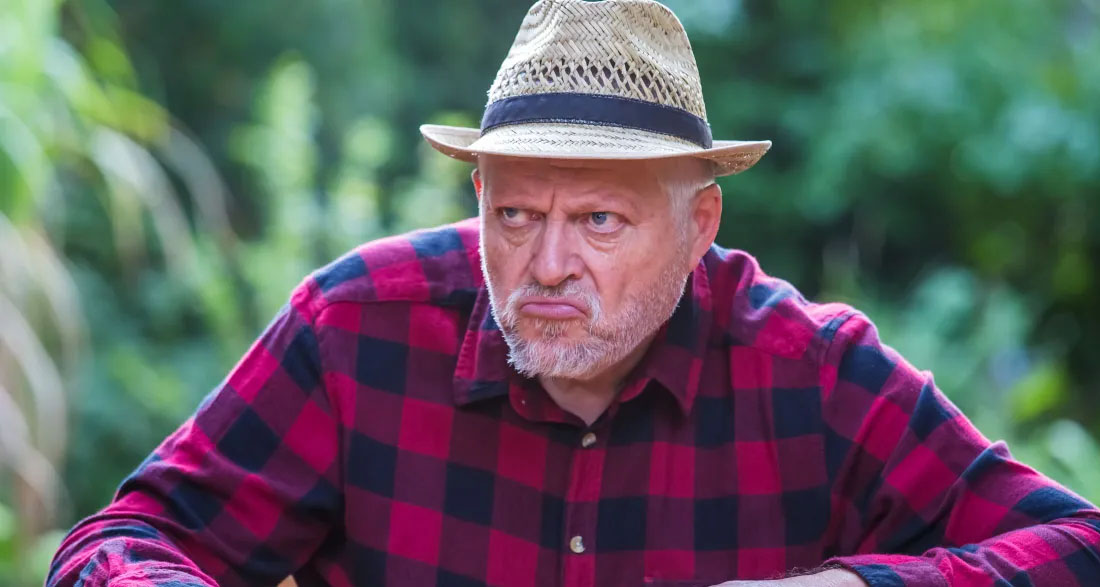
For ten long years, my neighbor yelled at my kids like it was his full-time job. If a basketball hit the pavement too hard, he yelled. If chalk dust floated too close to his driveway, he yelled. If a bike wheel crossed some invisible line only he could see, he yelled.
Then he died.
And just when I thought that chapter of our lives had finally closed, his daughter showed up with a locked metal box addressed to my youngest son.
That was the moment everything I thought I knew about the man next door began to unravel — one secret at a time.
The morning after Mr. Henderson died, the whole street felt wrong. Too quiet. Like someone had muted a sound we had gotten used to, even if we hated it. His absence wasn’t peaceful. It was unsettling. The air itself felt different.
My kids were outside.
Sam paced in front of the house, jittery in that anxious teenage way he had before school. Mia bounced her basketball, but softly — almost carefully — like she thought the pavement might complain. Leo sat on the porch step, legs crossed, holding a peanut butter sandwich he hadn’t touched.
The morning after Mr. Henderson died, the street felt wrong.
“Is it okay if we bounce the ball now, Mom?” Mia asked, looking at me like she needed permission for something that had always been hers.
I was kneeling, tying Leo’s shoelace. I looked up and gave her a smile I didn’t quite feel.
“Yes. It’s okay. It’s always been okay, honey.”
She nodded… but she still glanced next door.
The porch was empty.
The railing Mr. Henderson used to grip like a judge passing sentence looked small without him. Weak, even.
“Is it okay if we bounce the ball now, Mom?” she repeated quietly.
Ten years of yelling over chalk, basketballs, and bike wheels.
Ten years of me biting my tongue.
And on the rare days I didn’t bite it — snapping back.
The kids had learned to walk the long way to the bus stop just to avoid setting him off. They knew which boards on the sidewalk creaked too loud. They knew which patch of driveway he claimed like it was sacred land.
One December, I baked cookies. A peace offering. I left them on his porch with a polite note.
I watched through my front window as he opened the door, looked down at the plate, didn’t even lift the plastic wrap… and dumped the entire thing straight into the trash.
Didn’t open them. Didn’t hesitate.
Still, Leo waved at him every single morning.
Even when the only response was a growl.
Or a door slam.
Or nothing at all.
Ten years of me biting my tongue.
That night, something shifted.
The kids stayed outside longer than usual.
Mia climbed the tree in our front yard like she was reclaiming it. Sam rode his bike in tight circles up and down the street, back and forth, back and forth, like he was testing the edges of freedom. Leo knelt with sidewalk chalk and drew across our driveway… and then kept going.
Right across the sidewalk.
Right in front of Mr. Henderson’s house.
He didn’t ask.
He just did it.
And I didn’t stop him.
For the first time in years, it felt like we didn’t have to look over our shoulders.
The next afternoon, Mrs. Callahan from the HOA practically materialized out of nowhere. Arms folded. Eyes sharp. The kind of curiosity that wasn’t kindness.
“Well,” she said loudly, making sure half the block could hear. “So he finally died.”
Sam stiffened beside me.
“That’s a horrible thing to say,” I replied evenly.
Mrs. Callahan shrugged. “I’m just saying what everyone’s thinking. He complained about your… situation for years.”
A black sedan rolled slowly to the curb.
Mrs. Callahan leaned closer and lowered her voice just enough to feel threatening.
“You watch. His family’s going to come after you for all those HOA complaints.”
The car door opened.
The woman who stepped out was sharp in every sense of the word. Sharp black suit. Sharp posture. Sharp eyes scanning the street like she was collecting information.
She looked exactly like Mr. Henderson.
She didn’t head to her father’s house.
She walked straight up our path.
I stepped onto the porch, wiping my hands on a dish towel. Sam stood beside me. I rested my hand gently on his shoulder.
The woman stopped at the bottom of the steps.
“Are you the mother of the three rascals that made my father yell?” she asked, a slow smile forming.
I nodded cautiously. “Depends on who’s asking. I’m Jenelle.”
She lifted an eyebrow. “I’m his daughter. Andrea. And yes, I know I look like him.”
Tension rushed back into my chest.
I pulled Leo a little closer.
“I’m not here to start anything,” Andrea said calmly. “I just have something to deliver.”
“What kind of… something?” I asked.
She glanced past me into the living room. Her eyes paused on Leo’s LEGO creations stacked proudly on the shelf.
“It’s for your youngest boy.”
Leo appeared behind me, barefoot, thumb hooked in his pocket.
“I just have something to deliver,” she repeated.
After a long moment, I stepped aside.
She moved with purpose through the house, heels silent against the tile. She didn’t react to muddy sneakers by the door or the half-crushed science fair board leaning against the wall.
In the kitchen, she stopped.
Her eyes landed on the fridge.
Pinned between a pizza coupon and Mia’s spelling test was Leo’s latest drawing.
A stick-figure man with huge bushy eyebrows, holding a dandelion in one hand and a coffee mug in the other.
Above it, in bright orange crayon, Leo had written:
“Even mean people need flowers.”
Andrea’s face changed — just slightly. Something cracked.
She looked down at the metal lockbox in her hands and set it on the table like it weighed more than it should.
“This is for him,” she said quietly.
“For Leo? Why?” I asked.
Her jaw tightened.
“Because my father put it in writing,” she said. Then she exhaled slowly. “And because… I’m tired.”
Before I could ask what she meant, she turned and left.
The kids gathered around the box.
“Well?” Mia asked. “Are you going to open it, Mom?”
“Yes,” I said. “Let’s see what this is.”
Inside was a single USB drive.
“That’s it?” Sam muttered.
“Maybe there’s more. Bring me my laptop, baby.”
He handed it to me.
I plugged in the drive.
The screen flickered.
And there he was.
Mr. Henderson.
But he wasn’t yelling.
He was crying.
“Why does he look… sad?” Leo whispered.
My throat closed.
On the screen, his voice trembled.
“I made myself unbearable on purpose,” he said. “I needed to know if anyone could be kind to someone who didn’t deserve it.”
My hand shook. The mug I was holding slipped from my fingers and shattered on the floor.
“I’ve got it,” Sam said quietly, kneeling to gather the pieces.
The screen changed to porch security footage. Years of it. Time-stamped.
“There’s our old stroller,” Mia said softly.
“And there’s you,” Sam added. “Dragging us inside after he screamed at Mia for riding too close to his driveway.”
I watched myself on screen — furious, protective, wild-eyed.
“I look like a stranger,” I whispered.
“You were scared,” Mia said gently. “That’s not the same as being mean.”
Another clip appeared.
Three months ago.
Rain pouring.
Mr. Henderson struggling to bend down to grab his cane.
“That was the day I wore my yellow jacket,” Leo said.
There he was — tiny, soaked, hood slipping.
“Get away from me!” Mr. Henderson snapped in the footage.
But Leo didn’t run.
He picked up the cane.
He set it gently against the railing.
Then he reached into his coat pocket.
“A dandelion,” Leo whispered. “It was in my pocket all day.”
On the screen, he held it out.
“It’s for you. To make you feel better.”
The footage froze on Mr. Henderson’s face. Shock. Something softer underneath.
Then his voice returned.
“I spent 80 years trying to prove people are only good when it’s easy. That kindness is a reflex, not a choice. But he… he chose it. Every day.”
The screen went black.
Silence filled the kitchen.
A knock broke it.
Andrea stepped inside again.
“You watched it,” she said quietly.
“Yes,” I replied. “Your father had a camera pointed at the porch. That’s still not okay.”
“It was only the porch,” she said quickly. “No inside footage.”
“Don’t defend him.”
“I’m not,” she said, sitting down. “I’m trying to explain what I survived.”
She looked at the broken mug on the floor.
“He missed my graduation,” she said. “Sent rules instead of coming. That’s who he was.”
“That’s what he did to my kids,” I said. “He was awful to them.”
Andrea looked at Leo.
“Then why does it hurt so much,” she whispered, “that he finally softened… and it wasn’t for me?”
Her voice cracked.
I saw it then — not just anger. Years of loneliness.
“I’m sorry,” I said softly. “You didn’t deserve that. I can feel for you and still protect my kids. Both things can be true.”
She nodded slowly.
“He didn’t want connection. He wanted control,” she said. “He said kindness made people weak. Predictable.”
She looked at Leo.
“But this boy… he got a version of my father I never knew.”
She swallowed.
“It shouldn’t hurt. But it does.”
“It makes sense,” I said. “You didn’t get closure. You got a surprise.”
She pulled out a manila envelope.
“He left most of his money to charities,” she said. “Education. Mental health. Veterans. Quietly.”
“And the house?” I asked.
She nodded.
“The house next door is in Leo’s name. There’s a trust. College. Housing. Stability.”
My throat tightened.
“Why Leo?”
“Because your son didn’t ask for anything,” she said. “He just gave.”
She handed me the envelope.
Inside was a letter.
“To the Mother,
You kept your children kind in a world that tried to harden them.
That’s not weakness. That’s brilliance.
Thank you for letting Leo wave. Thank you for letting him be… human.”
Tears blurred the words.
“I should go,” Andrea said softly.
“You don’t have to,” I replied.
“Why?”
“Because you don’t have to carry him alone anymore.”
Leo looked up with that same steady kindness.
“Do you want some hot chocolate?” he asked her.
Andrea let out a breath that sounded like it had been trapped for years.
“Yeah,” she said. “I’d like that.”
A minute later, she smiled at him — small, crooked, real.
“He thought kindness was weakness,” she said. “But your son made him believe otherwise. That’s no small thing.”
Leo hummed as he pulled two mismatched mugs from the cabinet.
And there we sat — not enemies, not survivors.
Just people at a table.
A few shared silences.
And the boy who never stopped waving.