

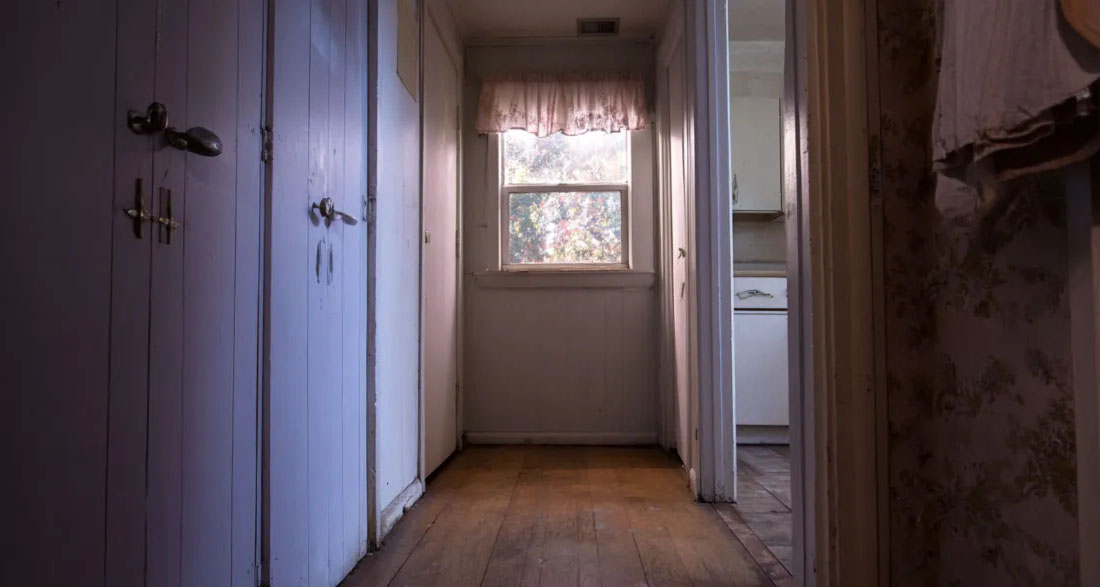
My husband and I built a quiet, steady marriage. Or at least, that’s what I thought. But there was one closet in our house I was never allowed to open. A small, locked door at the end of the hallway that Thomas kept off-limits. I never questioned it—until he died.
After the funeral, grief hit me harder than I expected. Forty years of life shared, and suddenly I was walking through our empty house, listening to the echoes of a laughter that was gone. The rain had soaked my coat as I watched them lower Thomas into the dirt.
“A heart attack,” the doctors said. “It was quick.”
“At least he didn’t suffer,” someone whispered at the wake.
I nodded, because what else do you say? People toss that line around like it cushions the blow, but it doesn’t. Grief after forty years is quiet. It doesn’t scream. It’s the empty chair across the table, the unsaid “good morning,” the silence that stretches and stretches.
Thomas had always seemed like a man with nothing to hide. Open, kind, predictable… except for that closet.
At the end of our hallway sat the forbidden door. He kept it locked. Always.
“Just old paperwork, Margaret. Nothing interesting,” he’d say whenever I asked what was inside.
And I believed him. Forty years of marriage teaches you to trade small curiosities for peace. You stop poking. You trust the man holding the key.
But after he died, I couldn’t ignore it anymore.
On the tenth day of being a widow, I called a locksmith.
When he arrived—a young man with a heavy tool belt and a bored expression—I stepped back and let him work. The metallic click of the lock echoed through the hallway like a gunshot in the quiet house. The door creaked open. Dust hung in the air, mingling with the faint smell of old paper.
Inside were stacks of boxes and a heavy metal strongbox. No skeletons, no shocking secrets at first glance. But then the real mystery began.
“You want me to pop this one too?” the locksmith asked, nodding toward the strongbox.
“Please,” I said, my hands trembling.
I pulled the first cardboard box toward me. Inside were bundles of letters tied with rough twine. Yellowed, fragile, decades old. I opened the first envelope.
Tom, the check came yesterday. Thank you. I didn’t know how I was going to cover the cleats and the league fee this month. He doesn’t know where the money comes from. I told him it’s from an old friend of his father. I hope that’s all right. He asks about you sometimes. — M
My hands went cold. I pulled another letter.
Tom, you don’t have to keep doing this. I know what it costs you to send it. But if you’re going to help, we need to talk about how long we’re going to keep the truth from him. He’s not a little boy anymore. He deserves to know who you are to him. — Marilyn
I froze. The truth? A life I’d never known existed. Thirty-nine years of marriage, and Thomas had a secret child—or so it seemed at first.
“I was 19 when I married you,” I muttered to the empty hallway. “When did you even find the time?”
I kept digging, and then one envelope stopped my breath. A return address: a State Correctional Facility.
Tommy, you shouldn’t be writing to me. Mom and Dad changed your name and moved you away to protect you from what I did, don’t you get that?
I blinked. I read it again.
Another letter:
I’m glad you reached out. It gives me a chance to apologize. I should’ve been a better role model for you, Tommy. If I could go back, I’d be a better big brother. — Steve
Big brother? Thomas always said he was an only child. Layers of lies stacked in that closet like dusty bricks.
Another letter:
Tommy, I heard from Marilyn. She’s pregnant. I don’t know what kind of father I can be from in here, but if that baby carries my last name, he deserves better than what I gave him. — Steve
Suddenly it clicked. Thomas wasn’t hiding a son. He was quietly helping a nephew. A nephew whose father had caused a tragedy and whose mother needed help.
The loud bang of the strongbox snapping open made me jump. Inside were newspaper clippings, a worn leather catcher’s mitt, and scuffed baseballs.
“Oh, wow! I know this guy!” the locksmith exclaimed. “My dad talked about him all the time. He had the best arm in the county. Then he got into a bad wreck. The other driver died, and he went to prison. People stopped talking to the family overnight.”
I picked up a photo: a young man in a baseball uniform, arm around a little boy, two adults smiling proudly behind them. The boy was Thomas.
I dug deeper and found a name change form. Thomas’s original last name stared at me in black and white. Everything clicked.
He hadn’t been hiding a child. He had been forced to carry a secret about a brother he loved but couldn’t claim. He had shouldered responsibility, helped a family, and stayed silent for decades.
“It’s a shame,” the locksmith said quietly. “One bad night, and your whole life is gone. Steve died alone in his cell years later.”
I paid him and let him go, then sat on the floor of the hallway, reading every letter, every note, every scrap of paper.
“Why did you think you had to carry this by yourself?” I whispered to the empty house.
The answer was clear: he didn’t choose shame; he chose love.
Two days later, I drove to Marilyn’s small, neat house, box in arms. A man in his 30s opened the door. He had Thomas’s eyes.
“Can I help you?” he asked.
“I… are you Marilyn’s son?”
He narrowed his eyes at the box, then me. “Who’s asking?”
“My name is Margaret. I was married to Thomas.”
He froze. Then: “My Uncle Tom?”
“You knew about him?”
He nodded. “Mom told me when I turned 18. He didn’t want credit. He just wanted me to have a shot at college.”
I smiled softly. “That sounds exactly like him.”
I handed him the box. “These were your father’s. Your uncle kept them to make sure he wasn’t forgotten. He loved his brother, even when he couldn’t say it out loud. You should have them.”
He traced the worn glove with his fingers. “Thank you.”
“Don’t thank me,” I said. “Thank your uncle. He did the heavy lifting.”
That night, I returned home. The hallway felt different. No longer narrow, no longer heavy. I stood in front of the open closet door. For thirty-nine years, I had avoided it. Not because he had secrets, but because I was afraid of the truth.
I never locked that door again. Silence doesn’t have to mean shame. My Thomas had been an honorable man all along, carrying love and responsibility in ways I had never imagined. I could honor him now by honoring the family he had quietly saved.