

When I first met Javier, I knew he had a daughter from his previous marriage. He spoke about her with warmth, but also with a careful distance, like he was protecting himself from old wounds. Her name was Lucía, and she was five years old when she came to live with us in Valencia after our wedding.
From the very first day, I noticed how quiet she was. She didn’t run around or demand attention.
Instead, she watched everything carefully. Her big brown eyes seemed to take in every detail, almost as if she were deciding whether the world around her was safe. She followed me around the house, her little stuffed rabbit clutched to her chest like a shield.
But the thing that worried me the most was her eating—or the lack of it.
No matter what I cooked—cheese omelets, baked rice, chicken croquettes, lentils—she would just push the food around her plate and whisper, “Sorry, Mommy… I’m not hungry.”
That tiny “Mommy” melted my heart every time. She said it so softly, almost unsure if she was allowed to. But there was also something heavy in her voice, a shadow that made my stomach tighten. I told myself she was shy, that she just needed time. Still, it hurt seeing her so thin, so fragile.
Every night, the routine was the same. I’d prepare something I hoped she’d like, set the table, and watch her take one or two small bites—or sometimes none at all. Then she’d sit silently, staring at her plate, until I finally told her she could leave the table.
After a few days, I couldn’t ignore it anymore. I spoke to Javier.
“Javi, something isn’t right. She barely eats anything,” I said one night after Lucía had gone to bed.
He rubbed his temples and sighed. “She’ll get used to it. It was worse when she lived with her mother. Give her some time.”
There was something in the way he said it that bothered me. It sounded rehearsed, like a phrase he’d repeated too many times. His voice held weariness, but also a strange dismissal, as if he didn’t want to face the truth.
I didn’t push him. Maybe he was right—maybe Lucía just needed to feel comfortable first. But a tiny voice in my heart whispered that this was more than shyness.
A week later, Javier left for a three-day business trip to Madrid. The first night without him, the house felt eerily quiet. I made Lucía a simple dinner—mashed potatoes and grilled chicken—and, as usual, she didn’t touch it. I cleaned the kitchen in silence, trying not to let my frustration show.
Then I heard a soft sound behind me—tiny footsteps on the tile.
I turned, and there she was, in her pajamas, clutching her rabbit. Her face was pale, her lips trembling, her eyes wide and serious.
“Can’t you sleep, sweetheart?” I asked, kneeling down to her level.
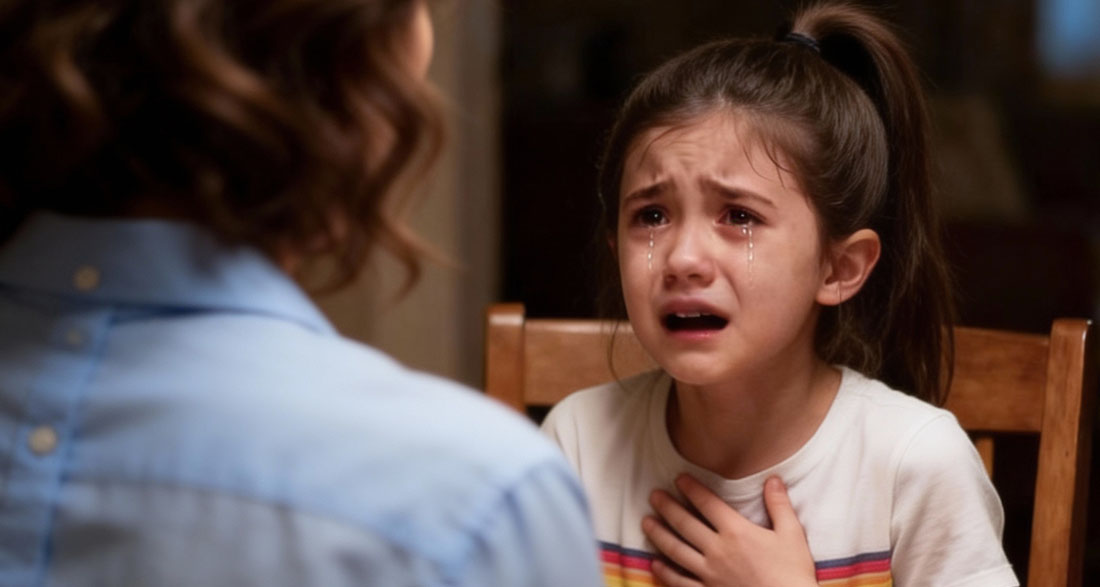
She shook her head. Her tiny voice barely rose above a whisper: “Mom… I need to tell you something.”
The chill that ran down my spine was immediate. Something in that tone made my stomach twist. I felt a cold dread settle over me, the kind that screams, something is very wrong.
I took her small hand and led her to the couch. She sat close, still hugging her rabbit, glancing nervously around the room, as if she feared someone might be listening. Then she leaned toward me and whispered words so quiet, I thought I’d imagined them.
But I hadn’t.
Her confession froze me. For a long, terrifying moment, I couldn’t breathe. My hands shook as I grabbed the phone, nearly dropping it as I dialed.
“I’m… I’m a little girl’s stepmother,” I stammered when the operator answered, my voice breaking. “And my stepdaughter just told me something very serious.”
The officer asked me to explain, and I tried, but my words came out in stammered bursts, choked by fear. Lucía sat beside me, clutching my arm, her eyes wide with confusion and fear. Then she repeated her story, loud enough for the officer to hear.
I will never forget the pause that followed, or the calm but urgent voice of the officer:
“Ma’am, stay where you are. Lock the doors. We’ve already dispatched a patrol car.”
Those ten minutes before help arrived felt like an eternity. I wrapped Lucía in a blanket, holding her close, feeling the weight of the warm lamp above us press down against the terror in my chest.
When the doorbell finally rang, I jumped. Two officers entered carefully, speaking softly, moving with gentle authority. One of them, a woman named Clara, knelt down to meet Lucía’s gaze and smiled warmly.
“Hi, sweetheart. I’m Clara. Can I sit with you?”
Lucía nodded ever so slightly.
Bit by bit, Clara coaxed the truth from her. Lucía didn’t say much at first, just enough to confirm the horrific pattern I had feared. She had been taught that if she “did something bad,” she wasn’t allowed to eat. That “good girls don’t ask for food.” That it was “better to stay hungry than be a bad girl.”
She didn’t say who had told her this, not yet. But the cruelty of it was clear—someone had used food as punishment for years.
Clara looked at me gravely. “We’ll take her to the hospital. She’s not in immediate danger, but she needs a full exam. And a psychologist will talk to her there.”
I packed a small backpack for Lucía, including her clothes and her rabbit, and we drove to La Fe Hospital together.
At the hospital, a young pediatrician examined her carefully. Afterwards, he looked at me with concern.
“She’s malnourished,” he said. “Not critically, but she shows signs of learned food avoidance. This behavior isn’t natural—it’s something taught.”
The words hit me like a thunderclap: learned. Taught. Conditioned.
While Lucía slept, I spoke with the police, telling them everything I knew—how she refused food, how Javier had brushed it off, how her nightly apologies always carried that strange weight. I felt guilt clawing at me. How had I not realized sooner?
Clara squeezed my shoulder. “Don’t blame yourself. You did the right thing. Tonight, you might have saved her life.”
Her words broke me. I hadn’t realized how tightly I’d held everything inside.
I asked about Javier. “Do you think he…?”
Clara hesitated. “We don’t know yet. But there are signs that someone in her past used starvation as punishment. Whether he knew or not, we’ll find out.”
My phone buzzed. It was Javier: “Just arrived at the hotel. Everything okay?”
The police instructed me not to respond.
We stayed overnight at the hospital. The next morning, a child psychologist arrived. She spent hours with Lucía, using gentle words, crayons, and drawings to help her open up. I waited outside, my nerves stretched thin.
When she emerged, her face was serious. “Can we talk privately?” she asked, leading me to a small consultation room.
“Lucía told me something else,” the psychologist said slowly. “She said it was her biological mother who punished her with hunger. But she also mentioned your husband.”
My chest tightened. “What about him?”
“She said that her father knew. That he saw her cry. That he sometimes tried to sneak her food—but then told her not to say anything. That her mother ‘knew what was best.’”
For a few moments, I couldn’t speak. I wanted to hope it was a mistake, that Lucía had misunderstood. But deep down, I knew the truth.
“Are you sure she’s not confused?” I asked weakly.
“Children her age might mix up words, but they don’t invent patterns of fear. This is real.”
Javier’s words echoed in my mind: She’ll get used to it. Now, they sounded entirely different—a justification, not comfort.
The police brought Javier in for questioning. He reacted with shock, then anger, then nervousness. He admitted that his ex-wife had been “too strict” but claimed he “didn’t think it was abuse.” The officers didn’t seem convinced. Neither did I.
Returning home felt strange. The house was quiet, but heavy with unspoken truths. That night, I made a simple broth for Lucía. She stood beside me, watching as I poured it into her bowl.
“Can I eat this?” she asked softly.
“Of course you can,” I said, forcing a smile as tears filled my eyes. “You can always eat here, sweetheart.”
From that night on, things began to change. Slowly, painfully, but they changed.
The psychologist helped us build new routines. I learned not to pressure Lucía, not to celebrate every bite too much. She needed to feel normal, not observed. The first time she asked for seconds, I had to excuse myself to cry quietly in the bathroom.
Weeks passed, then months. Each small victory felt monumental. She stopped asking for permission before touching food. She began to smile at the table. Once, she even licked the spoon after helping me make cake batter, giggling when I caught her.
“Sweetheart,” I told her, “that’s exactly what good girls do.”
She laughed. “I know.”
The investigation continued. Javier was superficially cooperative, but I couldn’t look at him the same way. Even if he hadn’t hurt Lucía directly, he had allowed it. He had chosen silence over protection.
Eventually, a judge issued protective measures for Lucía. She would stay with me, and her biological mother’s contact was suspended. Javier’s parental rights were under review.
It was hard. I felt torn between anger and sorrow. I still loved the man I’d married, but every time I looked at Lucía, I remembered the little girl who whispered, “Mom, I need to tell you something.”
Months later, I sat with Lucía on the couch, reading a picture book. She looked up suddenly.
“Mom… thank you for listening to me that day.”
My throat tightened. “I will always listen to you, my love. Always.”
She smiled—a real, carefree smile—and returned to her book. For the first time since she’d moved in, she looked like any other child.
I watched her, remembering how terrified she had been that first night, and how far she had come. The journey had been painful, but she was healing. We both were.
I didn’t know what would happen with Javier’s case, or what the courts would decide, but I knew one thing for certain: making that call had been the right thing.
Sometimes, love isn’t about keeping the peace—it’s about breaking it to protect someone who can’t protect themselves.
And as I watched Lucía laugh over her book, a bit of chocolate smudged on her chin from dessert, I realized something simple and powerful: in this house, she would never have to ask permission to eat again.