

THE THANKSGIVING PIE THAT CHANGED EVERYTHING
My name is Rachel, and I’m a paramedic.
People hear paramedic and instantly picture flashing red lights, brave rescues, and adrenaline exploding like fireworks. They think it’s heroic, dramatic, powerful.
But the real truth?
It’s messy.
It’s exhausting.
And sometimes it breaks your heart in slow, quiet ways no one warns you about.
Every shift is twelve hours that somehow turn into fourteen. You get blood on your sleeves, tears on your shoulder, and strangers’ tragedies dropped right into the center of your chest. You help people survive the worst day of their lives… while trying to survive your own.
The night before Thanksgiving, I worked one of those shifts — the kind that melts time into a blur.
At 11 p.m., we responded to a highway pileup. Metal twisted like paper, headlights shattered on the asphalt, people crying in the cold night air.
Then an elderly man struggling to breathe.
Then at 3 a.m., a woman in labor who grabbed my hand and begged, “Please don’t leave me, please stay.” She was terrified and alone — so I stayed.
By sunrise, I barely remembered what sleep felt like. My uniform smelled like antiseptic, sweat, and smoke. My stomach growled because I hadn’t eaten in nearly nine hours.
Meanwhile, my four-year-old son Caleb was home with a fever. My husband, Tyler, kept texting:
“He won’t eat, Rach.”
“He keeps asking for you.”
“What else can I do? What can I give him?”
“Temp’s still climbing.”
There’s no chapter in a medical textbook that explains what it feels like to save strangers while your own child is at home crying for you. There’s no guide on how to carry that guilt.
So, no — I didn’t bake this year. Not even close.
Two days before Thanksgiving, I’d done something completely reasonable: I ordered a pie from the sweetest little bakery in town. The kind with chalkboard menus, cinnamon-sugar smells drifting out the door, and pies so golden and shiny they looked like paintings.
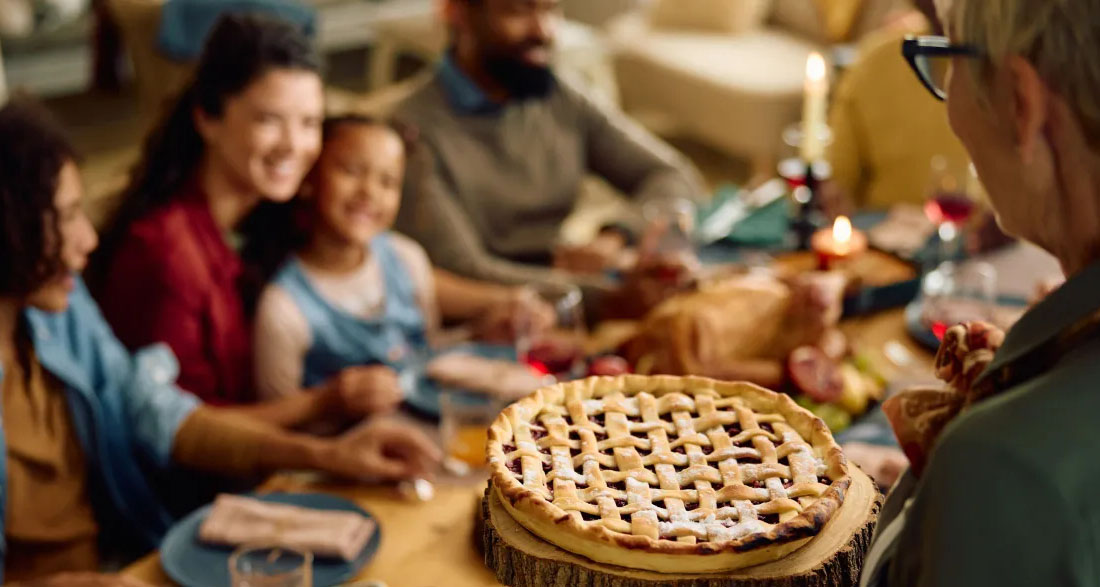
It had a braided crust and glossy apple filling you could actually see through the lattice. I felt proud bringing it to my mother‑in‑law Linda’s house.
I worked nights that whole week. I knew what was coming: bone-level exhaustion. So I planned ahead. I ordered early. I told myself that simplicity was okay.
Thanksgiving morning, Tyler went ahead to help his mother.
“I’m just going to help her around the house, Rach,” he said. “You know how she gets when there isn’t enough time to set the table and decorate the porch.”
“I do know,” I laughed. “Your mother takes hosting very seriously. I’ll come soon. I just need to wash the night off me.”
“Take your time, honey,” he said, already out the door.
Caleb finally fell asleep on the couch, still warm with fever. I took the fastest shower of my life, put on soft leggings, a cozy sweater, and twisted my hair into a low knot that whispered, I’m tired, but I’m trying.
When I pulled into Linda’s driveway, I could already hear the hum of Thanksgiving — laughter, football, clinking glasses, and the sound of a family I didn’t feel part of.
I walked in holding the bakery box and a hopeful smile.
“Happy Thanksgiving, everyone! Sorry we’re late — I had a rough shift and a sick little boy.”
Some people smiled.
Linda didn’t.
Her eyes went straight to the bakery box the way someone looks at a bug.
“What’s that?” she asked loudly.
“Rachel?”
“An apple pie,” I said. “I ordered it from that cute bakery by the farmer’s—”
“You bought it?” she interrupted, blinking like I’d just confessed to a crime. “You didn’t even try to make one? What on earth could have been more important to you?”
The whole room shifted. Conversations stopped. Someone muted the TV. Every eye turned to me.
“Linda,” I said quietly, “I just got off a night shift. Caleb’s been sick. I didn’t have time—”
My mother-in-law scoffed, lifted the box with two fingers like it smelled bad.
“Oh, no,” she said. “We don’t do store-bought desserts on Thanksgiving. Not in my house, missy.”
I froze.
“If you can’t be bothered to cook something yourself,” she added loudly, “then you shouldn’t sit at my table.”
Then, for the entire room to hear:
“This is a holiday about effort. And clearly, we don’t matter enough to you. Don’t be pathetic and lazy.”
Pathetic.
Lazy.
Because I bought a pie.
We all moved to the dining table, but the air had changed — sharp, awkward, painful. No one met my eyes.
Caleb tugged my sleeve.
“Mommy, why is Grandma mad at you?”
“I’m okay, sweetheart,” I whispered, smoothing his hair. “She’s just being loud.”
Linda carved the turkey with these angry little hacks, her knife smacking the platter.
“When I was your age, I worked full-time too,” she said. “And I still managed to cook and take care of my family.”
I poured water for Caleb and myself. Everyone pretended to be fascinated by their plates.
“But I guess not all women are built for that kind of responsibility, huh?”
Lucy, my sister‑in‑law, shifted uncomfortably. A cousin cleared his throat.
“Tyler,” Linda demanded, “Did you tell Rachel that everyone brings something homemade?”
“Yeah,” Tyler mumbled, shrugging. “She knew.”
I wanted to throw my glass at him.
Linda wasn’t done.
“Then why are we eating a store-bought pie and store rolls?”
“I didn’t bring rolls,” I said, breathing slowly. “I brought a pie. Because I—”
“I’m not attacking you, Rachel,” she snapped. “I’m just saying… effort matters.”
Caleb tugged me again.
“Mommy, can I have some gravy? My throat feels funny.”
“In a minute, baby.”
I looked at Tyler. Just one plea:
Say something.
Instead he said, with a fake smile:
“Mom’s not wrong, babe. You could’ve tried a little harder. It is Thanksgiving, after all.”
My stomach twisted.
“Tyler,” I said, “I worked all night. You were texting me about Caleb all shift. You know I haven’t slept.”
“I know,” he sighed, like he was the tired one. “But it would’ve meant a lot if you put in some effort.”
Linda pounced.
“Exactly! It’s not about pie. It’s about showing up the right way. Some people always have an excuse.”
Caleb sniffled.
“Mommy, I’m tired. I want to go home.”
That did it.
I’d spent the last hour fighting for basic dignity instead of caring for my sick son.
“So tell me, Tyler,” I said, voice steady. “When exactly was I supposed to bake? Between the woman in labor or the highway crash victim?”
“Goodness, Rachel,” Linda scoffed. “You don’t have to be dramatic.”
I pushed my chair back slowly. The scrape echoed like thunder.
“Linda,” I said, “I just want to confirm. Because I didn’t bake a pie after working all night and caring for your grandchild… you think I don’t belong at your table?”
“That’s not what I—”
“It is what you said,” I cut in. “And Tyler agreed.”
Tyler stared at a green bean.
“I didn’t want to start a fight,” he muttered.
“If effort makes someone worthy of this family,” I said calmly, “then next year, Tyler can bake the pie.”
A cousin snorted into his napkin. Lucy covered her mouth.
Then Sharon — sweet, blunt Aunt Sharon — leaned forward.
“Wait a minute,” she said, eyeing the box. “Isn’t that from the bakery you love, Linda?”
Linda blinked.
“You love their pies,” Sharon continued. “You brought one to book club last month!”
Lucy chimed in: “And didn’t you tell me to pre-order my Christmas dessert from there?”
The room tipped. Not toward me — just away from her.
That was enough.
I picked up the box.
“If it’s not good enough for your table, I’ll take it home. Caleb will be thrilled.”
“Rachel,” Linda snapped, suddenly frantic. “Don’t be ridiculous. Sit down. Don’t take Caleb — he needs to be with family.”
“I’m not being ridiculous,” I said.
And we left.
No yelling.
No door slam.
Just me, my sick little boy, and the pie that somehow meant everything.
In the car, I gripped the wheel and breathed. The shaking came next — not fear, but release. Years of swallowing hurt finally pushing their way out.
A strange pride warmed through me.
Not big, loud pride.
Quiet, grounded pride.
The kind that whispers, You didn’t let them break you.
I let Caleb sleep and sat in the driveway until Tyler pulled up.
He walked to my window with his hands shoved in his pockets like a kid caught doing something wrong.
“Rach… can we talk?”
I cracked the window an inch.
“You made fun of me,” I said. “You sided with your mother while she belittled me — and my job — in front of everyone.”
“I know,” he said softly. “I panicked. I froze. You know how she is, Rach.”
“No,” I said. “You didn’t freeze. You chose your mother over me.”
His shoulders sagged.
“I should’ve had your back,” he whispered. “You always have mine.”
“So,” I asked, “what will you do next time your mother targets me?”
Without hesitation he said, “I’ll be different. I’ll shut it down before it even starts.”
And somehow…
that was enough.
For now.