

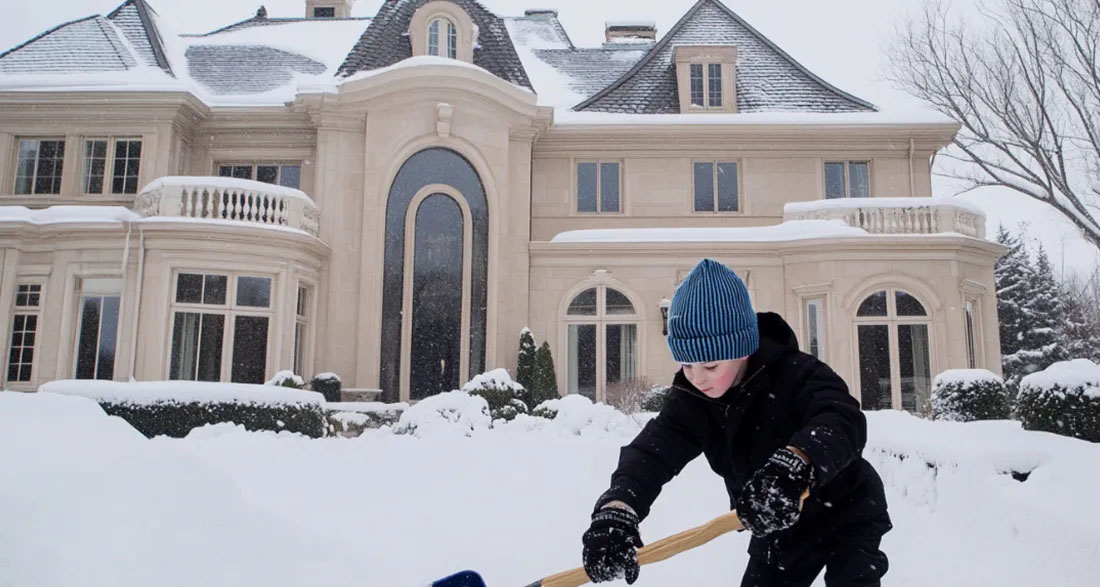
When my 12-year-old son Ben accepted our wealthy neighbor’s offer to shovel snow for ten dollars a day, he was so excited he could barely sleep. He talked nonstop about all the gifts he wanted to buy for our family.
But when that same neighbor refused to pay him, calling it a “lesson about contracts,” Ben came home completely crushed. That was the moment I knew I had to step in—and teach that man a lesson he would never forget.
I had always known Ben had a heart bigger than most adults I’d met. He was only twelve, but when he set his mind on something, he followed through with a level of focus and determination that could humble men twice his age. He didn’t complain easily, and he believed deeply in doing the right thing.
Even so, I never imagined I’d find myself standing in an icy driveway beside my husband, calmly getting revenge on a man who thought cheating a child was just another smart business move.
It all started early in December, on a morning when fresh snow blanketed the neighborhood. Ben had already been outside shoveling our driveway while I cooked breakfast. He burst into the kitchen, cheeks bright red from the cold, snow still clinging to his sleeves.
“Mom!” he said, barely able to breathe from excitement. “Mr. Dickinson said he’ll pay me ten dollars every time I shovel his driveway!”
His smile stretched from ear to ear.
Mr. Dickinson was our next-door neighbor, and he was exactly the kind of person you’d expect to be wealthy and annoying. He loved talking about his investments, his vacations, and his expensive cars. He treated every conversation like a business deal and every person like a potential advantage.
I had no doubt he believed he was doing us a favor by letting Ben “earn” money. Still, Ben was glowing, and I wasn’t about to ruin that moment.
“That’s wonderful, sweetheart,” I said, ruffling his hair. “So what are you going to do with all that money?”
“I’m buying you a scarf,” he said seriously. “And a dollhouse for Annie.”
His eyes lit up as he described everything in detail—the red scarf with tiny snowflakes stitched into it, and the dollhouse with working lights that Annie had been staring at every time we passed the toy store.
My heart nearly burst. “You’ve really thought this through, haven’t you?”
He nodded quickly. “And I’m saving whatever’s left for a telescope.”
Over the next few weeks, Ben turned into a snow-shoveling machine. Every morning before school, he wrapped himself in his oversized coat, tugged on his boots, and pulled his knit hat down over his ears. I’d watch from the kitchen window as he marched into the cold, shovel over his shoulder.
The sound of metal scraping against pavement echoed through the quiet mornings.
Sometimes he’d stop to rest, leaning on the shovel while his breath puffed into the air like little clouds. When he came back inside, his fingers were stiff and his face was red, but his smile never faded.
“How was it today?” I’d ask, handing him a mug of hot chocolate.
“Good! I’m getting faster,” he’d say proudly, shaking snow off his coat and sprinkling it all over the rug.
Every evening, he sat at the kitchen table with his worn notepad, carefully counting his earnings like it was the most important book in the world.
“Only twenty more dollars, Mom,” he said one night. “Then I can buy the dollhouse and the telescope!”
By December 23rd, Ben had become a well-practiced worker, humming Christmas songs as he headed outside that morning. I expected him to come home like usual—tired, cold, but happy.
Instead, the front door slammed open far too soon.
“Ben?” I called, rushing toward the hallway.
He stood there with his boots half-off, gloves clenched in his shaking hands. His shoulders trembled, and tears filled his eyes.
I dropped to my knees in front of him. “Sweetheart, what happened?”
At first, he couldn’t speak. Then the words finally came out.
“Mr. Dickinson… he said he’s not paying me.”
My chest tightened. “What do you mean he’s not paying you?”
Ben wiped his nose with his sleeve. “He said it’s a lesson. He said I should never take a job without a contract.” His voice broke. “Mom, I worked so hard. Why would he do that?”
Anger flooded through me, sharp and hot. I pulled him into my arms.
“Oh, honey,” I whispered. “You did nothing wrong. This isn’t your fault. This is on him.” I gently lifted his chin. “You don’t worry about this. I’ll handle it.”
I grabbed my coat and walked straight across the lawn. Dickinson’s house glowed with Christmas lights, music and laughter spilling out when he opened the door. He stood there holding a wine glass, looking pleased with himself.
“Mrs. Carter,” he said smoothly. “What brings you over?”
“You know exactly why I’m here,” I replied. “Ben earned eighty dollars. You owe him that money.”
He laughed. “No contract, no payment. That’s how the real world works.”
I realized then that arguing wouldn’t change him.
“You’re absolutely right, Mr. Dickinson,” I said sweetly. “The real world is about accountability. Enjoy your evening.”
By the time I walked back home, I had a plan.
The next morning, I clapped my hands loudly. “Alright, team. Time to go.”
Ben squinted at me from his bed. “What are we doing, Mom?”
“We’re fixing something that isn’t right.”
Outside, the air was freezing. My husband started the snowblower, its roar cutting through the silence. Ben grabbed his shovel, and Annie followed along with her tiny plastic one.
We cleared our driveway, then the sidewalk, pushing every bit of snow toward Dickinson’s driveway. The pile grew higher and higher.
“This is a lot of snow,” Ben said, grinning.
“That’s the idea,” I replied. “Think of it as undoing unpaid work.”
By mid-morning, Dickinson’s driveway was buried—higher than his car.
Soon, he stormed out. “What did you do to my driveway?!”
I smiled calmly. “We just reversed the work you didn’t pay for.”
By evening, he returned with an envelope.
“Tell your son I’m sorry,” he muttered.
Inside were eight crisp bills. Ben hugged me tightly.
“Thanks, Mom.”
“No,” I said softly. “Thank you for showing me what real hard work looks like.”