

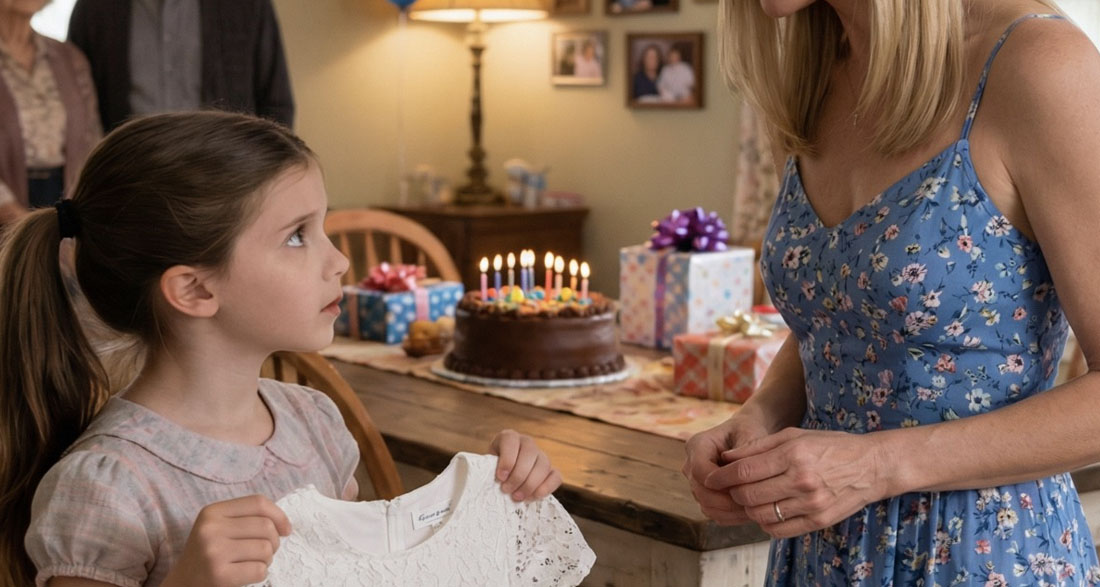
On my daughter’s eighth birthday, I wanted everything to feel light and joyful. I wanted the kind of happiness that didn’t ask questions or carry shadows.
I wanted crookedly taped balloons over the kitchen doorway, pancakes shaped like hearts, sticky fingers, laughter that bounced off the walls. I wanted a morning that felt normal, safe, and uncomplicated.
Emma had been through too much. The past year had weighed on her in ways no child should ever have to bear.
She’d overheard too many tense conversations, absorbed too many careful explanations meant to protect her, and looked at me with eyes far older than eight, asking questions that broke my heart just by existing.
But that morning, she smiled again. A real smile. The kind that started in her eyes and spread across her face without effort.
She wore a paper crown I’d cut and decorated with glitter the night before. She insisted on keeping it while she ate breakfast, sitting up straighter as if she truly were the queen of our small, slightly chaotic kingdom. I let myself believe, just for that morning, that things were getting better.
My parents arrived exactly on time. Not early. Not late. Right on the dot, as if punctuality were a performance rather than a habit. My mother looked perfect—hair flawless, makeup subtle but deliberate. My father stood beside her, phone in hand, angled to capture the day’s best angles.
“Happy birthday, sweetheart,” my mother sang, stepping forward with a shiny pink gift bag. The tissue paper inside was meticulously arranged, every corner fluffed just so. Nothing about it looked casual.
Emma gasped and reached for it immediately. She loved gifts, yes, but more than that, she loved being seen. She dug into the bag and pulled out a pink dress—soft, layered with tulle, sequins twinkling as she moved. The kind of dress children imagine when they dream of being princesses or fairy-tale heroes.
Her face lit up. She hugged the dress to her chest and spun once, laughing as the skirt flared even though she hadn’t put it on yet. For a moment, everything felt right.
Then it changed.
It wasn’t gradual. It wasn’t subtle. One second she was laughing, the next she froze. My stomach clenched, my heart jumped, my body reacting before my mind could catch up.
She looked down at the dress, frowning.
“Mom,” she said softly, “what’s this?”
I stepped closer, forcing my voice to stay light. “What do you mean, honey?”
She didn’t answer. She slid two fingers into the lining near the waist, pinched something small, and froze, eyes wide. My hands started shaking as I took the dress from her. I told myself it was probably nothing—a tag, some extra stitching, a slip of packaging. Anything else would be too sharp to face right there.
I carefully turned the dress inside out. That’s when I saw it—the stitching. Neat, precise, recent. Someone had opened the lining and sewn it back together deliberately.
Inside the seam was a small object, wrapped in plastic, flattened and hidden so it wouldn’t show unless someone looked closely. It wasn’t padding, it wasn’t decorative, it didn’t belong.
For a split second, my vision blurred. I wanted to scream. I wanted to demand answers. I wanted to grab my mother’s face and ask, “What kind of person hides something in a child’s clothes?”
But I didn’t.
Instead, I looked up.
My mother was watching me. Her smile stayed, but it was tight, controlled. My father stood behind her, expression blank, body angled like he could step back and claim ignorance at any moment.
They were waiting.
So I smiled.
“Thank you,” I said evenly. “It’s beautiful.”
My mother’s relief was almost invisible—a tiny exhale, a subtle loosening of her shoulders.
“We just wanted Emma to feel special,” she said lightly.
I folded the dress carefully, keeping the lining hidden, and returned it to the gift bag. Emma looked confused but trusted my expression. She went back to her cake and candles. I laughed when I should laugh, clapped when I should clap.
Inside me, something cold and solid settled.
This wasn’t a mistake. It wasn’t thoughtless. It was deliberate.
It was a test.
If I reacted, they’d know how much I understood. So I waited.
That night, after the guests left and the house was quiet, Emma fell asleep clutching her new stuffed bear. Her paper crown lay on the nightstand. I locked myself in the bathroom with the dress.
With trembling hands, I carefully opened the lining. The object fell free—it was small, sealed in plastic, marked with tiny numbers and a scannable strip. I didn’t need to know exactly what it was to know its potential danger.
By morning, my parents were calling nonstop. One missed call. Then another. Then texts:
“Has she tried the dress yet?”
“Call me, it’s important.”
“Don’t ignore me.”
Important. The word felt heavy with threat.
I didn’t answer.
The calls kept coming. Their tone was different from any birthday or even a sick day. Now, they couldn’t wait. Because they knew.
After Emma left for school, I placed the object under bright light on the kitchen table. I studied it, photographed every angle, examined the plastic, the stitching, the receipt still tucked in the bag.
Then I sealed it in an envelope, wrote the date, and put it in a drawer.
I called Naomi, a friend who worked in legal support. She had never dismissed my instincts. I explained calmly.
A long pause.
“Don’t confront them,” she said finally. “And don’t throw it away. Document everything. This isn’t a family disagreement. It’s a safety issue.”
I hung up and turned my phone face down.
The messages kept coming:
Why aren’t you answering?
You’re overreacting.
It’s not what you think.
You’re going to ruin the family over nothing.
An hour later, a message from my father:
Please don’t involve anyone else.
That was when doubt left me completely. Loving grandparents don’t panic like that. They don’t hide “nothing” in a child’s clothing.
I picked Emma up early. We talked about school, playground games, snacks, smiling and laughing while my mind raced.
At home, I sat her at the kitchen table.
“If Grandma or Grandpa ever ask you to keep a secret from me—about gifts, clothes, anywhere they take you—you tell me immediately. Okay?”
She nodded seriously. “Like the airport,” she said.
“Yes. Exactly like that,” I whispered.
Later, I called the non-emergency police line. An officer arrived within the hour, examined the envelope, photos, and messages.
“You did the right thing,” he said. “Don’t allow unsupervised contact.”
That evening, my mother appeared at my door. She knocked once, then harder. Through the peephole, I saw her—composed but tense, tears unshed.
“Open the door,” she said sharply. “We need to talk.”
“I’m not,” I said. “You’re scaring Emma. Leave.”
“You can’t keep her from us,” she snapped.
“You put something in her clothes,” I replied firmly. “That isn’t love.”
A long silence. My phone buzzed—confirmation that the evidence had been collected.
That night, after Emma slept, I wrote everything down: every comment, every crossed boundary, every moment dismissed as nothing.
Because control rarely comes loud. It arrives wrapped in care, concern, generosity—and sometimes, it hides inside a birthday dress, waiting to see if you notice.