

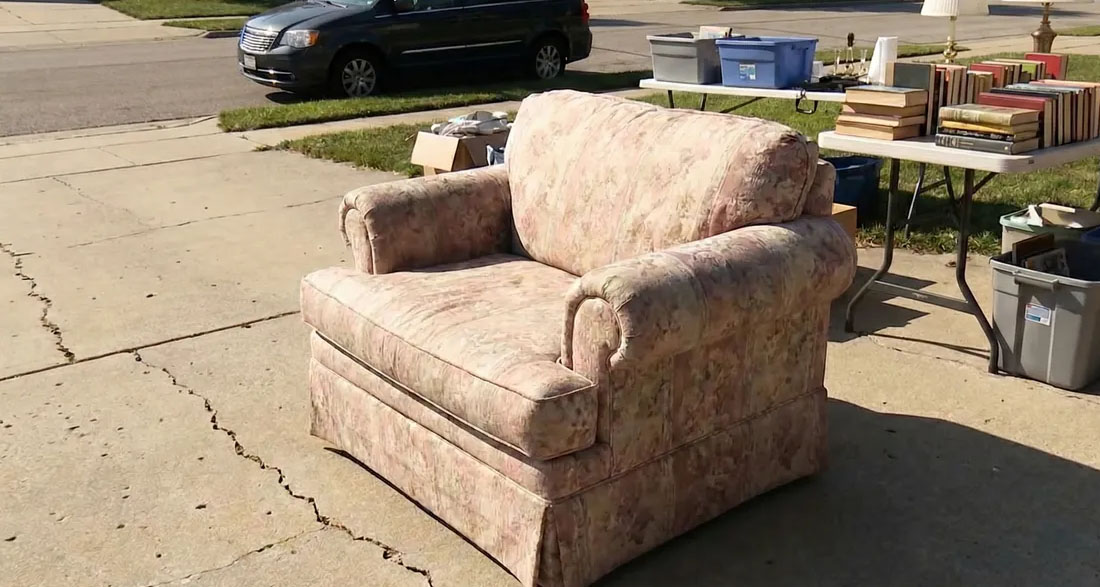
Milo would not stop barking at the yard-sale armchair.
Not for one minute.
He stood in front of it like it was an enemy. His ears were straight up. His teeth showed. His whole body shook as he growled at the left armrest.
At first, I thought he was being dramatic.
But then my mother-in-law saw the chair.
She turned completely white.
Her hand trembled as she touched the wood, tracing a dark scratch along the armrest like she knew it by heart.
And then she said the words that changed everything.
“We got rid of that for a reason.”
She looked at Jake.
“You were four years old the last time it was in our house.”
Jake and I had gotten married just two weeks after graduation. We had no money, no savings, and no fancy plans. Just love, hope, and Milo — our rescue mutt with floppy ears and too much personality.
We moved into a tiny rental that barely fit our mattress on the floor. We had a folding table for meals and mismatched cups from thrift stores.
“It’s temporary,” Jake would always say, rubbing my shoulder with that hopeful smile of his. “We’re building something.”
Every Saturday, we hunted yard sales like treasure hunters. We laughed at broken lamps. We debated over ugly paintings.
“It has character!” I’d say.
“It has mold,” he’d reply.
We loved it. Turning someone else’s junk into our story.
That’s when we found the chair.
It was shoved between plastic toys and a stack of old romance novels. Oversized. Thick arms. Faded flower pattern. Dusty but solid.
Jake ran his hand over the back and snorted.
“No way,” he said. “My grandma had one like this when I was little.”
I shrugged. “Exactly. It’ll remind you of your youth.”
The seller wanted twenty dollars. It smelled like a basement, but the frame was strong.
Jake grinned. “It is a cozy reading chair.”
I imagined winter nights. Blankets. Books. Milo curled at our feet.
So I handed over the cash.
Milo hated it instantly.
The second we brought it inside, he froze.
Then he exploded into barking.
“Buddy, it’s just a chair,” I said, grabbing his collar.
He lunged toward the left armrest, eyes locked, growling low and deep.
Jake tried treats.
“Sit. Stay. Good boy.”
Nothing worked.
Milo barked at that chair all night.
A week later, we hosted a small housewarming. Pizza. Cheap beer. Paper plates.
Jake’s mom, Diane, arrived last. She kissed our cheeks and walked through the apartment slowly, inspecting everything like she was judging a contest.
When she entered the living room, she stopped.
Her eyes locked on the armchair.
The color drained from her face.
She walked up to it. Once around. Twice around.
Then she touched the exact same scratch Milo had been barking at.
“Where did you get this?” she asked quietly.
“A yard sale,” I said. “Why?”
Milo barked.
The room went silent.
Diane swallowed hard.
“We got rid of it for a reason.”
Jake frowned. “Mom, you’re messing with us.”
But he didn’t step closer to the chair.
“You were four years old the last time it was in our house,” she said.
The air felt heavy.
“What happened?” I asked softly.
She didn’t answer me. She looked only at Jake.
“Get rid of it tonight,” she whispered.
Then she grabbed her purse and left.
Milo barked again.
Jake stood frozen.
After everyone left, Jake locked the door.
“Okay,” he said. “Tell me you didn’t hear that.”
“She recognized it,” I said. “How?”
Jake called her.
Voicemail.
Again.
Voicemail.
“Mom, call me back,” he snapped before tossing his phone on the table.
“We’re not throwing out a chair because my mom’s being weird,” he muttered.
But neither of us looked away from it.
Around midnight, Milo planted himself in front of the chair and refused to move.
He stared at the left armrest.
Growled.
Then barked once — sharp and loud.
“Fine,” I said. “Show me.”
Jake grabbed a seam ripper.
“If we find a squirrel skeleton,” he said nervously, “this thing is going in the trash.”
I slid my fingers under the seam of the left armrest.
The thread snapped.
Something crinkled inside.
Jake’s eyes widened.
“That’s not stuffing,” he whispered.
I pulled.
A taped plastic bundle came free.
Milo whimpered.
Inside was an envelope.
On the front, in shaky handwriting:
“For Jacob. When he is old enough.”
Jake stared.
“Yeah,” he breathed. “That’s me.”
Inside the envelope was a photo.
Toddler Jake. Sitting on a woman’s lap. In that same chair.
And a letter.
Jake read the first line out loud:
“If you’re reading this, the chair made it out alive.”
He swallowed.
The letter said his grandma was afraid she would be “erased.”
That Jake’s mother would rewrite the past until it sounded clean.
Then came the line that drained the blood from his face.
“If you are reading this, it means the chair made it out and I didn’t.”
Jake blinked fast.
“Grandma vanished one day,” he whispered.
Milo gave a soft bark.
“My mom knows why,” Jake said. “She has to.”
The next morning, we went back to the yard sale house.
The woman answered in curlers.
“Is something wrong with it?” she asked.
“Where did you get the chair?” Jake asked, holding up the envelope.
“Storage unit auction. I flip stuff.”
She handed us a crumpled receipt.
Under “Renter,” was a first name.
Then a maiden name.
Jake stared.
“That’s my mom.”
In the car, he texted her a photo.
Then sent the envelope.
“Tell me the truth.”
Her reply came instantly.
“Put it back. Please. I’m begging you.”
Jake called her.
“Jake, don’t,” she said, breath shaky. “Don’t dig.”
“We’re coming over,” he said.
Diane opened the door before we knocked.
Her eyes were swollen.
“Jake, honey—”
“Don’t,” he said. “Not ‘honey.’ Not now.”
He held up the letter.
“Tell me why you hid this.”
She glanced at the street.
“Come inside.”
“No,” he said. “Say it here.”
Milo growled.
Diane began crying.
“Jake, your grandma wouldn’t let it go,” she said. “She saw bruises. She said she’d call someone. She said she’d take you.”
“Take me from whom?” Jake asked.
“From your dad,” she whispered.
Jake went still.
“The night she disappeared,” Diane said, shaking, “she fought with him. He shoved her. She hit her head on the arm of the chair.”
I felt sick.
“Mom didn’t get up,” Diane whispered.
Silence.
“So you called 911,” Jake said.
Diane didn’t answer.
“You didn’t,” I said quietly.
“I was scared,” she whispered. “He said he’d take you. He said he’d ruin us.”
Jake let out a broken laugh.
“So you chose him over Grandma?”
She reached for him.
He stepped back.
“Where is she?” he asked.
“I don’t know,” Diane sobbed. “I didn’t ask.”
Milo barked once — sharp and angry.
Jake pulled out his phone.
“Jake, please. I’m your mother.”
“And she was my grandma,” he said.
He hit call.
Police came.
Statements were taken.
The chair was photographed. Bagged. Tagged.
Evidence.
Watching them carry it out felt unreal.
Days blurred together after that.
Jake barely slept.
When he did, he woke up shaking.
“I thought my childhood was normal,” he whispered one night.
“There’s no such thing as normal,” I said softly. “But I’m sorry yours is this big.”
Diane sent long texts.
Apologies.
Excuses.
Self-pity.
Jake replied once.
“You didn’t protect me. You protected yourself.”
Then he blocked her.
Months later, Jake started therapy.
One evening, he sat on the floor with Milo.
“I’m allowed to be mad,” he said.
Milo thumped his tail.
I looked at the empty space where the chair used to be.
I didn’t want that spot to feel haunted forever.
So I found a simple gray chair at a thrift store.
No flowers.
No secrets.
I carried it upstairs myself.
“Do you want a new reading spot?” I asked.
Jake eyed it carefully.
“Does it come with secrets?” he half-joked.
“This one’s just furniture,” I said. “No hidden notes. I promise.”
We placed it where the old chair had been.
Milo sniffed it once.
Then hopped up and rested his chin on his paws.
No barking.
That night, Jake sat in it with a book he’d wanted to read for months.
But he kept staring at the empty space in his mind.
“I keep thinking about Grandma,” he said quietly.
“Me too.”
He swallowed.
“I want a home that doesn’t hide things.”
I slid my hand into his.
“We’ll build one like that,” I said.
Milo climbed into his lap and fell asleep.
And as we sat there — quiet, honest, and tired — we started building something stronger than secrets.
A home where nothing would ever be hidden again.