

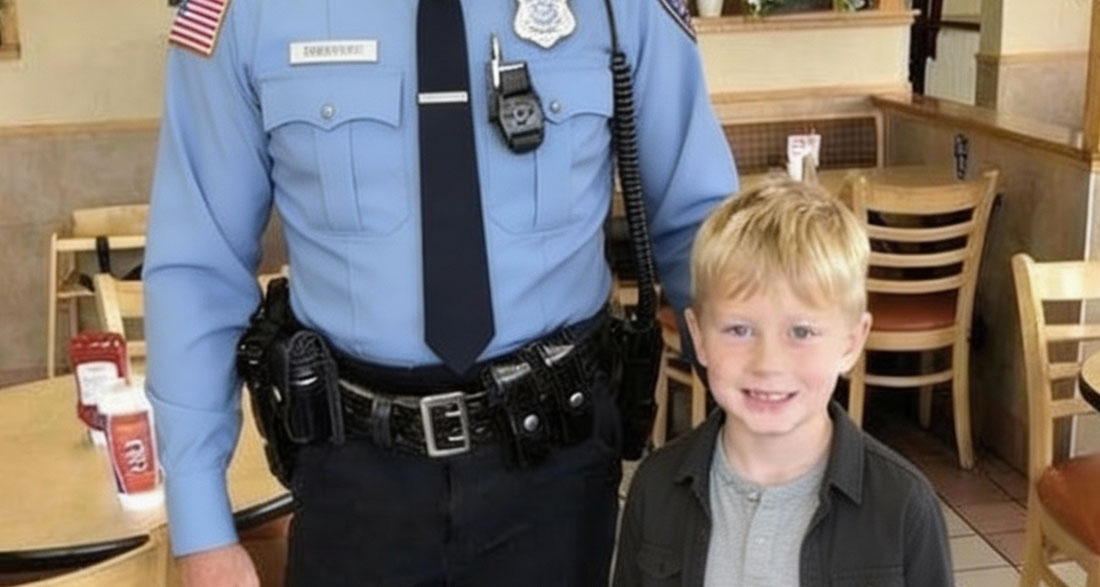
Barry turned eight on a gray afternoon, the kind of gray that feels like the sky has forgotten how to smile. The air hung heavy, pressing down on everything, and I felt it settle on my shoulders as if it wanted to remind me that life could be hard, even on birthdays.
I kept telling myself it was still his birthday—a day that should sparkle with something bright—but hope is a fragile thing when your pockets are empty and your mind is tired of pretending.
I had dreamed of simple magic: balloons tied to chairs, a cake big enough to make him gasp, maybe even a small pile of wrapped gifts that would make him feel like the world had tilted in his favor for once. But dreams are soft, and life has a way of pressing hard against them.
So I did what I could. We went to the local diner, the kind with vinyl booths that creak under you and lights that flicker like they’re too tired to stay awake. We ordered burgers and fries, nothing fancy, nothing that marked the day as special.
And yet, Barry smiled. He always did. There was something in that smile—steady, polite, grateful—that seemed too grown-up for a child. It was the kind of smile you’d expect from someone who had already learned how heavy the world could be.
When the waitress returned with her usual cheer and asked if we wanted dessert, my stomach twisted into a familiar knot. I wanted to say yes.
I wanted him to have a slice of cake, even a small one, just to taste a little sweetness and remember that birthdays aren’t meant to be swallowed whole by worry. But the numbers in my head weren’t flexible, and I froze. Before I could say anything, Barry shook his head.
“I’m full,” he said, patting his stomach like he meant it.
I knew better. He was saving space—not for food, but to shield me from the sting of telling a stranger what we couldn’t afford. That hit me harder than the truth of our situation ever had. It’s one thing to struggle.
It’s another to see your child quietly step into that struggle and carry some of it for you. Kids should want things without checking if wanting them is too costly. But Barry had learned to watch me, to read me, to soften his own desires so I didn’t have to feel worse than I already did.
Across from us, I noticed a man in the next booth. He shifted slightly, the kind of movement that makes you look, and then I saw the badge glinting on his uniform—a park ranger. He had been eating alone, a half-finished cup of coffee cooling beside him. His eyes met mine, warm but careful, and he leaned over.
“Mind if I buy your birthday boy a slice of cake?” he asked, his voice gentle.
Pride rose in me like a sharp tide. My mouth opened, ready to refuse, to protect myself. But Barry spoke first.
“No,” he said.
Not timidly, not embarrassed. Just a soft, small word spoken with the seriousness of someone older than eight. The ranger blinked, and I must have too. Barry continued, voice quiet but steady.
“I want to save my wish,” he explained. “Last year, I wished for a bike. It never came. I think wishes only work if they have a chance. I don’t want to waste another one.”
The diner seemed to hush around us, like the air itself had paused to listen. The ranger looked at Barry for a long moment, then nodded without a word. He left a few bills on his table, enough to cover more than our meal, and said softly, “The cake’s on me.
Wish included.” He spoke as if kindness should hurt no one. For once, I didn’t argue. I let the moment breathe.
Soon, the waitress brought a slice of cake with a single candle perched on top. The flame flickered uncertainly, a tiny light battling the draft. Barry stared, his expression softening.
He closed his eyes, held his breath like he always did when concentrating, and whispered his wish so quietly I couldn’t hear it. Then he blew out the candle, and the smoke curled upward, vanishing as if it had somewhere better to be.
After we finished, the ranger asked us to wait outside. His tone was calm but carried certainty, the kind that makes you trust someone without fully understanding why. So we stepped out.
The sky had grown darker, colder, and Barry, hands stuffed in the pockets of his too-thin jacket, kicked small rocks while humming softly. I kept glancing back at the diner, unsure why this stranger cared enough to involve himself, and yet afraid to question it.
Twenty minutes dragged by. Then a truck pulled into the lot.
It wasn’t the ranger’s vehicle, but another, marked with the same insignia. An officer stepped out, carefully guiding a red bicycle down from the truck bed. It gleamed even in the dull light, a ribbon tied to the handlebars as if it belonged in a holiday commercial.
Barry froze. His eyes widened, disbelief stretching into wonder. The ranger came beside him and explained, “This bike was donated months ago. It’s been waiting for the right kid. Today’s your day.”
I expected tears, but Barry didn’t cry. He laughed—a loud, free, unrestrained laugh that bounced across the parking lot, echoing off cars and concrete.
He climbed onto the bike immediately, wobbling as he pedaled, speeding up, slowing down, then speeding again. His joy didn’t care about balance. It didn’t care about the gray, heavy day. It simply existed, pure and whole.
I watched him, hands shaking.
And in that moment, I realized how close I had been to letting shame steal this day. If the ranger hadn’t insisted, if Barry hadn’t spoken honestly, if I had clung to pride, the day would have ended as it began—gray, heavy, forgettable. But kindness had quietly intervened, demanding nothing in return.
Later, at home, Barry buzzed with energy, telling the story again and again as if rehearsing it might keep it real. When I tucked him in, he stared at the ceiling with a small smile. “Maybe next year,” he said, “I’ll wish for something for you.”
I laughed, telling him he didn’t need to. But I knew what he meant. He wasn’t talking about gifts. He was talking about hope, about the quiet lessons learned from strangers who care, about the feeling that the world could still surprise you with good.
That day hadn’t really been about burgers, cake, or a bicycle. It had been about strangers choosing kindness without being asked.
About generosity that doesn’t demand thanks. About a child learning that wishes can come true—not just in whispers, but through the hands of people who see you, who care enough to act.
Watching him fall asleep, I understood: maybe he wouldn’t remember the bike forever, but he would remember the way the world opened up just a little, just for him.
The world is heavy. It can be cruel. But sometimes, when you least expect it, it lets in light. That day, on a gray afternoon with nothing planned, it reminded us that kindness can appear without warning, and hope can find you in the quietest, most unexpected way.
Barry learned that wishes sometimes arrive on wheels, tied with ribbons, carried by strangers who believe in giving. And maybe that was the real gift: the reminder that even in a small, limited life, goodness can still roll across a parking lot and make the impossible feel possible.
That night, as he drifted to sleep, I felt something settle inside me—something I hadn’t felt in a long time. We weren’t alone. The world could still surprise us. And sometimes, someone else carries the weight of the sky for a little while.