

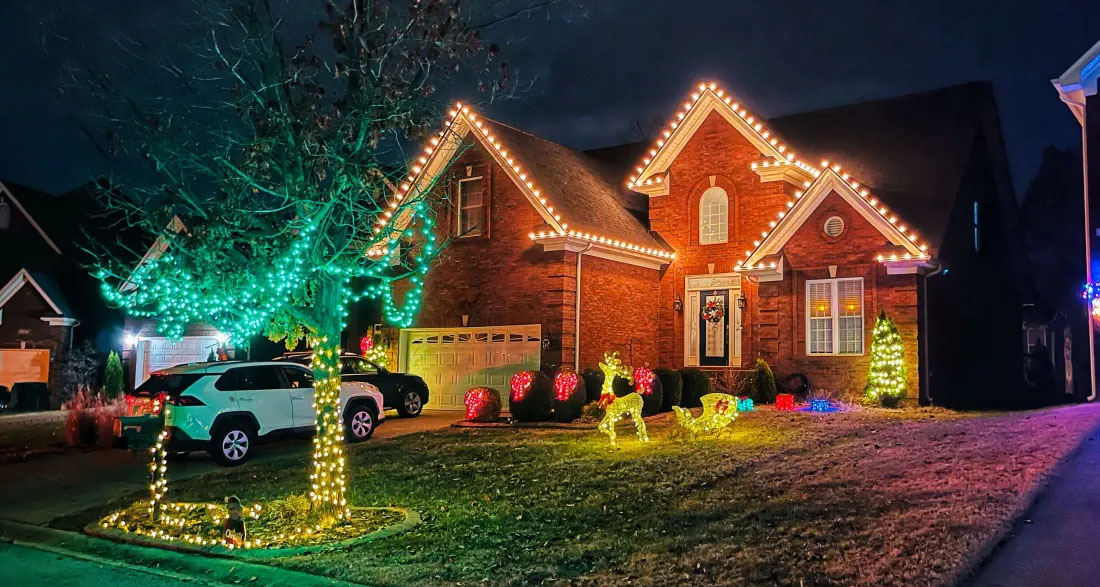
I have always believed that you can tell how warm a home is just by looking at it from the street.
Not by how expensive it looks. Not by how big it is.
But by the feeling it gives you.
Some houses make you drive a little slower. They make you smile without knowing why. They give off a soft glow, like they’re quietly saying, You’re welcome here.
Our house had that glow.
Every December, my three kids and I turned our little yellow bungalow into what our neighbors lovingly called “the Christmas postcard.” We didn’t have much money, but we had imagination, tape, glue, and a lot of love.
We hand-tied garlands across the porch rails. We wrapped twinkling lights around the windows, even when half of them flickered. An inflatable Santa stood in the yard, waving like he personally knew everyone who passed by.
By the mailbox sat our wooden reindeer. He was painted with shaky brushstrokes, patches of glitter that never really stayed put, and a red nose that was slightly crooked. He wasn’t perfect—but he was ours.
Nothing about our decorations was flawless.
But everything was made with love.
And that was the point.
My husband, Matt, used to laugh every year when we finished decorating. He’d stand in the driveway, hands on his hips, shaking his head with a grin.
“It looks like the North Pole exploded on our lawn,” he’d say.
But his eyes were always soft. I knew he loved it.
After Matt passed away, the kids and I kept everything going. The garlands. The lights. The Christmas Eve cocoa party. We did it because Christmas was when the house felt alive again.
It was the only time of year when the silence didn’t creep into the corners.
It was when laughter filled the rooms. When scissors and glue sticks were left open on the kitchen table. When the pain felt… lighter.
I think my love for decorating started long before that.
When I was little, my mom used to play old records while my sister, Jillian, and I decorated the windows with tissue-paper snowflakes. She folded hers perfectly. Mine were usually ripped, crooked, or uneven.
Dad would be outside wrapping lights around the porch. I’d hold the end of the string like it was the most important job in the world. Jillian stayed inside with Mom, tying bows and getting praised for how “neat and careful” she was.
But when Dad finished, he always clapped his hands and smiled at me.
“You lit up the whole street, Amelia.”
I never forgot that.
Even now, decades later, I think I still decorate for the same reason.
Some part of me still wants the street to feel lit up.
That morning, it started with a sound—or rather, the absence of one.
Not a crash. Not shouting.
Just a strange, heavy silence.
The kind that tells you something is already wrong.
I opened the front door with Noah on my hip.
And my heart dropped.
Everything was destroyed.
The lights were ripped from the roof and tossed into tangled piles across the lawn. The inflatable Santa was slashed open, deflated, and half-buried in the flower bed like someone had tried to erase him.
Our wooden reindeer was broken clean in two, lying by the curb.
The garlands—hand-tied with cinnamon sticks and red ribbon—were twisted, torn, and thrown aside like garbage.
I couldn’t speak.
Owen and Lily stepped outside behind me. Owen’s face fell.
“Mom… what happened to everything?”
Lily slipped her hand into mine. Noah stared at Santa’s torn body and whispered,
“Mom… is Santa dead?”
I stepped off the porch slowly, still hoping there was another explanation. A storm. Teenagers being careless. Anything.
Anything but this being done on purpose.
Then I saw it.
Something silver glinted in the grass near the broken reindeer.
A small, heart-shaped keychain with a delicate floral pattern.
I bent down to pick it up, Noah’s fingers clutching my shoulder.
I knew exactly who it belonged to.
My sister, Jillian.
She’d had that keychain since college. Dorm keys. Car keys. House keys. She never stopped carrying it.
Once, I teased her. “You still have that?”
She smiled and said, “It’s my safety net, Amelia. Or my lucky charm.”
Across the street, Jillian’s house stood calm and untouched. Elegant. Perfect.
I didn’t call the police.
I didn’t need to.
“I’m going to fix this myself.”
Ten minutes later—after cartoons and chocolate cereal kept the kids busy—I stood at Jillian’s door.
She opened it wearing a burgundy velvet robe and flawless red lipstick, as if she hadn’t just destroyed my Christmas.
“Amelia,” she said lightly. “You’re up early, sis.”
I held the keychain up between us.
“This was in my yard, Jillian. Your lucky charm.”
Her eyes flicked to it.
“I must’ve dropped it when I stopped by with the crackers for Owen,” she said smoothly. “Thanks for returning it.”
“Jillian,” I said quietly, “you destroyed my decorations, didn’t you?”
Silence stretched between us.
Then she sighed and stepped aside.
“You should come in.”
Her house was pristine. White. Silver. Cold. It smelled like eucalyptus and linen spray. There were no fingerprints. No clutter. No warmth.
“No one ever comes to my Christmas party, Amelia,” she said, arms crossed. “But everyone goes to yours.”
“You send formal invitations,” I said. “You hire decorators. You wear tailored suits. But where’s the warmth?”
“I like elegance and sophistication.”
“That doesn’t make the holidays meaningful.”
“No,” she snapped softly, “but I thought it might make me visible.”
“Why does that matter so much?”
She stared out the window.
“Because I try. Every year. And somehow, you always get the love.”
I laughed, but it cracked.
“You think people come for cookies?”
“No,” she said. “They come because of you. Because you make people feel like they belong.”
“That’s not something I planned,” I whispered. “That’s just who I am.”
“I know,” she said. “And that’s the worst part.”
Her voice softened.
“I was always second-best.”
I felt like a child again. Paper ornaments. Crooked snowflakes. Mom smiling at mine.
“I never meant to take anything from you,” I said.
“You didn’t have to,” she replied. “It just happened.”
“So you destroyed what my kids built… just to feel seen?”
“They never came to mine,” she said. “Mom and Dad. They’d leave early. Every time.”
That night, my kids made new decorations. Foil stars. Paper Santas.
Later, my parents came over.
“The house looks beautiful and warm,” Mom said.
“No,” I said gently. “But it’s enough.”
Over cocoa, I told them the truth.
“I think we were too hard on Jillian.”
They didn’t argue.
“What do you want to do?” Mom asked.
I looked across the street.
“I think we show up for her.”
That night, we decorated Jillian’s house quietly.
“I hope she likes it,” Lily whispered.
“She will,” I said.
On Christmas morning, Jillian stepped outside and froze.
Her shoulders dropped—not in defeat, but relief.
“Kids,” I said, “get your coats.”
When we knocked, she opened the door, eyes wet.
“I thought you hated me.”
“No,” I said. “Now we understand.”
Sometimes the real Christmas miracle isn’t fixing what’s broken—
It’s seeing what someone has been carrying…
And choosing to love them anyway.