

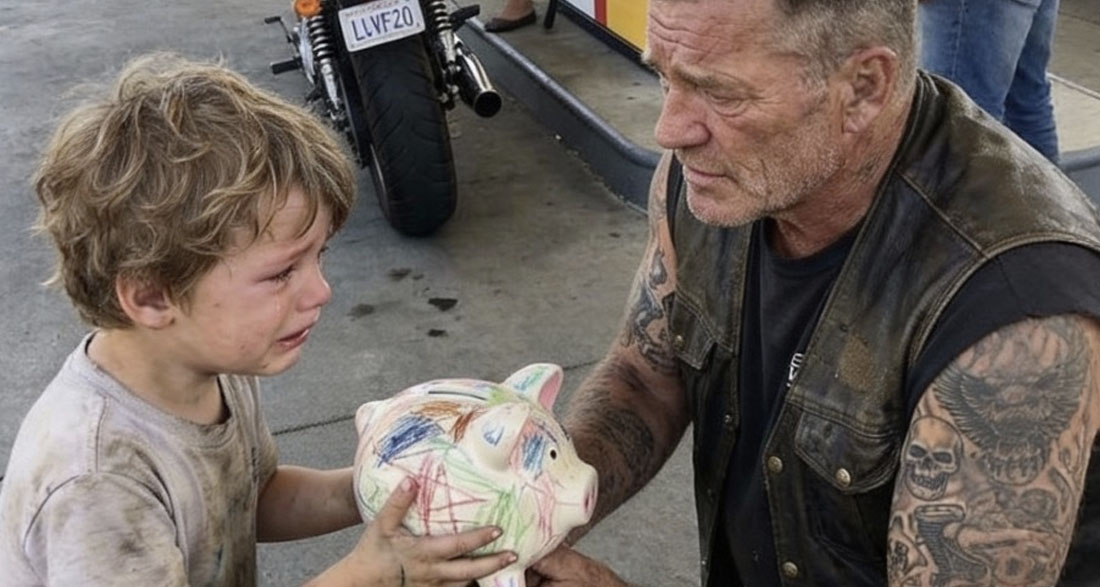
Tom was sixty-three, a retired cop and Vietnam vet, the kind of man who could fill a room without saying a word. Time had left its marks on him—the deep creases etched across his face, streaks of silver in his beard—but his eyes were sharp, steady, and calm.
He had seen enough chaos in his life to know exactly when to act and when to wait.
That afternoon, he was at a small gas station on the outskirts of town.
The quiet hum of the pump filled the space around him, broken only by the occasional bird or distant car. Then, he noticed a little boy, no older than five, shuffling toward him. In his tiny hands was a cracked plastic piggy bank, clutched like it contained the world.
“Please make my daddy stop hurting mommy,” the boy said, his voice trembling but fierce with determination.
Tom froze mid-pump, staring at the dirt- and tear-streaked cheeks of the child.
The boy’s fingers were sticky with melted crayon wax that had rubbed off the piggy bank. He placed it carefully on the concrete, as if it held something sacred. Inside, crumpled bills, coins, and the boy’s desperate hope rattled quietly.
Tom crouched to meet the boy’s eyes. “What’s your name, son?” he asked softly.
“Ethan,” the boy whispered. “I have forty-seven dollars. You look strong. You can make him stop.”
The words hit Tom like a punch to the chest. He had spent forty years hearing every kind of plea—angry, fearful, hopeless—but none had ever carried this weight. A child, so small, asking a stranger for protection—it was a call that demanded action.
Across the lot, an old Ford truck idled. Through the windshield, Tom saw a man gripping a woman’s arm hard enough to make her wince. Her shoulders hunched, trying to make herself smaller. He barked at her, words lost in the traffic noise, but the fury and control were unmistakable.
Tom straightened, piggy bank in hand, and crossed the pavement with a slow, deliberate step.
Decades of training kicked in, guiding his every movement. He no longer had a badge, but he didn’t need one. Authority and presence were enough. More importantly, he knew the type of man standing in that truck.
The man noticed him and sneered. “What the hell do you want, old man?”
Tom stopped beside the truck. “You the boy’s father?”
“Yeah. Why?”
Tom’s gaze fell on the red, swollen handprint blooming across Ethan’s cheek. “Because you hit your kid,” he said evenly. “And you’re hurting his mother.”
The man snorted. “Mind your damn business. The boy fell. He’s clumsy.”
“Try again,” Tom said, voice low but firm.
The man squared his shoulders, ready to intimidate or strike. But before he could, the deep rumble of motorcycle engines rolled across the lot. Three bikes pulled up side by side—black chrome, steel gleaming, engines roaring like wild beasts.
Rick, Marcus, and James dismounted in unison. Their boots hit the asphalt with purpose.
They weren’t young, but they carried a confidence only earned from surviving life’s storms. Their vests bore the same emblem Tom once wore—a symbol outsiders feared, but those who knew them understood it meant loyalty, protection, and justice.
The man’s bravado faltered as the bikers silently formed a line behind Tom. No words were spoken, but their presence said everything.
Tom kept his voice calm, controlled. “Here’s what’s going to happen. You get in your truck. You drive away. You never come near them again. You so much as call or follow her, and the law will deal with you in a way you won’t like. Understand?”
The man sneered. “You think you can scare me with your gang?”
“No,” Tom said softly, stepping closer, eyes never leaving the man’s. “I think you scare yourself every time you look in a mirror and see what you’ve become.”
Rick shifted his weight, crossing his arms. Marcus cracked his knuckles. James just stared, silent but immovable. The abuser had no ground to stand on.
He looked at Sarah, still trembling, then at Ethan, clutching her hand. For a moment, it seemed like he might try something desperate. But then, cursing under his breath, he climbed into the truck and sped off, tires screeching down the highway.
Tom exhaled slowly. “You’re safe now,” he told Sarah. Her shoulders relaxed, tears running freely. “Let’s get you somewhere he can’t find you.”
Rick made a call to a secure women’s shelter, a place known only to a few.
Within the hour, Sarah and Ethan were riding behind the motorcycles, escorted like VIPs through the town. People turned to watch—not out of fear, but respect. They looked like protectors, because that’s exactly what they were.
At the shelter, Maggie, the director, welcomed them warmly. Tom calmly explained the situation while Sarah held Ethan close, trembling. “You’re going to stay here for a few days,” Tom said. “My friends and I will watch outside. You’ll be safe.”
For seventy-two hours, the bikers never left.
They took shifts guarding the shelter, making sure no one got close. Tom sipped bitter coffee and barely slept, eyes always scanning the parking lot. On the second night, headlights flashed—he didn’t even need to check the plate.
The Ford truck.
Tom and Rick moved quickly, blocking the front gate. The man shouted about “talking to his wife,” slurring his words. Tom’s voice cut through cold as steel. “You were told to stay away.”
Rick’s hand landed on his shoulder, firm and unyielding. When the man tried to push past, Rick twisted his arm behind his back with precise skill. The man yelped, stunned, as Tom called law enforcement.
Minutes later, flashing red and blue lights filled the night. The abuser was cuffed, charged, and driven away, leaving the lot empty and quiet.
In the months that followed, Tom and the bikers didn’t stop. They visited Sarah, helped her find a lawyer, and even started a fundraiser through their biker network. Riders, veterans, strangers—all contributed.
Sarah got an apartment in a quiet neighborhood, a used car, and Ethan enrolled in a better school.
On moving day, Tom and the guys were there, carrying boxes, fixing locks. Ethan ran to his new room, small but bright, walls covered in superhero posters. Tom knelt beside him and handed back the old piggy bank.
“You keep this, kid. You already paid me more than enough,” he said.
Ethan shook his head shyly. “But I didn’t give you anything.”
“You gave me something more,” Tom said with a smile. “You gave me a reason to believe people can still be brave.”
Three years passed. Sarah rebuilt her life, working at a clinic and going to school at night. She eventually became a counselor, helping women escape abuse—turning her own pain into power.
Ethan grew taller, face losing its baby softness but keeping its kindness. He kept in touch with Tom and the bikers, visiting their clubhouse regularly. They had become a strange but real family—tough, rough men, and a boy who learned bravery in their shadow.
On his eighth birthday, they gave him a leather vest with a patch that read “Guardian Angel.” Ethan wore it proudly, grin stretching ear to ear.
Years later, when Tom asked Ethan what he wanted to be, the boy didn’t hesitate. “A police officer,” he said. “Like you. I want to help kids like me.”
Tom’s chest warmed. “Then you’re already halfway there,” he said. “You’ve got the heart for it.”
Tom still rode his bike on quiet Sunday mornings, wind whipping through his hair. Sometimes he thought about that gas station, the trembling hand holding the piggy bank, the terror in a mother’s eyes, and how his instincts had come roaring back when they were needed most.
It would’ve been easy to walk away, to tell himself it wasn’t his problem anymore. But Ethan’s small, brave voice had called to him, and he answered.
People saw Tom and his brothers as dangerous—tattoos, leather, roaring bikes—but they were dangerous only to those who preyed on the weak. For everyone else, they were shields.
The story of the gas station spread quietly. Everyone agreed: heroes don’t always wear badges or capes. Sometimes they wear old denim, smell like motor oil, and carry memories they’d rather forget.
For Sarah and Ethan, that day marked a new life. For Tom and his brothers, it reminded them why they stood together—to protect those who couldn’t protect themselves.
Ethan still kept the piggy bank on his shelf, faded crayon marks and all, saving for college and a future built from courage. Tom visited often, bringing gifts: a comic book, a bike helmet, a wrench. Each time, Sarah thanked him, misty-eyed.
“Don’t thank me,” he said. “Thank the kid who never gave up.”
The last time he saw them, Ethan ran to hug him, almost knocking him over. “You’re my hero,” he said.
Tom smiled, patting him on the back. “No, son,” he whispered. “You’re mine.”
As he rode away, the wind in his face, Tom knew the world still had darkness. But as long as children like Ethan were brave enough to ask for help—and people like him answered—there was hope.
And for a man like Tom, that was reason enough to keep riding.