

My son told the world I was dead long before he ever lay in that hospital bed, fighting for his life. I wasn’t just absent in his life—I had been erased. Every photo, every story, every memory he shared with anyone else had me scrubbed out.
To him, my tattoos, my leather vest, my years on the open road made me something shameful. I wasn’t the kind of dad you brought to a school event, or introduced to coworkers, or showed off at family parties. I was the ghost of a life he wanted to forget.
I still remember the moment that cut me deepest. Three weeks before the accident, he stood in front of me, his face hard, eyes cold like I’d never seen before. And he said the words that burned through my chest like fire:
“As far as I’m concerned, you’re dead.”
I froze. Tried to speak. Tried to reach him. But the silence that followed was a wall, tall and unmovable. I drove home that day, my hands gripping the wheel, my chest aching, feeling like I’d already lost him forever.
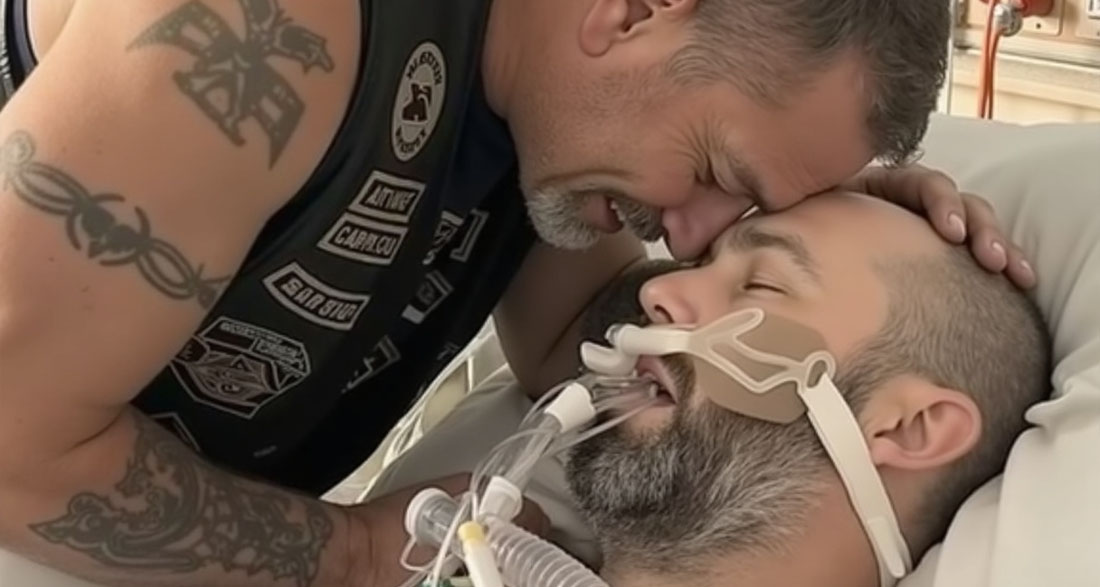
Now, standing beside his hospital bed, the same bed where machines hissed and beeped around him, I looked down at the face that had once lit up whenever I walked into a room.
Tubes ran into his body, bruises marked his skin, and yet I could still see him—the boy who used to laugh with abandon, the boy who once clung to my back on long motorcycle rides. I kissed his forehead and whispered his name, my voice breaking:
“Tyler…”
I wondered how it had come to this. How the boy who had once shouted for more speed on a winding desert road became a man ashamed to call me his father.
When his mother left, Tyler was only seven. She told me I wasn’t fit to raise him. My rough edges, my bar fights, my freedom on the road—they made me the wrong kind of man for her perfect little family.
Maybe she was right, or maybe she just couldn’t handle a life that wasn’t neat, tidy, and polite. She remarried a man who wore pressed shirts, smiled like a TV anchor, and drove a black sedan that gleamed in the sun.
Everything I wasn’t. Tyler slipped into that life like it was always meant for him. Soon, he started calling that man “Dad.” And me? I became “someone my mother used to date.”
The first time I heard him say that, I laughed. I didn’t know what else to do. The second time, I went home and punched a wall. The third time, I stopped showing up at all.
But I never stopped trying. Every birthday, every Christmas, I sent cards. Small gifts. Notes. Sometimes long letters, telling him about the rides I’d taken, the places I’d seen, and how proud I was of the man he was becoming.
I didn’t know if he read them. Sometimes they came back unopened. Sometimes they didn’t come back at all. But I hoped. I always hoped he’d change his mind. That one day, he’d call.
Three weeks before the crash, I couldn’t handle the silence anymore. I found his office address online, drove three hours just to see him.
I sat in my truck for twenty minutes, hands shaking, heart pounding. When I walked through the glass doors, I saw him—my son—tall, clean-shaven, wearing a crisp suit. He looked…successful. Happy.
When he saw me, the smile vanished. His coworkers glanced up, curious, confused. He pulled me into a side room, away from prying eyes. I tried to reach him. I said, “I missed you. I want to talk. Maybe a beer, a coffee.”
He looked at me like I was a stranger asking for money. Then he said it.
“As far as I’m concerned, you’re dead.”
I remember the calm in his voice, like he had rehearsed it a hundred times. I nodded, pretending it didn’t hurt, and walked out before he could see the tears. I rode my bike until my eyes dried in the wind. That was the last time I saw him alive.
The call came late one night. His wife’s voice trembled.
“It’s Tyler,” she said. “There was an accident. You need to come.”
I asked how bad it was. She didn’t answer at first, just said I needed to hurry. I rode through the night, the cold wind stinging my face, freezing my tears.
At the hospital, I learned he’d been hit by a drunk driver. He hadn’t woken up since. When I gave my name at the desk, the nurse hesitated. The records said I was dead. But his wife, Anna, said, “Let him through. He’d want you here.”
I walked into the room. My son—my grown son—was hooked up to machines, each one making a soft, rhythmic hiss or beep. His chest rose and fell mechanically, his skin pale, bruises spreading across his face. I took his hand and whispered, “Hey, kiddo. It’s Dad.”
For a moment, I thought his eyelids twitched. Maybe just wishful thinking. But I held onto it.
Days passed. I barely left his side. Anna was kind—bringing coffee, sitting quietly with me, telling me stories about the man Tyler had become. She showed me pictures of his kids—my grandchildren—and I felt a hollow ache for all the years I’d missed.
Then, one afternoon, Anna came in holding a box.
“I found this in his home office,” she said.
Inside were every letter, every card, every photo I’d ever sent. Nothing thrown away, just hidden. Some envelopes were still sealed, some worn from being read over and over. My handwriting stared back at me. I could almost hear him reading, almost feel him.
Then she handed me her phone. A picture of a handwritten letter, dated two weeks before the accident. From Tyler—to me. He never sent it.
He had written that he’d been ashamed—not of me, but of himself. Ashamed he cared too much about what people thought.
He said he realized the man who raised him, who taught him to ride, who gave him his first leather jacket, was still a part of him, no matter how hard he tried to hide it. He wanted to bring his kids to meet me, to show them where they came from.
The letter ended with these words:
“I love you, Dad. I always did. I’m sorry it took me this long to say it.”
I sat there in that hospital room, holding his hand, reading the letter over and over until the words blurred through my tears. I told him I forgave him. I told him I loved him. I told him I’d never stopped.
On the third day, the doctors said there was nothing more they could do. I kissed his forehead one last time, whispered goodbye, and watched as they turned off the machines. The sound of his final, natural breath still echoes in my mind. Soft. Peaceful.
His funeral was held in a church that smelled of lilies and polished wood. The pews were filled with the suits and shiny shoes of people who had known him only as the clean-cut, polished man he became. Not the boy who had once shouted over the roar of a Harley, laughing as we sped across open highways.
When I walked in, I felt their eyes on me—the tattoos, the leather vest, the long gray hair. I didn’t belong. But then I heard it—the rumble of engines. Fifty bikes lined up outside. My brothers from the road.
Men who never judged me, who understood loss, who knew the meaning of love and grief without pretense. They had come for me. They had come for him.
When it was my turn to speak, I read the letter aloud, hands shaking, letting every word echo through the silent church. Some people cried. Some looked away. But outside, the bikers stood in a circle, engines idling.
One handed me a helmet. Without a word, we all rode together down the highway. I felt the wind, the freedom, the memory of Tyler holding on tight and shouting, “Faster, Dad!”
Years have passed since then. His kids come over most weekends. Anna says they look forward to it all week. They call me Grandpa. Watching their small hands grip the handlebars of dirt bikes, I see Tyler in their smiles—the same spark, the same fearless joy.
They ask about their dad. I tell them stories—how he fell asleep on my shoulder during long rides, how he built his first bike from scrap metal, how proud I was of him even when he thought I wasn’t watching.
Sometimes, as the sun sets and they sleep on the porch, I whisper to the wind:
“I love you, son.”
Maybe it finds him. Maybe it doesn’t. But I know he hears me.
Because every ride I take, every sunset I watch, every small hand that wraps around mine, reminds me: the road between a father and son never truly ends. It bends. It breaks. It hurts. But it always finds its way back.
And somewhere, on a road I can’t reach yet, my boy is riding again—free, fearless, and finally at peace.