

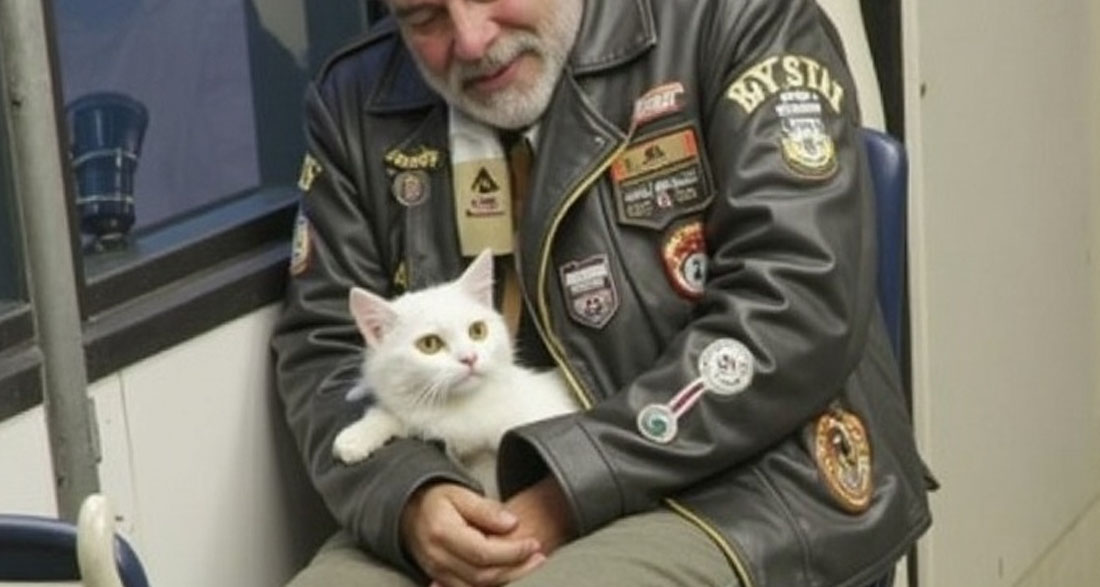
The biker sitting across from me on the subway was crying. Not just a few tears rolling down his cheeks—he was openly sobbing, holding a tiny orange-and-white kitten tight against his chest like it was the only thing keeping him from falling apart.
The kitten’s fur was messy, its little paws pressing against his vest, and it purred so loudly I could hear it over the rumble of the train.
He looked tough—leather vest covered in patches, hands rough and scarred, beard streaked with gray. He had to be around sixty-five, maybe older. But right now, he looked like a man whose heart had finally broken open.
Everyone else in the car was doing that city thing—pretending not to see, pretending not to hear. Their eyes glued to their phones, their faces blank and careful. But I couldn’t look away. The way he held that kitten, so gently, so carefully, like it could shatter at any moment, made something inside me ache.
The woman sitting next to him, dressed in a sharp business suit that screamed “upper management,” kept glancing at him like he was a stain on the floor. Each sniffle from him made her lips tighten. Finally, she huffed, stood up, and moved to another seat farther down the car, shaking her head as if his tears were contagious.
Then he spoke. His voice was raw, cracking, almost a whisper at first. But it cut across the train car. “I’m sorry,” he said, to no one in particular. “I just… I haven’t held anything this small and alive in forty-three years.”
The sound of his words made the air feel quieter. Conversations paused. Even the usual subway hum seemed to soften. He wiped his face with the back of his rough hand, still holding the kitten with the other. It pressed closer, purring like it knew exactly what he needed.
Something inside me pushed me forward. I slid into the seat next to him. “You okay, brother?” I asked gently.
He looked up at me, eyes red and wet, and let out a shaky laugh, half sob, half chuckle. “No,” he said. “Not really. But maybe I will be.” He ran a finger down the kitten’s head, a tiny smile flickering on his lips.
“Found this little guy in a dumpster outside the hospital,” he said. “Cardboard box. Crying its head off. Couldn’t’ve been more than a few weeks old.”
“You taking him home?” I asked.
“I don’t have a home,” he said, almost matter-of-factly. “Been sleeping rough for three years. Lost my apartment after a back crash on the bike. Messed up my knees, too. Can’t work anymore. But yeah… I guess I’m taking him. Can’t leave him to die.”
The kitten mewed softly, climbing closer to his neck. He crumpled, tears sliding down his cheeks. “Sorry,” he muttered. “God, I don’t know why I can’t stop crying.”
I understood. That hollow grief—deep, heavy, the kind that never really leaves—is something I knew well.
“What happened forty-three years ago?” I asked softly.
He didn’t answer at first. The train rattled, stopping at a station. People got on, people got off. The kitten curled into him, still purring. Finally, he spoke.
“My daughter,” he said quietly. “Born forty-three years ago. September 14th, 1980. Five pounds, two ounces. Little tuft of orange hair right on top of her head. Just like this kitten.” His voice broke. “I held her for seventeen minutes. That’s all I got.”
He swallowed hard. “Her mother’s parents took her. Said I wasn’t fit to raise her. Said bikers were criminals, degenerates.
They got the courts involved, got full custody for my ex-wife, and a restraining order for me. I was twenty-two, working construction, riding with a club on weekends. Not perfect, but I wasn’t what they said. I loved that little girl more than anything.”
His eyes glistened. “I tried to fight it. Every penny I had went to lawyers. Didn’t matter. They won. Last time I saw her, she was six months old. Her grandmother brought her to a supervised visit. Wouldn’t even let me hold her. Said I’d done enough damage.”
“Jesus,” I whispered.
He nodded. “I looked for her for years. Wrote letters. All came back. Sent birthday cards, Christmas presents—returned unopened. When she turned eighteen, I hired a private investigator.
Thought maybe she’d want to know me.” His voice dropped even lower. “Found out her mom remarried when she was two. Her new husband adopted her. Changed her name. They told her I was dead.”
His hand trembled as he stroked the kitten. “She thinks I’m dead. She’s forty-three now. Probably has a family of her own. Maybe she’s a mom too. And she doesn’t even know her dad’s still out here, thinking about her every single day.”
The kitten pressed its tiny face against his beard, comforting him. He closed his eyes, tears still slipping down. “When I heard this little guy crying in that box, I swear… it was the same sound. The same little cry she made when the nurse handed her to me.” His voice cracked. “I just—I couldn’t walk away.”
“You picked him up,” I said quietly.
He nodded. “Yeah. I picked him up. He stopped crying. Looked at me, started purring like he already knew me. And I thought… maybe this time, I can keep something alive. Maybe I can do it right.”
He gave a small, bitter laugh. “Stupid thought, huh? Old man, broke, homeless, can barely take care of myself. And here I am, trying to save a kitten.”
“That’s not stupid,” I said. “That’s the most human thing I’ve heard all day.”
Across the car, an older woman who had been pretending not to listen reached into her purse. She pressed a twenty-dollar bill into his rough hand. “For the kitten,” she said softly. “Get her something to eat.”
The biker looked stunned. “Ma’am, I can’t—”
“Yes, you can,” she said firmly. “And you will. That baby needs you.”
A guy in a hoodie across the aisle handed him another twenty. “For a vet,” he said. “She deserves a checkup.” Then a woman with two kids gave him thirty dollars. “Please,” she said. “Take it.”
One by one, strangers started giving. Within minutes, he had almost two hundred dollars in his lap. His face crumpled again, but this time his tears came with a smile.
“I don’t even know what to say,” he whispered.
“Say you’ll take care of her,” the older woman said. “Say you’ll give her the love you couldn’t give your daughter.”
He nodded, staring down at the kitten. “You hear that, little one? You’re stuck with me now. I’ll take care of you. I promise.”
The train slowed to my stop. I didn’t want to leave, but I had to. “What’s her name?” I asked.
He smiled through tears. “Hope,” he said. “I’m naming her Hope. Because that’s what she gave me when I didn’t think I had any left.”
I nodded, feeling the lump in my throat. “Take care of each other.”
He nodded. “We will.”
As the doors closed behind me, I looked back. He was still there, but something had changed. His shoulders weren’t slumped. He looked… lighter. He tucked Hope into his vest, making sure she was warm and safe.
People had gathered around him now, six or seven strangers, offering help, writing things down, promising cat food tomorrow. Even the businesswoman who had moved seats earlier came back, soft-eyed, handed him a card, nodded, and walked away.
The train moved again, carrying him off. For forty-three years, he had carried the weight of losing his daughter. But in that subway car, holding a tiny kitten who trusted him completely, surrounded by strangers who believed in him, he wasn’t alone anymore.
Maybe the universe has a way of sending what we need, even when we’ve stopped believing. For him, it came in the form of a shivering kitten in a cardboard box. And in saving her, he finally saved himself.
Because sometimes, the family we rescue is the one that rescues us back.