

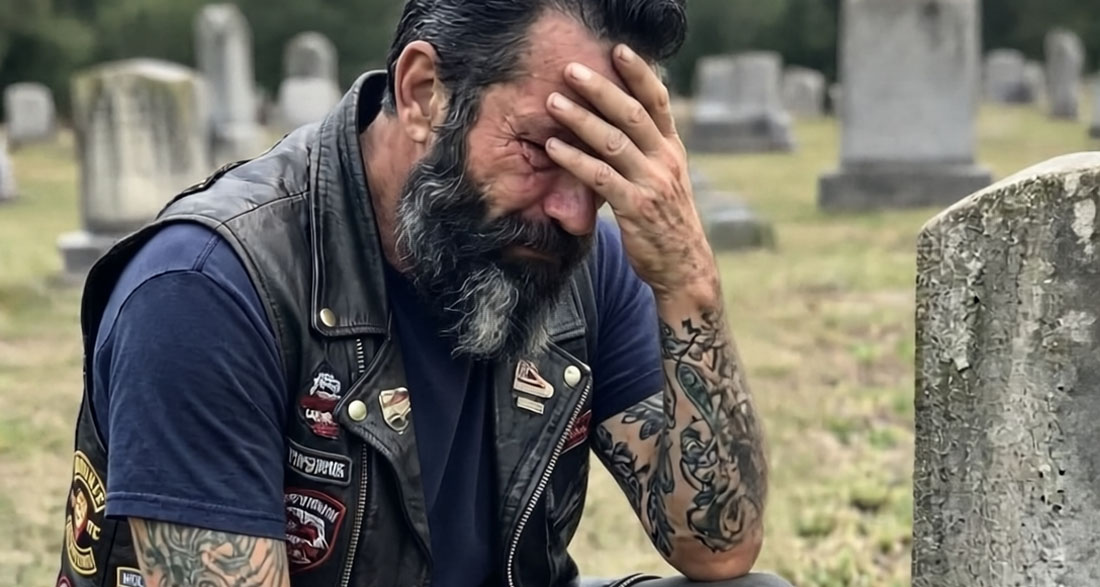
Rain slammed down in thick, icy sheets the morning I buried Daniel “Wrench” Morrison—my brother, not by blood, but by bond. The sky wept harder than anyone I knew could that day.
I stood at the edge of the grave, mud sucking at my boots as I lowered the urn into the earth. Thunder rolled overhead, deep and angry, like the heavens themselves were mourning.
His mother had hung up on me that morning. Sharp, cruel words cutting through the phone: “Don’t call here again,” she’d said. “I don’t have a son. I don’t bury trash.”
Trash. That’s what she called the man who ran into a burning car to save a stranger while everyone else whipped out their phones to record it.
I’d been with him in the hospital for hours. Six hours, maybe more. His skin was pale, raw, burned almost beyond recognition. His breath rattled through his chest. And still, he wasn’t angry. Not at fate, not at family, not at the world that had abandoned him.
He whispered apologies instead—apologies to a mother who had disowned him, to the ex-wife who had turned his kids against him, to the children who told him to leave them alone. His voice cracked when he said, “Tell them I love them anyway.”
I held his hand until the last pulse faded. I remember thinking: how unfair it is that a man who gave so much, left this world empty-handed.
When I drove to the cemetery that morning, I expected loneliness. Just me, the urn, the relentless rain. But as I turned down the narrow road, headlights began to appear. Then more. And more. By the time I reached the gates, the road shimmered like a river of chrome and tears.
Three hundred forty-seven bikers. Brothers from the club, veterans from Desert Storm, people who had never met Daniel but knew of the man who lived by his own code of courage and loyalty.
Engines went silent. Helmets came off. Rain fell, cold and heavy, but the air was thick with respect. There was no priest, no speeches. Just silence. Then a lone harmonica began to play—low, cracked, full of sorrow. One by one, people shared stories.
Tales of a man who gave food to strangers, fixed bikes for free, spent nights helping vets rebuild their lives. They spoke of a gentle, loyal soul, the opposite of the man his family had chosen to forget.
Daniel never walked away from them. They walked away from him. His mother couldn’t accept that her son preferred the open road to Sunday dinners and church pews. She said the club had poisoned him. But the truth? It saved him.
After the war, when nightmares came faster than sleep, it was the brothers in leather who kept him breathing. When his marriage fell apart, the roar of the road drowned out the silence of an empty house. And even as they shut him out, he kept giving quietly—month after month.
He paid the mortgage for his ex-wife. Covered the medical bills for the son who never called him Dad. Set up a college fund for the daughter who refused to see him. Every check, every dollar, came from a man they called worthless.
He never told a soul. I only found out after he died, sorting through his apartment. In a shoebox under his bed were years of proof: cancelled checks, receipts, letters, and notes in his crooked handwriting—a hidden record of love.
Six months later, I took that shoebox to his kids. I wasn’t sure they’d answer the door. Emily, his daughter, stood there in her nurse’s scrubs, arms crossed, eyes wary. Older than the photos Daniel had kept in his wallet.
I handed her the box. “This was your dad’s,” I said quietly. “You should see what’s inside.”
I left it with her, expecting nothing more. But that night, she called, sobbing so hard I could barely understand her. She’d found the letter he wrote before he died—the one where he told her he’d watched her nursing school graduation from his truck in the parking lot.
“He didn’t want to ruin your day,” she whispered through tears. “He sat there for three hours, just smiling at me from afar.” That letter broke her heart wide open.
Her brother, Mike, didn’t react so quietly. He went through the papers—bank slips, insurance documents, checks—and punched a hole in the drywall. Then he collapsed to the floor, realizing his father had quietly built a safety net, a life insurance policy that would leave each of them a quarter of a million dollars.
Money earned from long, blistering shifts fixing other people’s bikes, just so his kids would never have to worry. The same kids who had told him they didn’t want him around.
Weeks later, Emily showed up at the garage where the club met, coffee in hand and a small bouquet of daisies. She wanted to thank the people who had loved her dad when she hadn’t.
She listened as we told stories: the time he rode 300 miles through a storm to deliver a bike part to a stranded rider, the time he fixed a single mother’s car for free because she was late for work. Her eyes stayed red the entire time. When she left, she hugged me so tight it hurt.
Mike took longer. He was angry—at his dad, his mom, and himself. But one Saturday, he finally showed up. “Can you teach me to ride?” he asked. Silence followed. Then one of the guys handed him a helmet. “Your old man would be proud,” he said. Mike didn’t reply but smiled faintly. That was enough.
Years later, Mike rides with us. His patch sits right where his father’s once did—over his heart. He still doesn’t talk much, but when he does, it’s about his dad. He rides the same model bike, same color, even the same scratches on the tank. “I don’t want to fix them,” he told me once. “They’re his fingerprints.”
Emily visits the cemetery every month. Plants flowers. Cleans the headstone. Sometimes she just sits, speaking softly, like he’s listening. And I believe he is.
The world still calls him a hero for running into that burning car. But he was a hero long before that—every time he chose kindness over anger, loyalty over bitterness, love over hate. Every act of giving without expecting anything back.
His family used to say the club changed him. They were wrong. We didn’t change Daniel. We saw him—beneath the scars, beneath the rough exterior, beneath the laughter and the reckless energy.
He had a stubborn streak, a temper, a tendency to frustrate anyone near him—but also a heart bigger than any engine roar I’ve ever heard.
When the first memorial ride happened, the turnout was incredible. Hundreds of bikes, chrome flashing under the sun like a moving river. Emily rode pillion on my bike, holding tight as we passed the spot where her father died. She touched my shoulder and whispered, “He’d have loved this.” I couldn’t answer; my throat was too tight.
Afterwards, we gathered at the old diner he loved. Stories flowed until the sun disappeared behind the mountains.
Emily stood and thanked everyone for keeping her father’s name alive. Then she said something that hushed the room: “For years, I believed lies about my father. I thought he didn’t care. But he was the only one who ever really did.”
That was the ending Daniel deserved. Truth had reached the people he loved most. Lies erased. Shame replaced by pride.
Even now, I visit his grave. I bring a beer, sit on the grass, and tell him what’s new: his kids are okay, Emily is married, Mike rebuilt his old bike. His patch still hangs above the clubhouse door, sunlight catching it every morning.
People forget quickly, but not him. Not Daniel “Wrench” Morrison. His story rides on in every mile, every engine roar, every stranger helped. He taught us what matters: you measure a man not by who stands beside him alive, but by who remembers him after he’s gone.
He once told me, “When you’re on the road, it’s just you, the wind, and everything that doesn’t matter disappearing behind you.” I didn’t get it then, but I do now.
Every time I take Route 19, wind whipping, rain and gasoline in the air, I feel him there—the rumble of his engine ahead, his laughter in the wind. For a moment, he’s not gone. He’s just riding ahead, clearing the path like he always did.
Daniel Morrison died saving a stranger. But he lived saving those who didn’t know how to love him back. He left more than ashes and memories—he left proof that real goodness doesn’t need recognition. It just keeps going… like the road itself. And as long as we ride, his story won’t end.