

For as long as I can remember, my name felt like a coat that never quite fit. It was always a little too tight across the shoulders, a little too heavy in places I didn’t understand yet. Before anyone asked me what I liked or what I dreamed about, they already thought they knew me.
I was “the garbage collector’s son.” Not my real name, not the one my mother whispered when she kissed my forehead at night. This was the label people used when they looked at me.
It stuck to me everywhere—in the hallways, in the lunchroom, even in the way teachers paused for just a second too long before calling on me. It followed me like a shadow I couldn’t escape, no matter how fast I walked.
At first, I didn’t even fully understand what it meant. I just knew it came with a certain look on people’s faces—a thin, polite smile that didn’t reach their eyes, a kind of distance colder than open dislike.
Other kids wore their parents’ jobs like medals. “My dad is a lawyer.” “My mom works in finance.” “My aunt is a doctor.” They said it proudly, like those words gave them extra space in the world.
When someone asked about my parents, I learned early to answer fast and change the subject. “My mom works for the city,” I’d say. Then I’d ask about their dog, their new shoes, or homework—anything to steer the spotlight away from me.
My mother hadn’t planned this life. She used to tell me about nursing school, the long nights of studying, the smell of antiseptic and coffee in hospital corridors. She loved the idea of helping people, of easing someone’s pain.
Then my father fell. It was an accident—a stupid, ordinary accident on a construction site, the kind you see in the news for a day and then forget. One moment he was alive, joking about dinner.
The next, he was gone. Grief didn’t come slowly. It crashed over us like a wave, knocking everything down—dreams, plans, even the sense that the world was safe. All of it washed away.
Mom took the first job she could get that paid enough to keep us afloat. She didn’t complain, not once. Every morning, before the sun rose, she tied her hair back, pulled on gloves, and stepped into a world that smelled of diesel, garbage, and hard work.
When she came home, her hands were rough and her shoulders ached, but she still cooked dinner, asked about my day, and listened when I babbled about little things that didn’t really matter. I learned to lie easily. “It was fine,” I’d say. “Nothing special.”
I didn’t want to pile my small hurts onto the heavy ones she already carried.
At school, the jokes were quiet but sharp, like tiny cuts that sting later. A wrinkle of a nose as I walked past. A note on my desk with a stick figure next to a trash can. Soft giggles that a teacher couldn’t punish.
I tried to make myself small, disappearing in plain sight. I sat in the back, didn’t raise my hand, perfected the art of being there without being noticed.
The library became my refuge. It was cool, quiet, and no one judged you there. Books didn’t care who your parents were. Numbers didn’t sneer. I buried myself in old math textbooks, online lessons, anything I could get. I loved problems with clear answers, worlds with rules. If you did the work, you got the result. Life outside wasn’t fair, but here, it was.
I started teaching myself beyond what school offered. Algebra became calculus, calculus became subjects I didn’t even know how to pronounce. I didn’t know why I loved it so much.
When I solved a problem, the world outside faded. The laughter, the whispers, the labels—they all disappeared.
One day, Mr. Anderson noticed. He was my math teacher, thin, with kind eyes and a habit of pushing his glasses up his nose when thinking. “You’ve been working late,” he said softly, peering at my notebook.
“Do you want to try something harder?” No one had ever asked me that before. He gave me books, links, problems far beyond my comfort zone. He treated me like someone with a future, not a past others had labeled.
With him, college stopped feeling like a fantasy. It became a goal. We researched programs, scholarships, forms that looked like another language. Application fees seemed impossible until we found waivers.
Essays forced me to speak truths I’d kept buried. I cried at my laptop while Mom slept in the next room, exhausted from work. I didn’t want her to hear me. I didn’t want her to think she’d failed me.
Then the letter came. Thick, official, heavier than it had any right to be. I held it trembling, heart pounding. When I opened it, the words blurred at first: Full scholarship. Housing. Acceptance. A future I’d only dared to imagine in quiet moments.
Mom cried when I told her. Not quiet tears, but loud, shaking sobs that startled both of us. “I’m so proud of you,” she said again and again, as if saying it would make it real.
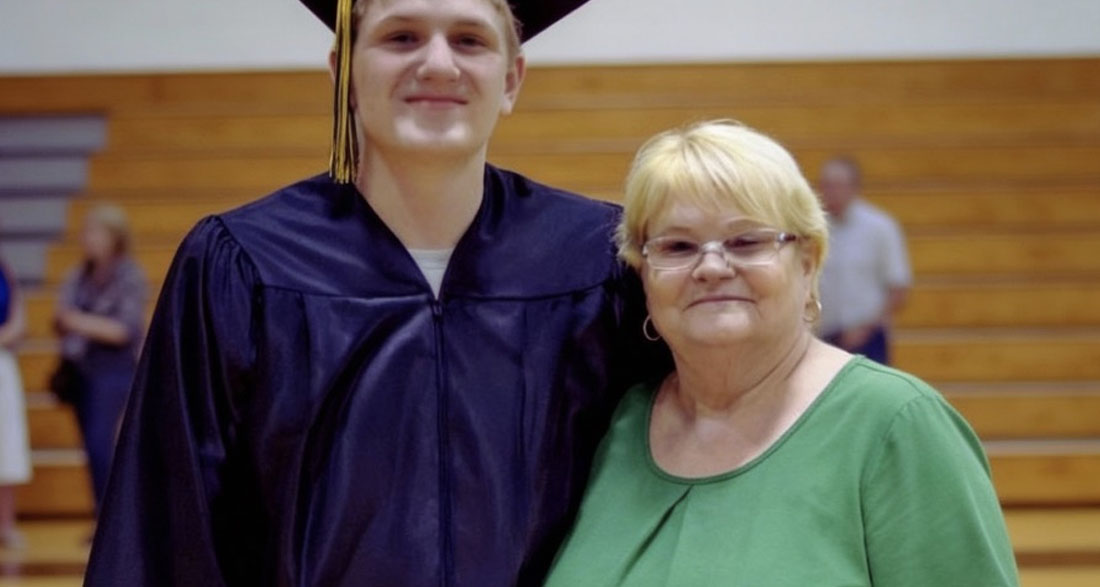
Graduation came faster than I expected. The gym buzzed with families, balloons, cameras, and the mixed smell of flowers and sweat.
When my name was called as valedictorian, I felt like I was floating above myself. I stood at the podium, looking at faces that had only ever known me in fragments.
I spoke. I talked about the jokes, the labels, my mother, her uniform, her strength. “It’s easy to decide who someone is before you really see them,” I said. “Dignity isn’t given by a job. It’s something you carry.”
The room was quiet like I’d never heard before. Applause came, but it felt distant, underwater. The only real thing was my mother’s face—wet with tears, shining with relief, joy, and pride.
That night, when she came home from work, her uniform still smelled the same, but it didn’t feel heavy anymore. It felt like proof of something strong, unbreakable, human.
I held that feeling, letting it fill the empty spaces inside me, finally learning that a coat doesn’t have to fit perfectly to keep you warm.