

The call came just after three in the morning. My phone vibrated against the nightstand, sharp and urgent. I groggily answered, and the voice on the other end was trembling. “Please… come quick,” it said. That wasn’t the kind of request firefighters usually make.
These are men who run straight into burning houses without thinking, men who lift heavy beams off strangers, men who don’t flinch at screams or smoke. But that night, their voices were thin, shaky, and my stomach knotted tight with unease.
“There’s a boy… a little boy… he won’t stop screaming,” one of them said. “He keeps saying he killed his mommy. Nothing we do calms him.”
Rain was falling in cold sheets when I got there. My leather vest stuck to my shoulders as I hurried toward the house, headlights cutting through the storm. Outside, a group of firefighters stood in silence. Their faces were red, eyes wide and raw.
They’d already done the hard work—fought the fire, dragged hoses through smoke, saved what they could—but now they were frozen. Not because of the fire. Because of the boy.
Inside, the kitchen was blackened with soot. The wet smell of ash and smoke clung to everything. And there, in the corner, half-hidden behind a table leg, sat Marcus. He was tiny, fragile, and shaking as though his own body had betrayed him.
His pajamas were soaked, not just from the rain but from tears. He muttered over and over, a cracking, frantic voice: “I killed my mommy. I killed my mommy.”
What he meant by those words was even more heartbreaking. When the fire started, his mother had pushed him toward the back door, shouting, “Run! Call 911!” He’d obeyed—he’d run away to save himself—but in his young mind, leaving her felt like betrayal.
He thought he had abandoned the person he loved most, not understanding that she had made the same choice he had: to give him a chance to live.
A couple of firefighters tried to speak to him, gently coaxing, but he just curled in tighter, shivering. I knew if I reached for him, he’d pull away, maybe scream louder. So I didn’t. I lowered myself to the floor, back against the melted cabinet, a safe distance away.
“I’m not here to take you anywhere you don’t want to go,” I said softly. “I’ll just sit here. That’s all. I’ll stay as long as you want.”
For a long time, he didn’t even look at me. He sobbed into his knees, a raw, gut-wrenching sound. Slowly, though, the storm inside him eased just enough for him to hear something other than his own guilt. His head lifted. Eyes wide, fearful, confused—but somewhere inside them, a flicker of hope. Maybe someone could tell him he wasn’t the monster he thought he was.
I decided to tell him a story I rarely let myself speak aloud. I told him about the night my own house burned when I was eight. How my father shoved me out a window through thick smoke, telling me to run and get help.
How I did exactly what he said—and how the roof collapsed before he and my baby sister could make it out. I told him how, for years, I had believed I had killed them. How every time someone said it wasn’t my fault, I nodded politely, but deep down I didn’t believe it.
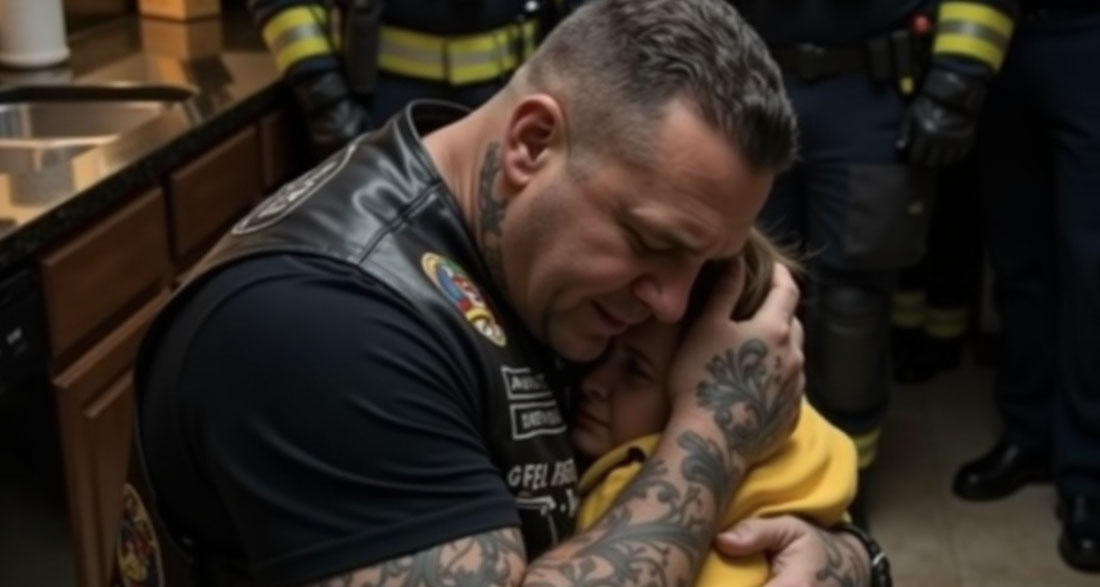
As I spoke, Marcus froze. His sobs quieted to shallow, trembling breaths. The air seemed to hold its breath with him. Then, without warning, he lunged across the floor into my arms. It was desperate, urgent, as if he thought I might vanish if he hesitated for a second. I wrapped my vest around him and held him close, rocking him gently.
“I want Mommy,” he whispered.
I hugged him tighter. There was nothing I could give him but the truth: his mother had loved him fiercely, and her last act was to save him.
By sunrise, the fire was out, the rain had stopped, and child services arrived. The social worker knelt down to speak softly to Marcus. But he clung to me, burying his face against my shoulder. “Don’t leave me,” he begged. She looked at him, then at me, and finally nodded. I could stay with him through the transition.
Over the next few days, I stayed close. I held his hand through medical checks, comforted him during nightmares, and listened to his quiet, halting words. I saw in him the same pain I had felt as a child, alone in grief, wishing someone would just sit with me.
When his grandmother finally arrived—a tired woman with soft, worn hands—Marcus clung to her, but never let go of me completely. “Thank you,” she whispered, her voice shaking, and led him home. I thought that would be the end of it. But something inside me refused to walk away.
So now, every month, I drive hours to see him. His grandmother always sets out a chair for me under the big, uneven tree in the backyard. Marcus runs out to greet me, not with the fear of that first night but with a growing, confident smile.
We sit on the grass, or at the old picnic table, talking. About school, about nightmares, about guilt—the kind that can beat inside you like a second heartbeat.
I tell him the things I wished someone had told me when I was eight: that being a child doesn’t make you responsible for the impossible, that love can be fierce enough to shove you through a door or a window if it means survival, and that surviving isn’t a crime.
Bit by bit, I watch the weight on his little shoulders lift. He laughs now, a pure, bubbling laughter. He’s learning that the story he told himself—how he caused his mother’s death—isn’t true. She saved him, not the other way around.
Last month, we were tossing a ball back and forth when he paused mid-throw, his face serious. “Can I call you Uncle Danny?” he asked. I froze, the words hitting me deep. All I could do was nod.
In that moment, I realized something powerful. I hadn’t just helped Marcus escape his guilt. He had helped me face mine. The memory of my father’s final act, of my sister, of that night, no longer felt like a burden I carried alone. Marcus’ trust, his small hand in mine, his laughter—they had begun to heal me in ways I thought impossible.
Sometimes healing doesn’t flow in a straight line. Sometimes it moves quietly, slowly, in circles. Sometimes it’s two people sitting under a backyard tree, sharing fear and love and loss.
Sometimes it’s a tiny hand reaching for yours, trusting you to hold on. And sometimes, the person who arrives to comfort a child is the one who discovers that their own broken pieces can start to mend.
I went there to save a boy who thought he had caused the unthinkable. But in the months after, he saved me too. His mother’s love had lived on, not just in him, but in the way he helped me see that love—and healing—can circle back in ways we never expect.
Now, when he calls me Uncle Danny, I feel something settle inside me, something restless for decades finally at peace. I didn’t just save Marcus that night. He saved me too.