

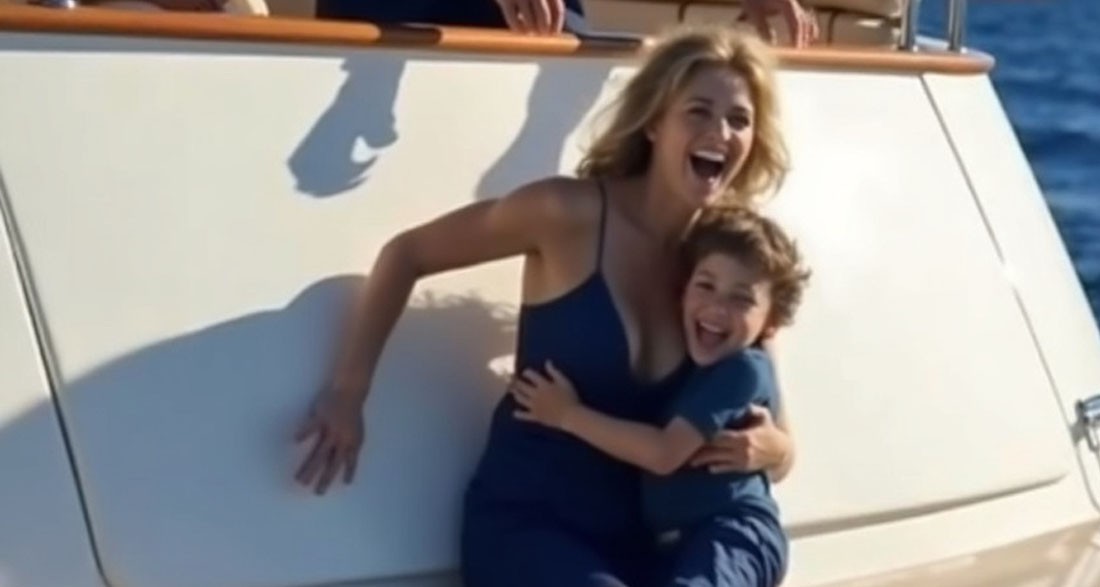
The night air smelled like salt and polished wood—clean, rich, and expensive. It was the kind of luxury my parents loved surrounding themselves with. The yacht moved smoothly through the black water like a silent knife, its soft golden lights glowing against the dark Atlantic.
We were twenty miles off the Boston coast. No land. No boats. No help. Just endless sea and a sky full of cold stars.
I stood by the railing with my five‑year‑old son, Lucas, leaning against me. His small body felt warm and tired, his cheek pressed on my shoulder. He was half-asleep, breathing softly as we watched the waves rise and fall.
For a moment, everything felt peaceful. Safe.
I didn’t know how wrong I was.
We never heard them come up behind us.
The shove came fast and brutal. One second, the deck was steady beneath my feet. The next, the world tilted and disappeared. The ocean opened beneath us like a hungry mouth.
I twisted around on instinct. My heart slammed against my ribs.
The last thing I saw under the deck lights was my mother’s face—calm, cold, and terrifyingly familiar. Her expression didn’t change. Not even a flicker.
Her voice cut through the wind like a knife.
“You’ll vanish as if you never existed.”
Beside her, my husband leaned forward. The man I once loved. The man I trusted. He wore a twisted smile that never touched his eyes.
“Goodbye, worthless ones,” he whispered.
There was no time to scream.
No time to beg.
My body reacted before my mind could.
I wrapped both arms around Lucas, locking him against my chest as the deck dropped away and the dark ocean rushed up to swallow us.
The impact felt like crashing into concrete. Ice-cold water slammed into my lungs, my ears, my nose. The ocean roared around us, wild and merciless.
The waves dragged us under, twisting us in every direction. It felt like the sea was trying to rip Lucas out of my arms. I kicked and clawed upward, not for air—just for control.
Panic scratched at the edges of my mind. But panic kills. I learned that long before I became a wife, long before I became a mother.
I forced my head above the surface. One breath. One second of air.
Another wave crashed over us.
Lucas didn’t scream. Didn’t cry. His tiny fingers were still locked in my jacket—just like I had trained him during our pool sessions.
Hold tight. Don’t fight the water. Trust me.
The cold stabbed into my bones. My muscles cramped almost immediately. Above the waves, the yacht’s engine roared, getting fainter and fainter.
They were leaving.
They thought we were already dead.
I fought my way to the surface again, coughing and choking. The yacht’s lights were shrinking, drifting away like distant stars.
They weren’t slowing down.
They weren’t turning around.
In their eyes, we were gone.
But I had survived worse than freezing water.
Before my quiet life, before marriage, before motherhood—I worked in places where one mistake meant death. Where trust was rare. Where survival required a calm mind and quick hands.
That training was still inside me.
Drowning wasn’t going to kill us.
Giving up would.
My numb fingers reached into the inside seam of my jacket. I felt something small and hard—the emergency beacon I had sewn into the lining years ago out of habit.
I pressed the activation switch.
A faint click. A tiny vibration.
I prayed someone, anyone, would pick up the signal.
All I could do next was float, kick when needed, and keep Lucas’s head above the surface.
Time stretched into something endless. The ocean was black and huge and cold beyond anything I had ever felt.
My arms shook with exhaustion. My legs felt like iron weights. Every few minutes, I shifted Lucas in my arms to keep us moving.
I whispered to him, even though the wind stole most of my words.
“We’re okay, baby.”
“Remember the red slide at the park?”
“Tomorrow we’ll eat pancakes. Your favorite.”
I lied to save him. I lied to save myself.
At some point, my foot hit something solid. A drifting rescue float. Probably fallen from some forgotten vessel. I grabbed it with the last strength I had and dragged Lucas and myself onto it.
The plastic burned my frozen skin, but it floated.
I collapsed over my son, using my body to block the freezing wind. I counted his breaths against my chest until my eyelids felt like ice.
The night crawled by.
The darkness never seemed to end.
Then—finally—thin gray light appeared along the horizon.
At first, I thought it was a dream.
Then I heard it: a distant engine.
I forced my head up, every muscle screaming. A small boat cut through the morning mist, searchlights sweeping across the water.
They passed us at first. My heart dropped.
Then—one bright beam swung back, landed on the orange rescue float, and stayed there.
People shouted.
The boat turned.
Hands reached for us. Warm blankets wrapped around our bodies. A woman leaned close, her voice trembling as she asked, “Can you hear me? What’s your name?”
Someone checked Lucas’s pulse. Someone tried to separate him from me, but my hands refused to let go until they gently pried my fingers off his soaked shirt.
As my vision darkened, I whispered into his ear:
“We are not the ones who vanish.”
—
I woke up in a room smelling of antiseptic and clean linens. For a second, I didn’t know where I was. Then the memory crashed back, sharp and brutal.
I shot upright—panicked.
Lucas lay in the bed beside mine, wrapped in blankets, breathing steadily. His small chest rising and falling like a miracle.
Relief hit me so hard it stole my breath.
We were moved before anyone outside the rescue team even knew we were alive. By sunrise, we were hidden in a safe house on a quiet stretch of coast. Doctors checked us again. We got dry clothes, warm soup.
Only when the door closed did reality settle over me like heavy stone.
They had tried to kill us.
Not an accident.
Not a mistake.
A decision.
Evidence arrived quickly:
– An insurance policy I never knew existed
– Forged documents transferring my assets
– Financial moves timed perfectly to my “death”
They planned everything.
My life was worth more to them dead.
Something inside me hardened. Something cold and sharp that had been asleep for years.
I didn’t tell Lucas the truth. He was five. He didn’t need that darkness. To him, we fell into the ocean and kind strangers saved us. That’s all.
By nightfall, the fear turned into something stronger.
Resolve.
Let them believe I was dead.
Let them perform their grief in front of cameras. Let them hold each other in warm rooms, thinking they had escaped consequences.
Meanwhile, I moved like a ghost through old networks—old skills sliding back into place like they never left.
My “death” made me invisible.
Invisible was powerful.
I watched as my husband cried fake tears on TV. My mother clung to him, her voice trembling as she said, “My daughter… my sweet girl… gone.”
Cameras flashed. Flowers piled outside the mansion. Reporters whispered praises.
Behind the scenes, money moved exactly how they planned.
I waited.
Three nights after they returned home, the mansion was quiet. Dark. Perfect.
The first scream shattered the silence.
It bounced through the hallways like something alive. Then another. And another.
Every screen in the house flickered on at once.
TVs. Phones. Tablets. Security monitors.
All showed my face.
Not broken. Not drowned.
Calm. Pale. Unblinking.
Four words appeared across every screen:
I’m not gone yet.
My mother collapsed into a chair, shaking. My husband stumbled backward, terror twisting his face.
Their fortress suddenly felt like a cage closing in on them.
That was just the beginning.
Soon, their accounts froze. A transfer failed. A crucial document vanished. They tried to blame glitches.
Then the messages started:
Time stamps. Account numbers. Secret details only they and I knew.
My husband slept with the lights on. My mother refused to leave the house. The press noticed their strange behavior.
Cracks opened.
An anonymous tip triggered a financial audit. Then another. Questions grew. Rumors spread. The insurance policy looked suspicious. The forged paperwork looked criminal.
Stress ate them alive.
My mother’s hair turned gray. My husband lost weight. Their fights became loud enough for neighbors to hear.
Then—he broke.
One night, my husband rushed into a police station trembling.
“Someone’s after me,” he said.
“Someone’s destroying everything!”
He didn’t confess—but cracks in a story eventually split open.
Investigators pulled at threads. Crew statements. Phone records. Boat logs. A changed course after our fall.
Public sympathy turned into suspicion.
Finally, digital fingerprints exposed the forgeries. Everything pointed directly at my husband.
He cracked again. This time completely.
He confessed.
He tried to blame my mother. She denied everything until investigators showed her the yacht’s audio logs. Her silence broke with a strange, choked sound.
They were arrested within the same hour.
Cameras followed them as they were led away in handcuffs—faces pale under cold flashes of light.
Not a tragedy anymore.
A crime.
Only after it all ended did I reclaim my life piece by piece. A ghost becoming solid again.
When Lucas and I finally left the safe house, we did so with new names, a fresh start, and a future the ocean could not steal.
We moved somewhere far from cold waters—where the sea was warm and gentle. Where Lucas could learn to swim without fear.
Some nights, when he’s asleep, I stand on the balcony and listen to the waves. I remember the shove. The freezing darkness. Their certainty that I was gone.
They were wrong.
And now they live every day with that truth—behind prison walls money cannot soften, haunted by the woman they tried to erase…
and failed.