

I’d been running Maggie’s Diner for over thirty years. Thirty years of mornings smelling of bacon, afternoons filled with coffee chatter, and nights echoing with the hum of the fridge behind the counter.
After all that time, I thought I could read anyone the moment they stepped through my door. I’d seen everything—drifters looking for a free meal, families arguing over ketchup, truckers who needed nothing but a hot coffee, and the occasional drunk who thought a stack of pancakes would sober him up.
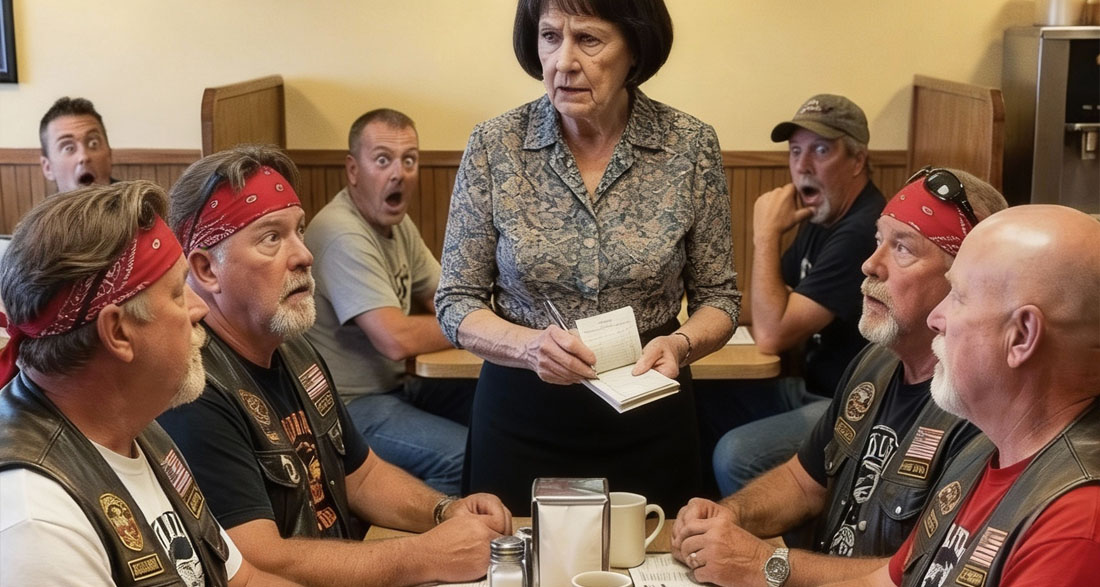
So when fifteen bikers rolled in late one Tuesday night, boots heavy with dust from the road, jackets still smelling faintly of gasoline, my stomach tensed. It wasn’t fear exactly, but a sharp, guarded instinct that comes from protecting something you’ve built with your own hands.
The neon clock above the counter blinked past ten, and the streets outside were empty. Just me, my young waitress, and the soft hum of the fridge.
They filled the doorway like a storm. Leather vests covered in patches, chains clinking as they moved, sunglasses hiding their eyes even though it was pitch dark outside. My heart skipped a beat.
Maybe trouble wasn’t inevitable, but instinct told me to be ready. I gripped the coffee pot a little tighter than usual, my voice sharper than I intended: “You boys can eat, but you pay before I serve.”
Silence stretched across the diner. The biggest man, gray hair tucked behind his ears, beard streaked with white, shoulders like a brick wall, finally spoke. “No problem, ma’am,” he said, calm and polite. He reached into his pocket and handed me a thick roll of cash. “We understand.” His voice carried a respect that made me flinch in shame.
I told myself I’d made the right choice. Life had taught me caution, especially after Tom died and I’d been running the diner alone. Fear had crept in quietly over the years, a companion I refused to name. Still, as I walked back to the kitchen, shame burned low in my chest.
The bikers moved to the back, away from the windows. They ordered burgers, eggs, pies, and mountains of coffee. My waitress, young and nervous, took their orders with trembling hands. But the men were gentle with her.
“Thank you, sweetheart,” one said with a smile. Another asked about the pie. “Apple,” she replied. His face softened, like the taste meant more than just sugar and dough—it meant home. They spoke quietly among themselves, voices calm, steady, like men who had shared years of hardship together.
When they finished, they stacked their plates, wiped the table, and left without a single sound. No yelling, no broken glass, just the soft jingle of the doorbell and the fading roar of motorcycles down the highway.
Relief washed over me, mixed with guilt I couldn’t explain. I had judged them unfairly, before they even gave me a reason to.
Then my waitress called, voice trembling: “Maggie?” I walked over, expecting maybe a lost wallet or jacket. Instead, on the clean, empty table, sat an envelope. My name, written in neat block letters: “Maggie.” No last name, no return address.
I opened it. Inside was more cash than their bill—enough to cover it and then some—and a folded note. The handwriting was careful, deliberate, like someone wanted every word to matter.
“Ma’am,” it began, “we’re sorry if we made you uncomfortable. We’re veterans—all of us. We were riding home from a funeral for one of our brothers. We stopped because we saw the American flag in your window. We figured a place that flies that flag might feel like home, at least for a cup of coffee.”
I swallowed hard and continued reading.
“We understand why you asked us to pay first. The world’s made it hard to trust people. But we want you to know who we are beneath the leather. Men who served. Men who’ve lost more than most can understand.
We noticed the picture behind your counter—the man in uniform. We can tell he mattered to you. If he served, then we owe him our thanks. And if he was yours, then we owe you our respect. You may not have trusted us tonight, but please know—we would’ve protected you with our lives if we had to. That’s who we are.”
I sat down at the table, the diner quiet except for the soft hum of the neon sign.
My tears spilled freely, the kind of tears that come from the deep places where grief, shame, and gratitude meet. I had been so sure of my instincts, so sure fear kept me safe. But the note taught me something my instincts had missed: grace.
I thought of Tom, my husband, and how he used to walk through that very diner door in uniform when he was home on leave. How proud he looked in the framed photo behind the counter, eyes full of hope.
He’d been gone for years, but somehow these bikers saw him. And somehow, they saw me too, even when I was too busy guarding myself to see them.
The next morning, I couldn’t stop thinking about the note.
I stared at the flag in the window, wondering if that had drawn them in—or if it was just fate reminding me that appearances aren’t always the whole story. I wanted to find them, to thank them properly, to apologize for letting fear dictate my actions.
A week later, they returned. Same group, same quiet presence. This time, I didn’t ask them to pay first. I poured coffee, smiled, and said, “The pie’s on the house tonight.”
The gray-haired man, Ray, smiled back. “We were hoping you’d say that,” he said softly.
I told them I’d read the note, my voice cracking as I managed, “I’m sorry.”
Ray nodded, eyes kind. “You don’t owe us that. You were doing what you thought you had to do. That’s what people like us understand.”
That night, we talked. About where they’d been, the brothers they’d lost, the bonds they’d forged on the road after the war. They told me about “Doc,” the friend who patched them up overseas, now gone.
I told them about Tom, the folded flag, and the letter I’d received. Ray nodded slowly. “He’d be proud of you, Maggie,” he said. “You kept his spirit alive right here.”
From that night, the diner changed. They came back often, always respectful, always kind. They helped with repairs—a leaky roof, a back door, even a new sign when the old one cracked in the wind.
When my health started giving out, they checked in. Ray shoveled snow, Hank, a quiet one, taught my grandson to throw a baseball. “Every kid needs to learn how to catch,” he said.
The diner became more than a place to eat. It became a refuge. They brought new riders, men and women who served, introducing them like family. “This is Maggie,” they’d say. “She makes the best pie you’ll ever eat.”
Word spread. People stopped fearing bikers, seeing leather as a symbol of brotherhood, not danger. Strangers would ask me if I ever got scared with so many around. I’d smile and say, “Those men? They’re the safest thing that ever happened to this diner.”
Years passed. Some moved away, some grew too old to ride. Some were lost along the way. But Ray remained, steady, visiting once a month, even trading his Harley for a pickup. He’d sip coffee at the counter and ask, “You still keeping that envelope?”
I always nodded. The envelope stayed in the drawer under the register, cash untouched, the note folded neatly on top. It wasn’t about money—it was a reminder. A memory of the night fear almost defined me, and they refused to let it.
One rainy evening, I closed up early. The diner silent, lights dim, rain tapping on windows. I took out the envelope, reading the note again. The paper had yellowed, the ink faded, but the words still carried weight. I thought of all the times I judged someone before speaking, and how wrong I’d been.
Experience may make you wise, but it can also make you cautious, even cynical. That night showed me something better: goodness can wear any face, even one you might not trust at first glance.
Now, every stranger who walks through my door reminds me to look beyond the surface. They might just need a warm meal, a kind word, or a little trust. I can give them that.
The diner still stands. Walls lined with photos—Tom in his uniform, the veterans on their bikes, my grandson and Ray grinning together. The flag still hangs in the window.
Sometimes, when I hear motorcycles rumbling in the distance, I step outside, hoping it’s them. The sound fades, but the memory stays. Those men didn’t just pay for food—they gave me something I’d lost: trust.
I once made them pay first because I didn’t trust appearances. They repaid me with loyalty and compassion that stretched for years. They taught me fear can blind you, but humility opens your eyes. Character isn’t written on the outside—it’s carried in the heart.
And sometimes, when the diner is empty, and the neon hums softly against the night, I whisper a quiet thank-you—to my husband, to those men, to the lesson that still keeps my heart warm after all these years.